
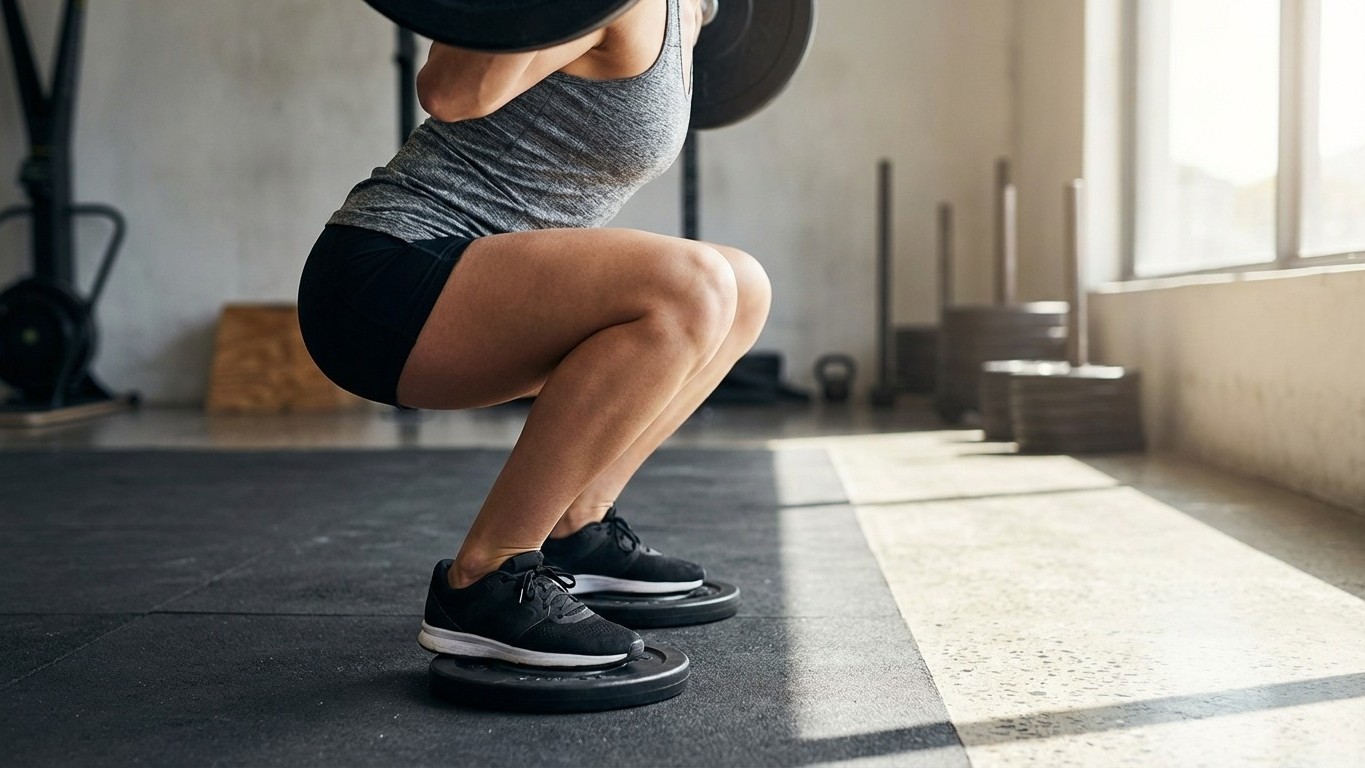
Six weeks. That’s all it took for one small adjustment to completely reshape how my quads respond to training. Elevating your heels during squats, whether with a wedge plate, a dedicated heel-raise block, or even a pair of squat shoes, shifts the mechanics of the movement in ways that most gym-goers never fully appreciate. I went in sceptical. I came out a convert.
Key takeaways
- One small angle change forced my quads to work harder than they ever had before
- By week three, something unexpected happened to my flat-foot squat performance
- The visible quad definition shift wasn’t about weight loss—it was pure hypertrophy
Why heel elevation changes everything about the squat
The squat is not one movement. It’s a negotiation between your ankle mobility, hip structure, femur length, and torso position, all happening simultaneously. When your heels are flat on the floor, limited ankle dorsiflexion (the ability to flex the foot upward) often forces your torso to lean forward, shifting load onto the posterior chain and away from the quads. Raising the heels compensates for that restriction. Suddenly your knees can travel further over your toes, your torso stays more upright, and your quadriceps end up doing a disproportionately larger share of the work.
Research supports this shift. A study published in the Journal of Strength and Conditioning Research found that heel elevation during squats increases knee flexion range of motion and places greater demand on the quadriceps compared to flat-footed squatting. The difference isn’t trivial, either. The angle of the shin, and therefore the moment arm at the knee, increases meaningfully with as little as two to three centimetres of heel lift. That’s a genuine biomechanical change, not a placebo.
What surprised me most was how quickly my body adapted to the new position. Within the first two sessions, I felt my vastus medialis (the teardrop-shaped muscle just above the inner knee) firing in a way I genuinely couldn’t replicate with conventional squats. Whether that’s a matter of range of motion, muscle length, or motor pattern, I couldn’t say with certainty, but the sensation of actually Loading the full quad rather than defaulting to hips and lower back was immediate and unmistakable.
What six weeks of heel-elevated squats actually did
By week three, something unexpected happened: my conventional flat-foot squat improved. This wasn’t the plan, but it makes sense in retrospect. The heel-elevated variation forced me to maintain a more upright torso and practice deeper knee flexion, patterns that carry over once you remove the elevation. My ankle mobility also felt noticeably freer, possibly because I was training the bottom position more confidently without the fear of tipping forward.
The quad development was the headline, though. By week six, the definition around my knees had shifted visibly, and not because I’d lost weight. The lower portion of the quads, an area I’d always found stubbornly resistant to hypertrophy, looked fuller. My training partner noticed before I said anything, which felt like adequate peer review.
I kept the rest of my leg day largely unchanged: Romanian deadlifts, leg curls, walking lunges. The only variable was replacing my standard barbell back squat warm-up sets with heel-elevated goblet squats, then performing my working sets with a 25mm heel raise using weight plates. Volume and intensity stayed consistent. That controlled approach made it easier to attribute the Changes specifically to the heel elevation rather than a general training effect.
The practical side: how to actually do this
You don’t need specialist equipment. Sliding a 2.5kg or 5kg plate under each heel works fine to start, though plates can shift mid-set, which is mildly terrifying. A purpose-built heel wedge (widely available from Fitness retailers for under £20) is more stable and lets you focus on the movement rather than your footing. Olympic weightlifting shoes with an elevated heel are the premium option, beloved by competitive lifters, and genuinely worth considering if you squat regularly.
Heel height matters. Two to three centimetres is a reasonable starting point for most people. Going too high too quickly can shift so much load to the knees that you’re essentially fighting through discomfort rather than building strength. If you have existing knee pain, this is absolutely a conversation to have with your GP or a Physiotherapist before experimenting, not something to troubleshoot mid-set.
Form cues worth keeping in mind: push your knees out in line with your toes, keep the chest tall, and resist the urge to let the heels do all the work by collapsing into an excessively forward lean. The elevation is a tool to improve mechanics, not a workaround that lets you abandon good technique altogether. A few sessions with lighter weight to groove the pattern will save you a lot of frustration later.
Who benefits most, and the honest caveat
Lifters with naturally limited ankle dorsiflexion tend to see the most dramatic benefit. If you’ve always struggled to hit depth without your heels rising or your lower back rounding aggressively, heel elevation can feel revelatory. Taller lifters with longer femurs are also classic candidates, as their proportions often make conventional squatting mechanically brutal.
That said, heel-elevated squats aren’t a magic fix for everyone. Some individuals with pre-existing patellar tendon issues find that increased knee-forward travel aggravates symptoms. Others simply prefer the posterior chain emphasis of flat-foot squatting and have perfectly adequate ankle mobility to support it. No single variation is objectively superior across all goals and all bodies.
My honest take: after six weeks, I’d never drop this variation entirely. It lives in my programme now as a semi-permanent fixture, alternating with conventional squats depending on the training block. The quad emphasis fills a genuine gap that isolation machines never quite managed to address for me. And there’s something quietly satisfying about fixing a problem not with a new supplement or a fancier piece of kit, but with a plate and a slight change of angle. The question worth sitting with is how many other small adjustments you’re yet to try.