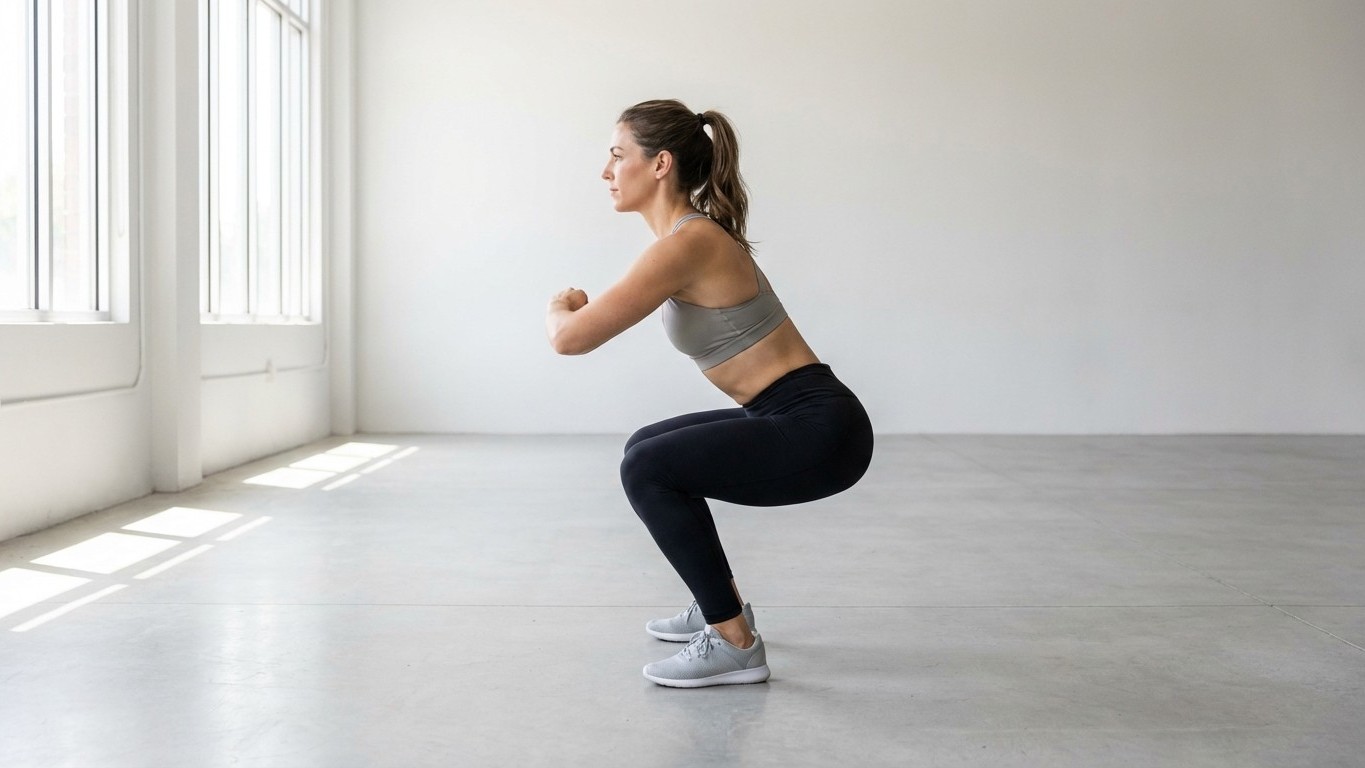
Squats are supposed to be the king of lower body exercises. Every fitness coach, every gym programme, every beginner’s guide says so. For years, I believed them, squatting regularly, feeling the burn in my thighs, and assuming that meant the exercise was working exactly as intended. Then a physiotherapist watched me perform a set and gently, almost apologetically, told me I had been predominantly loading my quads and lower back rather than the glutes and posterior chain the movement is meant to challenge. Years of work, not wasted exactly, but significantly less effective than it could have been.
If any part of that resonates, you’re in good company. Poor squat mechanics are extraordinarily common, and the frustrating part is that the movement can feel completely fine while loading the wrong structures entirely. Your body is brilliant at compensation. It will always find the path of least resistance, which means your dominant muscles will quietly take over if you allow them to.
Key takeaways
- Your body is brilliant at finding shortcuts—but that might mean your strongest muscles are stealing work from your glutes
- The cue that changed everything wasn’t about going deeper or lifting heavier, but about how your knees and feet actually move
- Even experienced lifters find themselves humbled when they rebuild from bodyweight, forced to confront patterns built over years
Why the glutes so often get left behind
The gluteus maximus is the largest muscle in the human body, and it is chronically underused in most people who spend significant time sitting. A term you’ll sometimes hear from physiotherapists is “gluteal amnesia,” the idea that prolonged sitting can reduce the brain-to-glute neuromuscular connection. Whether or not you subscribe to that concept entirely, the practical reality is consistent: most people who squat without deliberate cueing end up driving the movement through their quads and, when they fatigue, compensating with lumbar extension.
The squat itself is a mechanically demanding movement. Ankle mobility, hip flexor length, thoracic spine position, and even where you place your feet can all shift the load dramatically. Someone with tight hip flexors, for instance, will often tilt their pelvis anteriorly at the bottom of the squat, taking the glutes out of their most effective working range before the real work even begins. You might feel fatigued after a heavy squat session and assume it worked because you’re sore the next day, but if that soreness is concentrated in the front of your thighs and your lower back rather than your posterior, it’s worth pausing to reconsider the mechanics.
The small adjustments that changed everything for me
Stance width matters more than most people realise. A narrower, more quad-dominant stance is genuinely useful for certain goals, but if you’re trying to develop the glutes and posterior chain, a slightly wider stance with moderate toe-out (roughly 20 to 30 degrees outward for most people) creates the hip position where the glutes can work most effectively. This isn’t a universal prescription, hip socket anatomy varies considerably between individuals, but experimenting with width and toe angle is one of the first places to start.
The cue that transformed my squat was learning to actively push my knees out over my toes throughout the movement, rather than simply sitting straight down. This external rotation cue engages the hip abductors and creates the conditions for the glutes to fire properly. Paired with this, consciously “spreading the floor” with your feet (as if trying to pull the ground apart, without actually moving your feet) can deepen the muscle activation considerably.
Depth is another variable that attracts strong opinions. There is evidence that squatting below parallel increases glute activation compared to a partial range of motion. The caveat is that achieving true depth requires sufficient ankle and hip mobility, and forcing depth without that mobility often leads to the pelvis tucking under at the bottom (the infamous “butt wink”), which loads the lumbar spine in a position it isn’t designed to handle. Mobility work before loading is not optional, it is genuinely the foundation on which Everything else sits.
Rebuilding the pattern from the ground up
If you suspect your squat mechanics have been off, the most effective approach is to temporarily reduce the load and film yourself from the side and from the front. You don’t need a coach present for this initial audit, though a qualified strength and conditioning professional or physiotherapist can offer nuance that no video angle can. Watch for forward lean of the torso beyond what feels natural, knees caving inward under load, and that telltale pelvic tuck at depth.
Bodyweight box squats, sitting back to a surface just below knee height, pausing briefly, then standing — are excellent for retraining the posterior shift that loads the glutes and hamstrings. The box removes the temptation to “bounce” out of the bottom position and forces you to build tension from a dead stop. Many experienced lifters who have developed compensation patterns find this humbling at first. That’s the point.
Single-leg variations like the Bulgarian split squat and the rear-foot-elevated squat deserve more attention than they typically receive. Because you’re working one leg at a time, your dominant side can’t mask weaknesses on the other, and the range of motion tends to drive significant glute recruitment when performed with an upright torso. I’d suggest starting with these before adding any barbell load to your bilateral squat if you’re rebuilding from scratch.
Glute-specific accessory work, hip thrusts, Romanian deadlifts, cable pull-throughs, can also help re-establish the neuromuscular connection and give you a clearer sense of what it actually feels like when the glutes are the primary mover. Once you have that sensation, returning to the squat with the same intent becomes much easier. The body learns by contrast, and most people have simply never experienced what a genuinely glute-dominant squat feels like.
The larger question worth sitting with is how many other movements in your routine might be working the same quiet compensation. The squat is only the most visible example of a much broader pattern, one where our strongest, most familiar muscles constantly volunteer to protect the ones we’ve never properly learned to switch on.