
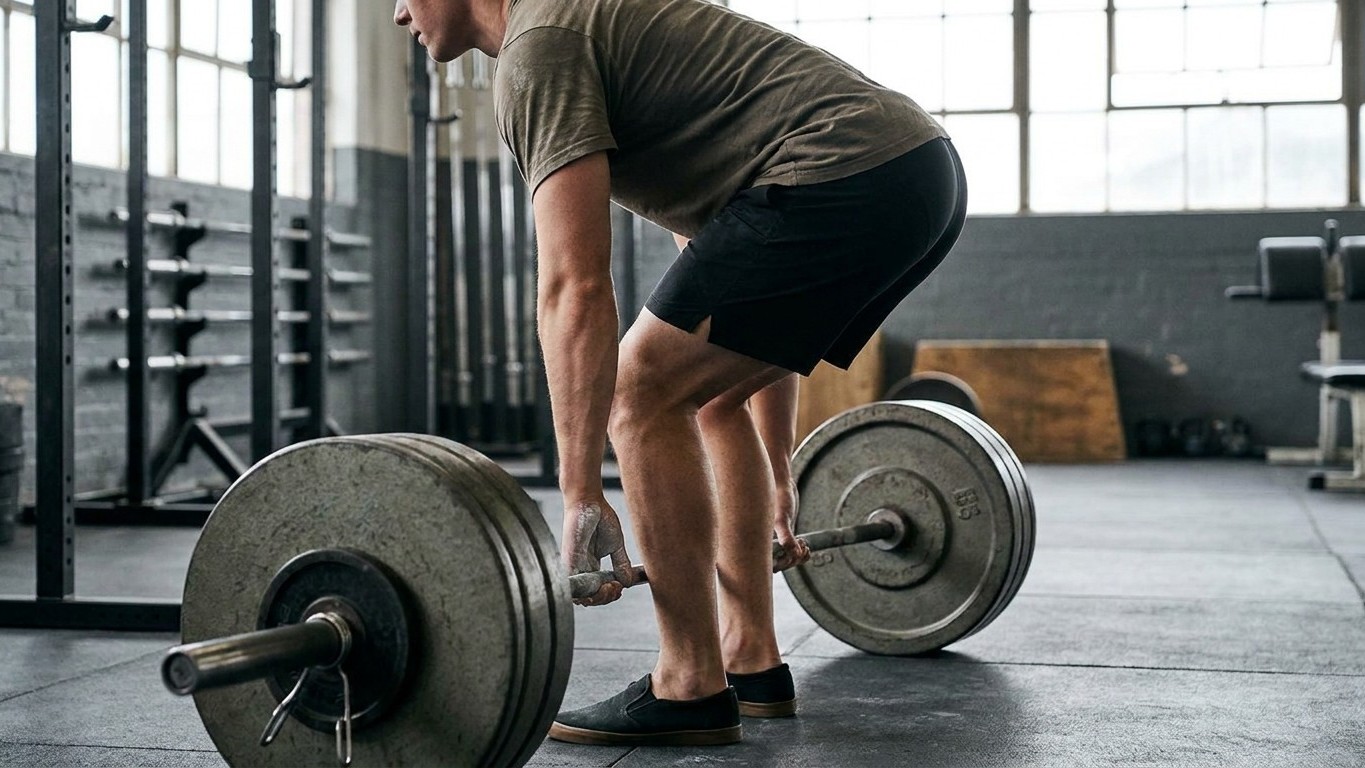
Blood on the shins is not a badge of vanity. For anyone who deadlifts regularly, those small grazes from the barbell travelling close to the leg are actually a rough indicator that the lift is going reasonably well. Walk away with pristine shins every single session, and there is a fair chance your spine is quietly absorbing forces it was never built to tolerate.
This is one of those biomechanical realities that gets lost in the noise of gym culture, where the focus tends to fall on how much is on the bar rather than where the bar travels. The distance between the barbell and your body during a deadlift is not a cosmetic detail. It is the difference between a hip-dominant pull and a lumbar stress test.
Key takeaways
- Clean shins might mean your barbell is drifting dangerously away from your body
- Forward bar drift shifts load from glutes onto lumbar discs that weren’t built for shear forces
- Small cumulative damage over months of bad form can lead to disc herniations at L4-L5 and L5-S1
Why bar path is a spinal health issue, not just a technique preference
The spine handles compressive load reasonably well when that load is distributed evenly through the vertebral bodies and intervertebral discs. What it handles poorly is shear force, the kind generated when a load pulls the spine forward and out of its neutral curve. As the barbell drifts away from the body, the moment arm (the horizontal distance between the bar and your lumbar spine) increases. Physics does the rest: a longer moment arm means the erector muscles must generate exponentially more force to maintain position, and that force gets transmitted directly through the lumbar discs.
Research published in biomechanics literature consistently shows that anterior shear forces at L4-L5 and L5-S1 rise sharply when the barbell is allowed to swing forward during the pull. These are the same vertebral levels implicated in the majority of disc herniations seen in the general population. The deadlift, performed correctly, is not inherently dangerous to these structures. Performed with the bar drifting forward, it becomes a different exercise entirely.
The shin contact that experienced lifters often describe is a natural consequence of keeping the bar close. You cannot drag a barbell up your leg without it being in contact with your leg. The grazes are incidental. The proximity is the point.
What actually happens when the bar drifts forward
Think of it this way: holding a full shopping bag at arm’s length feels dramatically heavier than holding the same bag tight against your thigh. Your shoulder knows this instantly. Your lumbar spine experiences the same physics at much higher loads, without any of The Warning Signs your shoulder might give you.
When the bar begins its journey away from the shins, the hips tend to rise faster than the shoulders, which pitches the torso more horizontal. This shifts the lift away from the glutes and hamstrings, which are designed to move heavy loads, and onto the lumbar extensors, which are designed more for postural stabilisation than prime-mover work. The discs at L4-L5 and L5-S1 sit at the hinge point of this mechanical disadvantage.
Disc tissue is not particularly sensitive to pain until damage is already significant. This is partly why people accumulate spinal stress over many sessions before anything becomes symptomatic. A small amount of forward bar drift in every deadlift session, multiplied across months or years, represents a substantial cumulative load on structures with limited capacity for repair. Annular disc fibres, once torn, do not regenerate in the way that muscle tissue does.
The setup habits that actually keep the bar close
Correcting bar drift is mostly a setup problem, not a mid-lift problem. By the time the bar is moving, the pattern is already established. The most consistent cause of forward drift is starting with the bar too far from the body before the lift begins. A good working rule, used by many coaches, is that the bar should sit over the mid-foot (roughly the lace area of a flat shoe) and the shins should be close enough to nearly touch it when you hinge down to grip.
Lat engagement is the other half of the equation. “Protecting your armpits” or “bending the bar around your legs” are coaching cues that activate the lats, which act as a tensioning system to keep the bar close throughout the pull. Without this tension, the bar swings forward as soon as it leaves the floor. Practising the Romanian deadlift, where the bar travels in close contact with the legs throughout the movement, can reinforce this pattern effectively before adding heavier loads.
Footwear matters more than most gym-goers realise. A raised heel, common in standard training shoes, shifts the weight distribution forward and encourages the bar to drift in the same direction. Deadlifting in flat shoes, or even barefoot where facilities permit, supports a more vertical shin and keeps the mechanics closer to what the lift requires.
When to take the signs seriously
Persistent lower back soreness after deadlifts is not just a recovery issue. Soreness that sits deep in the lumbar region, rather than the surface fatigue you might feel in the glutes or hamstrings after a heavy session, warrants genuine attention. The same applies to any sensation of stiffness that takes more than 48 hours to resolve, or discomfort that radiates into the buttocks or legs. None of these are diagnoses, and a GP or sports medicine specialist should always be the first port of call for any persistent spinal symptom.
One thing worth knowing: the deadlift, far from being the back-wrecking exercise it is sometimes portrayed as, has reasonable support in the rehabilitation literature as a loading strategy for people recovering from certain types of back pain, when performed under appropriate guidance. The problem has never been the lift. It has always been the execution.
Clean shins after every session might mean you are successfully avoiding the bar. Or they might mean your technique is being kind to your legs and quietly unkind to your spine. Either way, it is worth checking.