
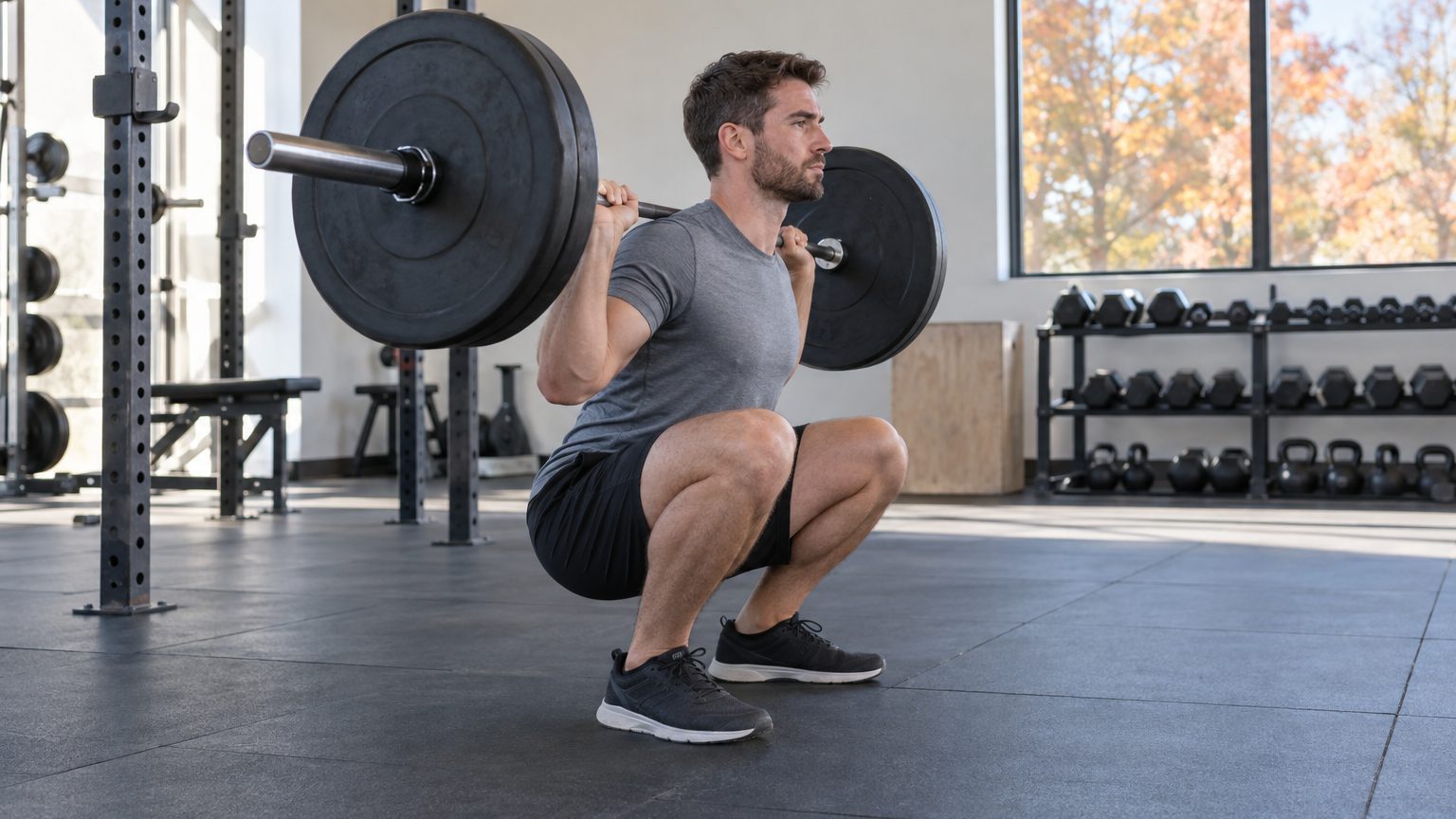
Your knees travelling past your toes in a squat is not, on its own, a hazard. For healthy knees it is a normal part of the movement, and forcing them to stay back often just shifts the strain somewhere else.
The rule is older than most of the research testing it.
- Knees passing your toes during a squat is normal and safe for healthy joints.
- Restricting knee travel reduces knee torque by roughly 20 percent but increases hip torque more than tenfold.
- Olympic weightlifters routinely squat with knees well past their toes under heavy load through gradual conditioning.
Where “knees behind toes” came from
Fitness folklore often points to a study from Duke University in the late 1970s, though tracking down the original paper is harder than you’d think. That difficulty says something about how the advice spread: coaching cues travel faster than citations. By the time the rule reached gym walls and personal-training manuals, the nuance had been shaved off.
The cue does have some logic behind it. As the knees travel forward, the forces through the knee and the joint behind the kneecap do rise, and that part is real. A coach watching a beginner whose heels lift and knees wobble has good reason to say “sit back into it”. The trouble began when a fix for one specific problem hardened into a universal law for everybody.
What the measurements actually show
The study most often used against the rule was published in 2003 in the Journal of Strength and Conditioning Research by Fry and colleagues. It was small, and it compared squats with the knees free to move forward against squats where they were held behind the toes. Restricting the knees reduced knee torque by roughly a fifth, but hip torque rose dramatically, by more than tenfold in the figures reported, and the trunk leaned further forward.
Load doesn’t vanish when you restrict the knees; it relocates.
Depth follows a similar pattern. A 2013 review in Sports Medicine by Hartmann and colleagues found no convincing evidence that deep squats damage healthy knees, although forces at the kneecap do climb as you go lower. Connective tissue generally adapts to load that is increased gradually, which is why an experienced lifter tolerates work that would leave a novice sore for days. Everyday life makes the same point: walking downstairs or lowering yourself into a low chair sends your knees well past your toes without anyone raising an eyebrow.
Squat style matters too. A low-bar back squat tends to involve more hip hinge and a more upright shin, while a high-bar or front squat usually brings the knees further forward. Both are legitimate, and neither is the “safe” one by default.
Making the squat work for your body
Ankle mobility is frequently the real bottleneck. If your ankles are stiff, your heels may lift or your torso may pitch forward to compensate, and neither feels good under load. Raising the heels slightly (a thin plate or weightlifting shoes) can help, as can regular calf and ankle mobility work. Keep your whole foot on the floor, and make sure your knees track in line with your middle toes rather than collapsing inwards.
Pain changes the picture. If you have sharp pain at the front of the knee, a history of ligament or meniscus injury, or persistent tendon soreness, it is worth having a GP or physiotherapist assess it before deciding how deep or how far forward to go. Consult your GP for personal medical advice, because a sensible short-term adjustment may suit you better than any rule from the internet.
Temporary modification is not the same as a lifelong ban.
Olympic weightlifters, who handle some of the heaviest squat loads in sport, routinely have their knees well beyond their toes at the bottom of a clean or snatch. Their knees are conditioned to it through years of progressive training, and that gradual build-up, far more than any line drawn at the toes, is what separates robust knees from irritated ones.