
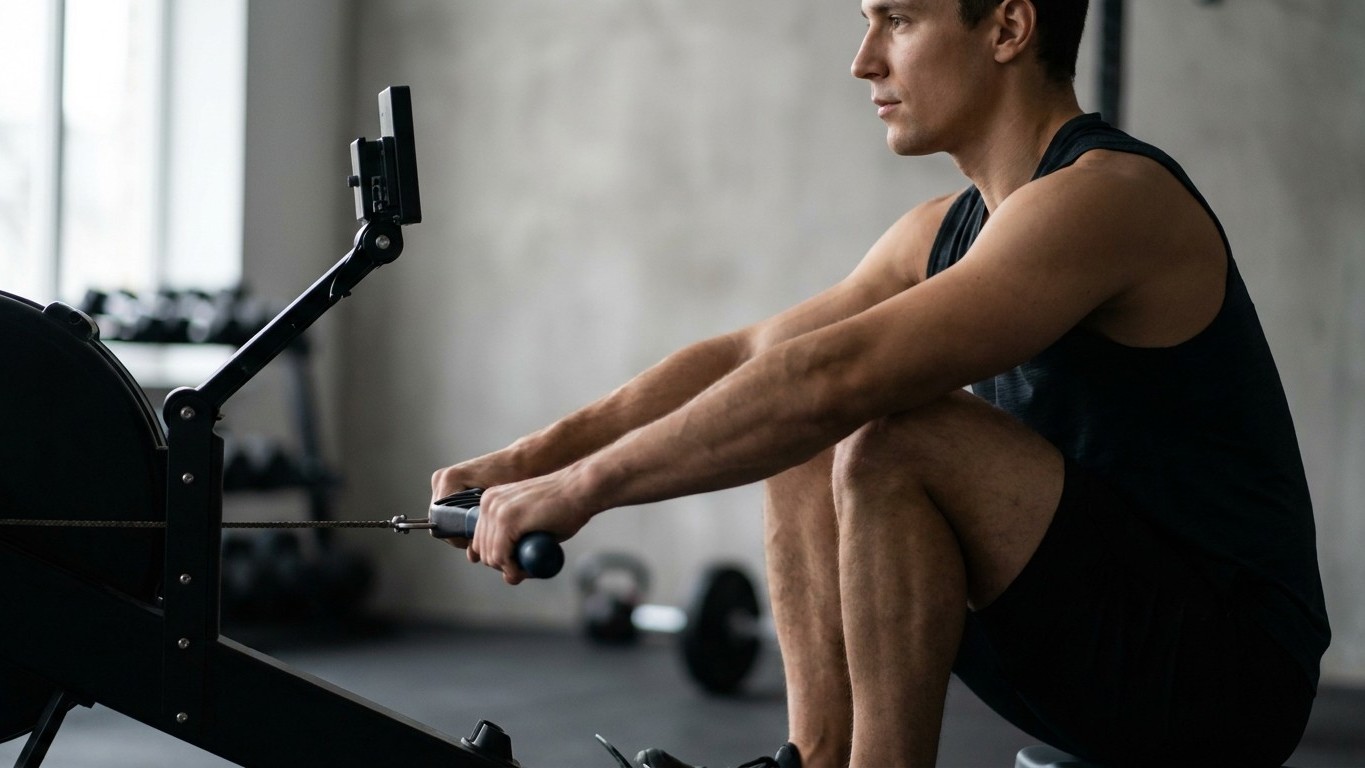
Rowers obsess over the drive, the powerful leg-then-back-then-arms sequence that sends the flywheel screaming and the metres ticking over. But the injury actually happens earlier, in the split second before the pull even begins. As the seat glides forward and the body folds into the catch position, the lumbar spine quietly absorbs a stress most people never notice, and it’s this moment, not the pull itself, that research increasingly points to as the real culprit behind rowing-related back pain.
The catch is the compressed position at the front of the stroke, knees bent, shins vertical, arms reaching forward, torso pitched over the thighs. To get there efficiently, the body needs three things working together: good ankle flexibility, hip mobility, and a controlled forward tilt of the pelvis. The ideal catch position consists of hip flexion and anterior pelvic tilt, a position that innately stresses the lumbar spine and is only worsened by twisting forces. Even when everything goes right, the lower back is under load before a single stroke has been pulled. When mobility is lacking, which is common, the body finds a shortcut, and that shortcut runs straight through the lumbar discs.
Key takeaways
- Peak compressive forces at the lumbar spine reach 4.6 times body weight during rowing—but the spine’s position in the catch determines if it’s safe
- Many rowers compensate for poor ankle and hip mobility by rounding the lower back at the catch, loading vulnerable disc tissue instead of bone
- Fatigue makes everything worse: lumbar flexion increases subtly during long sessions when rowers stop paying attention
Why the split-second before the pull matters more than the pull
Picture the compensatory pattern physiotherapists see constantly on ergometers up and down the country. Many rowers, particularly young males, simply don’t have the biomechanics to achieve the optimal catch position, so they enter it with too much lumbar flexion, or rounding, which loads the soft tissues of the lower back and can lead to overuse injuries. Rather than hinging cleanly at the hips, the lower spine rounds to make up the shortfall in range of motion. It looks like a minor stylistic quirk from the side. Mechanically, it’s the difference between load travelling through bone and muscle designed to take it, versus load landing on disc tissue that was never built for repetitive compression.
The numbers involved are sobering. Peak compressive force at the lumbar spine during rowing has been measured at roughly 2,694 newtons, equivalent to 4.6 times the rower’s own body weight. That load doesn’t arrive gradually across the stroke. It builds through the catch and peaks as the legs fire, meaning the spine’s position in that fraction of a second before the drive determines whether the force travels safely or concentrates on already-vulnerable structures. A University of Melbourne study comparing the lumbar spines of female rowers against age-matched controls found the L4/L5 joint endured the greatest shear and compressive forces during ergometer rowing. L4/L5 happens to be one of the most common sites for disc herniation in the general population too, which is not a coincidence.
Fatigue makes the whole picture worse. Athletes tend to think of technique breakdown as something that happens near the finish of a hard session, but the research is specific about where it shows up. In both on-water and ergometer rowers, fatigue results in increased lumbar spine flexion at the catch, and this effect is greater on the ergometer than on the water. That’s a genuinely useful nugget for anyone doing long indoor sessions during winter training blocks: the tenth minute of a steady-state row on a machine is precisely when the catch position tends to collapse, quietly, without any obvious change in stroke rate or power output.
What separates a back-friendly rower from one heading for injury
A systematic review pooling 22 studies and 429 participants found consistent differences between rowers with and without a history of low back pain. Rowers without low back pain show distinct kinematics, including neutral or anterior pelvic rotation at the catch, greater hip range of motion, and a flatter low back position at the finish, alongside trunk extensor dominant muscle activity with less flexor involvement. By contrast, rowers with low back pain had relatively greater posterior pelvic rotation at the catch, greater hip extension at the finish, and less efficient trunk muscle activity. In plain terms, the injury-free group tilts the pelvis forward and lets the hips do the work of folding into the catch. The pain group tucks the pelvis under and asks the lower spine to do a job it was never designed for.
There’s a reasonably reliable self-test that Physiotherapists use to flag this before it becomes a problem. If a rower can perform a full squat without the heels lifting off the ground, they generally have the range of motion needed to achieve the desired catch position without compensating through the lower back. If the heels rise, or the lower back rounds sharply at the bottom, that’s a strong signal that ankle or hip stiffness is being masked by lumbar flexion every single stroke. Given that a typical training session might involve hundreds or even low thousands of strokes, even a few degrees of unwanted flexion per catch adds up to a serious cumulative load over weeks and months.
Small adjustments that protect the discs
None of this means abandoning the rowing machine, which remains one of the most efficient full-body cardio tools around. It means paying attention to the quieter half of the stroke. Slow the recovery down rather than rushing back to the catch, allowing the hips and hamstrings to lead the movement instead of the lower back. Keep the shins vertical rather than over-compressing the knees to chase a longer reach, since at the catch the knees are typically flexed 110 to 120 degrees and the spine flexed around 30 degrees to vertical, not folded double. Building ankle dorsiflexion and hip mobility away from the machine, through simple daily stretching, pays dividends every single time the seat glides forward. And on long ergometer sessions, checking in on catch posture every few minutes matters more than checking the display, precisely because fatigue-related lumbar flexion creeps in on the ergometer before most rowers notice any drop in power.
Low back complaints are far from rare in this sport, and one detail rarely makes headlines: low back injuries account for roughly 15 to 25 percent of all rowing injuries, putting the lumbar spine on a par with, or ahead of, the knee as the area most likely to sideline a rower. If you row regularly, whether on water or indoors, it’s worth asking a coach or a chartered physiotherapist to watch your catch position from the side just once. As always, if you’re already experiencing back pain, that’s a conversation for your GP or a physiotherapist rather than a training tweak on your own.
Sources : sciencedirect.com | ncbi.nlm.nih.gov