
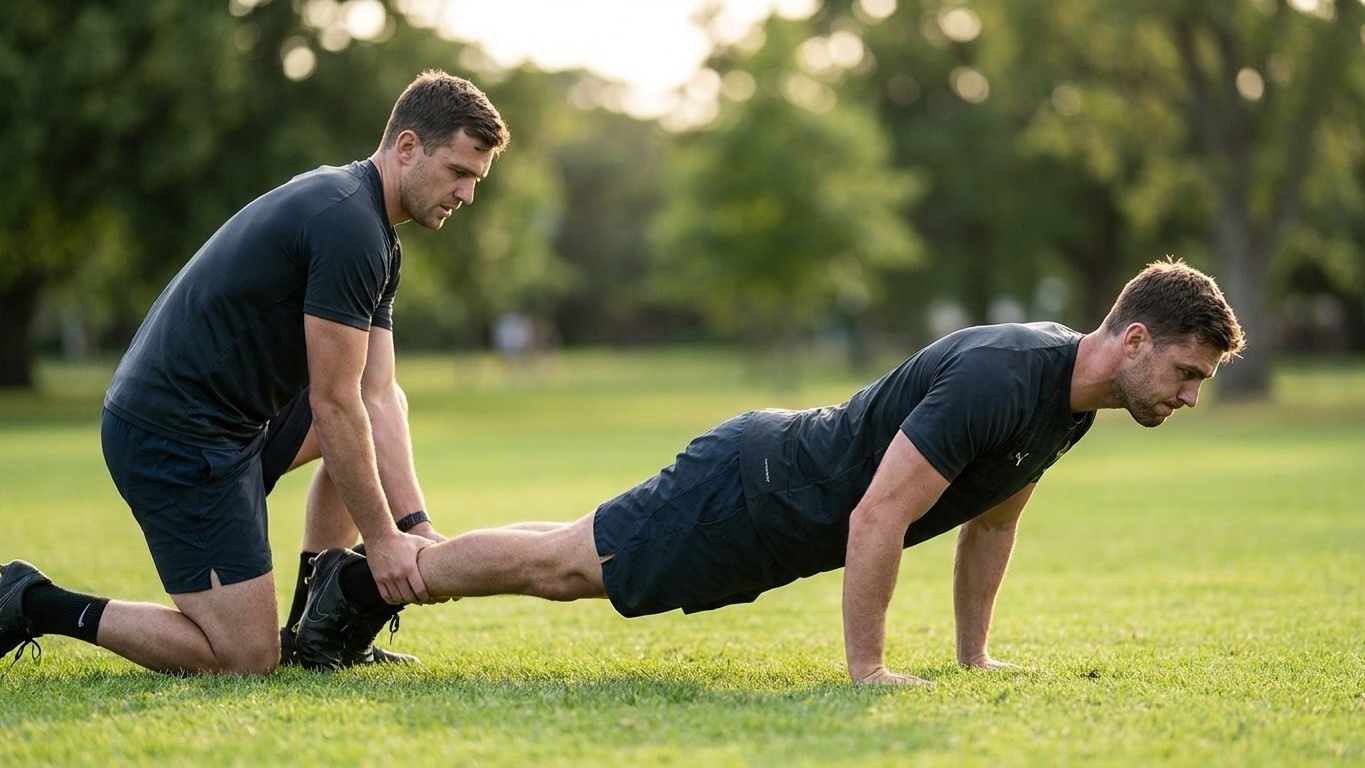
A single Nordic hamstring curl, performed with a partner pinning down the ankles while the athlete lowers slowly to the floor, cuts the risk of a hamstring tear by roughly half. That’s not marketing copy from a fitness brand: it’s the headline finding of a 2019 systematic review and meta-analysis published in the British Journal of Sports Medicine, pooling data from 8,459 athletes and 525 hamstring injuries across 15 studies. And yet, walk into most amateur or even professional changing rooms across Europe, and you’ll struggle to find a squad doing it properly, week in, week out.
The mismatch between what the science says and what actually happens on the training pitch is stark enough to make any sports scientist wince.
Key takeaways
- One exercise has been scientifically proven to cut hamstring injuries nearly in half, backed by data from over 8,000 athletes
- Elite football clubs have known about this prevention method for nearly two decades, yet adoption rates remain below 20% worldwide
- The barrier isn’t cost or complexity—it’s the brutal soreness in week one and a cultural resistance that even top-flight players struggle to overcome
What the research actually found
The van Dyk, Behan and Whiteley review didn’t cherry-pick a handful of favourable trials. It drew on studies spanning multiple sports, competition levels and both sexes, comparing squads that included the Nordic hamstring exercise in their prevention routines against those that stuck with standard training. The results indicate a statistically significant and clinically meaningful reduction of 51% in hamstring injuries for all athletes competing at different levels of competition and across multiple sports. That’s not a marginal tweak. It’s the kind of effect size that, in a pharmaceutical trial, would generate front-page headlines.
Earlier attempts to answer the same question had been far murkier. In 2010, a Cochrane review on interventions aimed at reducing hamstring injuries found that of six studies included, only two investigated the NHE as an intervention, and the results were inconclusive as to its effectiveness. The 2019 analysis, with a much larger combined sample, gave the exercise the kind of statistical weight that finally settled (or so it seemed) a decade of uncertainty.
Worth noting: not everyone agrees the case is fully closed. A 2021 methodological reappraisal in the journal Contemporary Clinical Trials Communications reanalysed the same evidence base using stricter randomised-controlled-trial criteria and reached a more cautious verdict, concluding that the evidence underpinning the protective effect of Nordic hamstring exercise so far remains inconclusive, and that under GRADE criteria Nordic hamstring exercise can be only conditionally recommended. Good science invites scrutiny, and this debate is a healthy one. But even sceptical reanalyses aren’t arguing the exercise is harmful, only that the size of the benefit may be less certain than the headline 51% suggests.
Why so few clubs actually do it
Here’s where the story gets genuinely puzzling. Football’s own governing bodies have known about the Nordic curl’s protective potential for well over a decade, having folded it into the FIFA 11+ warm-up programme back in 2006. Despite that, uptake at the elite level has been dismal. A landmark survey of Champions League and Norwegian Premier League clubs found that of 150 club-seasons covered by the study, the NH programme was completed in full in 16 (10.7%) and in part in an additional 9 (6%) seasons, meaning 125 (83.3%) club-seasons were classified as non-compliant. A follow-up study of English professional football five years later found things had barely moved: uptake of the 10-week Nordic hamstring programme is as low as 11% and 17% in professional soccer.
Women’s elite football tells a similarly sobering story. A 2015 study found that only 13% of included teams reported that they used the complete or parts of the NHE programme, and by the 2020-21 season, among elite European women’s teams surveyed, one team (9%) used the full original NHE programme, and four teams used the programme in team training during parts of the season. This is despite evidence that, in women’s football specifically, the programme’s protective effect may be even larger than in the men’s game.
It isn’t just football. In UK professional cricket, researchers found that three clubs have utilised the NHP in the last three seasons with one club considered fully compliant, despite uptake of the Nordic hamstring exercise, only three clubs adopted the full programme. The barriers identified were strikingly human: players not positively perceiving the programme (60%) with a cultural change required (60%) for its adoption.
Interestingly, Major League Soccer in the United States bucks the trend rather sharply. A survey of nearly every top-division club found eighteen clubs (75%) reported a formal hamstring injury prevention program, with eccentric exercises (94%), high-speed running (94%), and NH exercises (89%) the most common strategies adopted. That gap between American and European adoption rates suggests this isn’t really about resources, most Champions League clubs have far bigger medical budgets than MLS sides. It’s about culture, habit and, frankly, how unpleasant the exercise feels in the first weeks.
The soreness problem, and what it means for you
Ask any player who’s tried it: the Nordic curl produces brutal delayed-onset muscle soreness in the first fortnight, even though that soreness fades with consistent practice. Coaches worry it will sap sprint speed in the days before a match. Players complain it feels like it’s doing nothing, right up until the moment it prevents the tear that would have kept them out for six weeks. That perception gap, between short-term discomfort and long-term protection, appears to be the single biggest reason uptake remains so patchy even among professionals who are paid to trust the evidence.
For anyone playing five-a-side, running club rugby, or training for a half marathon, the practical lesson is refreshingly simple: you don’t need a fancy Nordbord machine or a physiotherapist standing over you. A training partner kneeling on your ankles and two sessions a week of a handful of controlled, slow repetitions is the same protocol the research was built on. Consistency Matters More Than intensity here; the studies behind that 51% figure were built on weeks of habitual practice, not the occasional session before a big match.
This piece is provided for general information and isn’t a substitute for personalised medical or physiotherapy advice. If you have a history of hamstring problems, do check with your GP or a qualified physiotherapist before starting a new eccentric strength programme.
Sources : research.regionh.dk | journals.humankinetics.com