
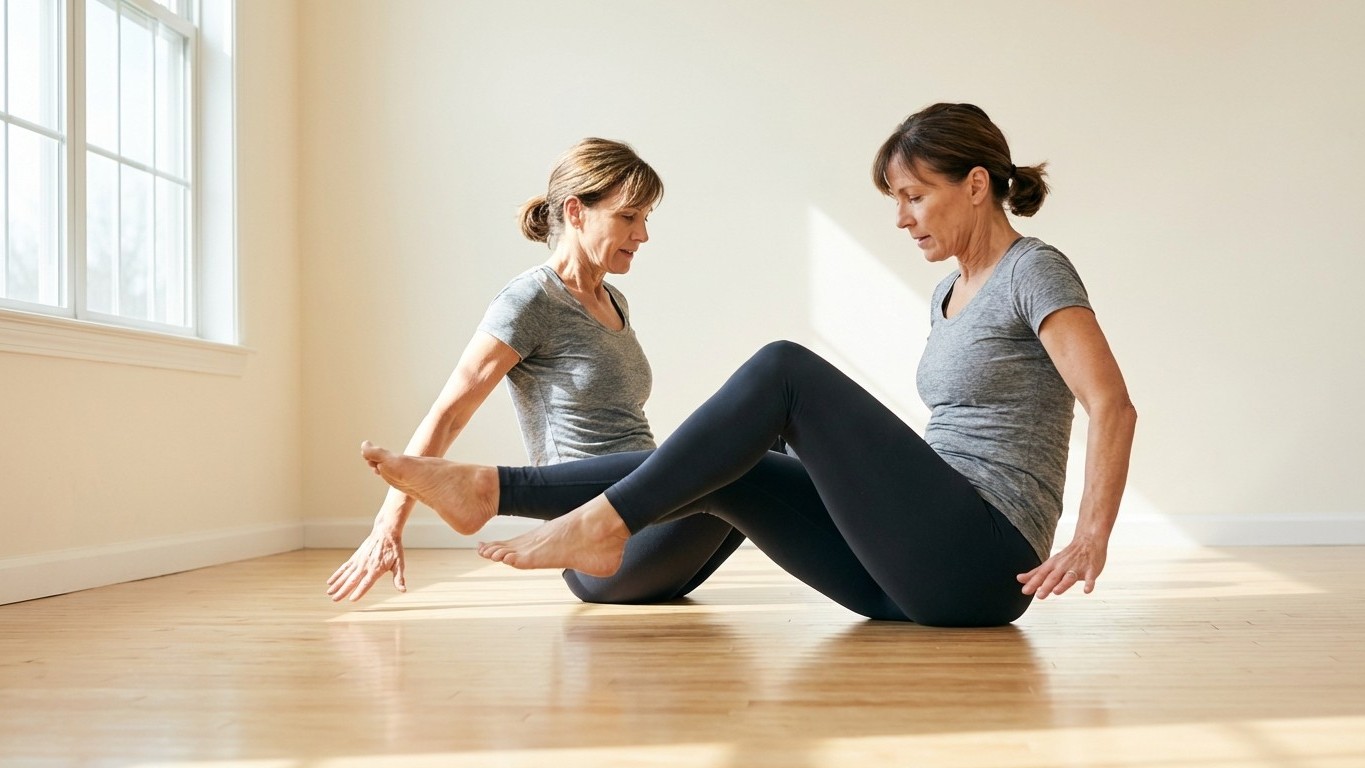
The way you lower yourself into a chair, sink onto the sofa, or settle cross-legged on the floor might seem like the most mundane thing in the world. Yet researchers have found that this everyday act, performed dozens of times a day without a second thought, can offer a surprisingly clear window into how your body is ageing, and how well it might continue to do so.
Key takeaways
- A deceptively simple floor test reveals something striking about your body’s true age
- Participants scoring low were found to be 5-6 times more likely to face serious health decline
- The good news: the physical qualities being measured respond remarkably well to training
The sitting test that caught scientists’ attention
The test in question is deceptively simple. Stand upright, then lower yourself to sit cross-legged on the floor, using as little support as possible, and then rise back to standing again. No hands on the floor. No knee propped against the wall. Just your own body, gravity, and whatever reserves of strength, balance, and flexibility you happen to possess.
This is the Sitting-Rising Test (SRT), developed by Brazilian physician Claudio Gil Araujo and his colleagues at the CLINIMEX Exercise Medicine Clinic in Rio de Janeiro. The scoring system awards up to five points for sitting down and five for getting back up, with deductions for every time a hand, forearm, knee, or side of the leg is used for support. A half-point is also lost for a visible wobble on the way up. The maximum score is ten.
What makes this more than a party trick is the research behind it. A study published in the European Journal of Preventive Cardiology followed over 2,000 adults aged 51 to 80 for roughly a decade. Those who scored between zero and three were found to be five to six times more likely to die during the study period than those who scored eight to ten. Each single-point increase in score was associated with a 21% reduction in mortality from all causes. Those are striking numbers for something that takes thirty seconds to perform.
What the test is actually measuring
Before you start worrying that a creaky knee has sealed your fate, it helps to understand what the SRT is genuinely picking up. It is not magic. What it captures is a cluster of physical qualities that together paint a picture of musculoskeletal health: muscular strength (particularly in the legs and core), flexibility, coordination, and balance. These are the same qualities that determine whether someone can catch themselves after a trip on the pavement, carry shopping up the stairs, or recover from an illness without a prolonged period of bed rest.
Muscle loss with age, known as sarcopenia, is one of the more underappreciated threats to healthy ageing. It begins earlier than most people realise, with some evidence suggesting a gradual decline in muscle mass starts as early as the mid-thirties. The SRT is sensitive enough to pick up early functional decline, which is precisely why it is useful. A low score does not mean you are doomed; it means there is something worth addressing.
Balance is the other half of the equation. Falls are among the leading causes of serious injury and hospitalisation in people over 65 in the UK, with the NHS recording hundreds of thousands of fall-related admissions each year. The coordination required to sit and rise smoothly from the floor draws on the same neural and muscular systems that prevent falls during daily life. If those systems are struggling, the SRT makes it visible.
How to try it and what to do with the result
Try the test on a clear patch of floor, ideally with someone nearby if you are at all uncertain. Cross your legs as you descend and aim to keep your hands entirely away from the floor. Score yourself honestly. A score of eight or above suggests good functional fitness for your age. Anything below six is a signal worth taking seriously, not as a diagnosis, but as motivation.
The good news is that the qualities the SRT measures respond well to training. You are not locked into a fixed trajectory. Strength training, particularly exercises that target the glutes, quadriceps, and core, can produce meaningful improvements in a relatively short time. Yoga and Pilates both build the flexibility and body awareness that make floor-based movement easier. Simply spending more time sitting on the floor rather than on furniture, something common in many East Asian and Middle Eastern cultures where low-level living is the norm, can gradually restore range of motion and hip flexibility that years of chair-sitting have eroded.
Mobility drills targeted at the hips and ankles are often overlooked but can be transformative. Many people who find the SRT difficult discover that their ankles simply do not dorsiflex enough to allow a clean sit-to-stand, and that is entirely correctable with consistent work. A physiotherapist or qualified personal trainer can help identify the specific weak links and design a programme around them.
Ageing well is not about one number
The SRT is one lens, not the whole picture. Cardiovascular fitness, sleep quality, nutrition, mental health, and social connection all weave together to determine how well we age. A person who scores ten on the SRT but smokes, sleeps four hours a night, and lives in chronic isolation is not on course for a flourishing old age.
What the test offers is immediacy and honesty. Unlike a blood panel or a VO2 max test, it requires no clinic appointment, no equipment, and no specialist knowledge to interpret. Your body simply tells you, in the most direct possible way, where things stand right now.
There is something almost philosophical about the SRT: the floor has always been there, available, free, indifferent. The question is whether we retain the physical freedom to meet it on its own terms. At whatever age you try this, the more interesting question is not what your score says about your past, but what you decide to do with it from here.
Always consult your GP or a qualified health professional before starting a new exercise programme, particularly if you have existing joint, cardiovascular, or balance concerns.