
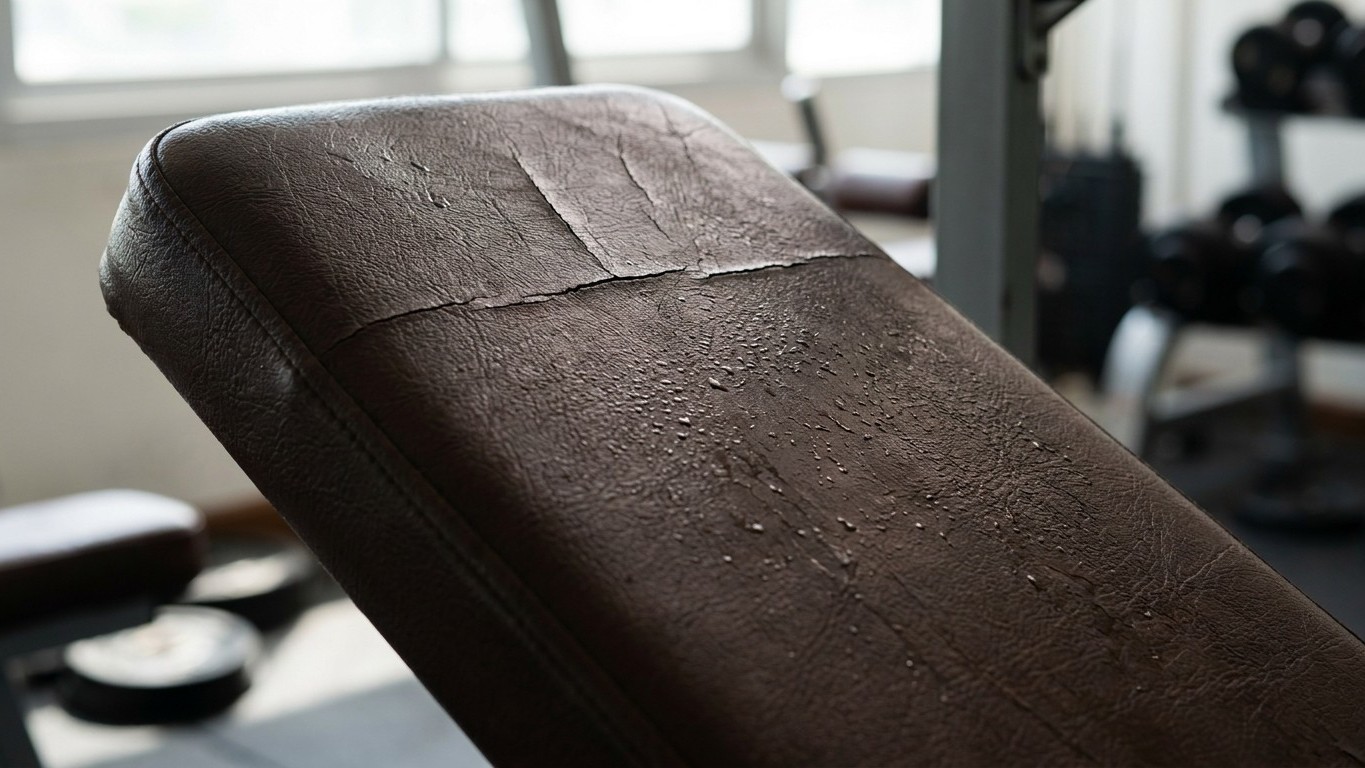
Walk into any gym on a Saturday morning and you’ll see the same ritual: someone finishes their bench press, grabs a wipe, and meticulously cleans the barbell before racking it. Meanwhile, the vinyl pad they’ve just been lying on, soaked with sweat from their shoulders, upper back and head, gets a passing glance at best. A recent study published in the journal Pathogens found that high-contact equipment acts as a hub for microbial persistence partly because of material properties such as vinyl surfaces retaining moisture and debris. The bar gleams. The bench quietly becomes a reservoir.
Key takeaways
- The equipment you touch briefly gets cleaned obsessively—but what keeps your skin pressed against it for minutes stays neglected
- Cracked vinyl bench padding creates sealed pockets where bacteria can hide from disinfectants and evaporation
- Benches tested positive for MRSA and skin-infection organisms in 74% of samples, yet remain the gym’s most undertreated surface
Why we clean the wrong surface
There’s a logical reason we fixate on the metal. Chalk dust, visible sweat drips and the cold, hard texture of a barbell make dirt obvious. Vinyl padding, by contrast, absorbs moisture rather than displaying it, so the mess disappears from view even as it seeps into seams and cracks. The July 2026 Pathogens research, which sampled a fitness facility repeatedly over a working week, found that surface microbiota primarily reflects human shedding during exercise, though contamination was unevenly distributed across equipment types. Devices involving prolonged skin contact, not brief hand contact, came out worst. The researchers specifically flagged the functional trainer, leg extension/curl, and seated row as likely high-contact hubs due to prolonged use, intensive skin contact, and material properties, which is essentially a description of what happens on a weight bench too. A barbell touches your palms for a few seconds per rep. A bench pad sits against damp skin for the entire set, and often for the rest between sets as well.
Once vinyl starts to crack, the problem compounds. Older gym equipment guidance on disinfectant use notes that using the wrong cleaning product on vinyl bench padding causes cumulative damage that shows up months later as cracked vinyl, and that damage isn’t just cosmetic. Splits and seams create tiny pockets where sweat can’t evaporate and wipes can’t reach, giving bacteria a sheltered spot to sit undisturbed between cleanings, sometimes for days rather than hours.
What’s actually growing there
The numbers on gym surface contamination vary depending on who’s measuring and how, but they consistently point the same direction. Testing commissioned by the fitness review site FitRated found that free weights carried 362 times more bacteria than a toilet seat, while a separate industry survey reported that samples from 27 pieces of gym equipment across three gyms turned up more than one million colony-forming units. Of the bacteria identified in that survey, skin infection-causing organisms such as MRSA and ringworm accounted for 41% of everything found.
Bench-specific research backs this up. A study of gymnasiums in Malaysia that swabbed benches, mats and other equipment found Staphylococcus aureus present in nearly 74% of samples tested, leading the authors to conclude that gymnasium equipment is a potential reservoir for S. aureus that might play a role in transmitting the pathogen to humans. Separately, an industry hygiene report citing research from the National Academy of Sports Medicine states plainly that weight machines and benches harbour more contamination than cardio equipment.
Not every study paints such an alarming picture, and I think it’s worth including this for balance rather than cherry-picking the scariest figures. A University of Florida investigation that swabbed benches, dumbbells and weight machines 240 times before and after routine cleaning found no methicillin-resistant or methicillin-sensitive Staphylococcus aureus in any sample, concluding that gym surfaces don’t appear to be significant reservoirs for staphylococci. The lead researcher on that study suggested people might be overestimating the risk from touching things, since MRSA may be more likely to pass from skin to skin than from surfaces to skin. Reality probably sits somewhere between the two extremes: benches aren’t a guaranteed infection risk, but the conditions for bacterial growth (warmth, moisture, skin contact) are present, and cracked, poorly maintained vinyl makes those conditions worse.
Cleaning the pad properly, not just the pole
Treating the bench with the same ten seconds of attention you give the bar isn’t quite enough, because vinyl behaves differently to steel. Porous, textured surfaces need products designed for them; guidance from commercial cleaning specialists notes that upholstered benches and foam mats require products specifically tested for porous materials, since most consumer wipes are labelled for hard, non-porous surfaces only. Harsh bleach or ammonia-based sprays might feel thorough, but they can degrade vinyl over time; a general rule from equipment maintenance guidance is to avoid bleach and ammonia on plastics and metals to prevent corrosion and discolouration, using gentler alcohol-free formulations instead. Contact time matters more than people assume, too. Alcohol-based sprays may need as little as ten seconds to work, while quaternary ammonium compounds often require four minutes of surface contact to kill bacteria effectively, which means a quick spray-and-wipe before the disinfectant has had time to sit does very little.
If your home gym bench has started showing hairline cracks, that’s worth treating as more than an aesthetic issue. Once the surface splits, no amount of spraying reaches what’s settled inside, and at that point, a cover or a proper repair does more good than another bottle of cleaner.
A few small habits that actually help
None of this requires a dramatic overhaul of your routine, just a shift in where your attention goes:
- Lay a towel between your skin and the bench pad, particularly for exercises involving prolonged contact like bench presses or seated rows.
- Wipe the bench before your set as well as after, since infection specialists note this protects you from what the previous user left behind, not just what you might leave for the next person.
- Give benches, not just bars, a proper weekly deep clean rather than a daily quick pass, since surface build-up in seams needs more than a wipe to shift.
If you notice unexplained redness, swelling or a warm, tender lump after a gym session, particularly near broken skin, that’s a reason to see your GP rather than reach for a search engine. Most gym-related skin issues are minor and resolve quickly, but staph infections can occasionally need proper medical treatment, and a professional is best placed to tell the difference. The habit worth building isn’t paranoia about every surface you touch. It’s simply remembering that the part of the equipment holding the most moisture, for the longest time, deserves at least as much attention as the part that looks dirtiest.
Sources : ncbi.nlm.nih.gov | 2xlpro.com