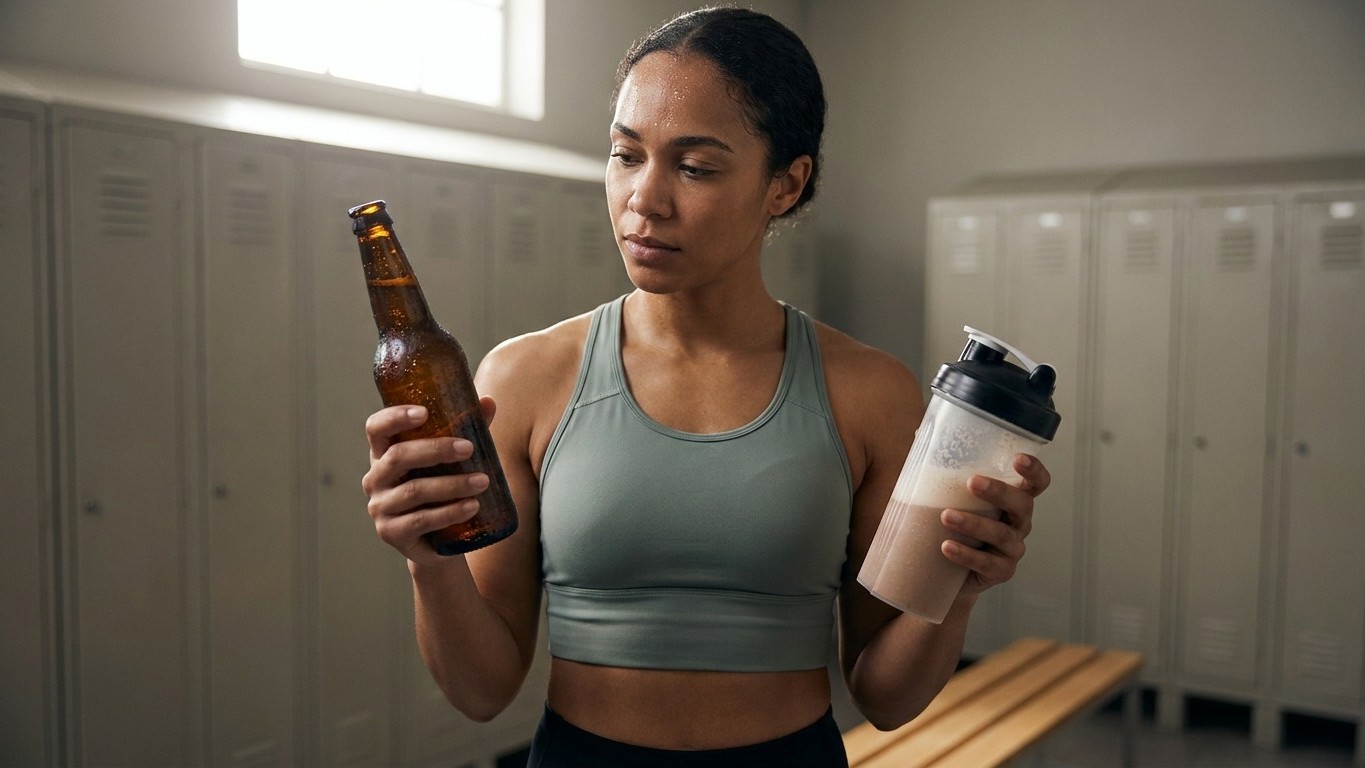
That celebratory pint after a hard session does more than just taste good: compared to protein alone, there was a hierarchical reduction in muscle protein synthesis of 24% when alcohol was combined with protein, and 37% when combined with carbohydrate. That’s not a rounding error. That’s roughly a third of the repair work your muscles were meant to be doing, quietly switched off within hours of you finishing your set.
The research behind this comes from a tightly controlled trial published in PLOS ONE, where eight physically active males completed Resistance exercise followed by continuous and high-intensity interval cycling, then received either a whey protein drink, alcohol with protein, or alcohol with carbohydrate. Immediately after exercise and again four hours later, subjects consumed either 500 mL of whey protein, alcohol co-ingested with protein, or an energy-matched carbohydrate drink also containing alcohol, with muscle biopsies taken to track what was actually happening inside the tissue. The result was unambiguous: alcohol consumption reduces rates of muscle protein synthesis following exercise, even when co-ingested with protein, suppressing the anabolic response and potentially impairing recovery and adaptation to training.
Key takeaways
- One simple post-workout habit might be silently sabotaging a third of your muscle repair work
- The damage happens at a molecular level you’ll never feel—at least not immediately
- There’s a specific threshold where alcohol stops mattering and starts destroying your recovery
What actually happens inside the muscle
The mechanism isn’t mysterious once you look at the signalling pathways involved. Phosphorylation of mTOR, the master regulator that switches on muscle protein synthesis, was higher with protein alone compared to alcohol plus protein or alcohol plus carbohydrate two hours after exercise. mTOR is essentially the green light for repair. Alcohol dims it. A wider systematic review pooling twelve separate studies confirms the pattern isn’t a one-off finding: cortisol levels seemed to be increased while testosterone, plasma amino acids, and rates of muscle protein synthesis decreased following alcohol intake after resistance training.
What’s genuinely reassuring, though, is what alcohol does not seem to touch. The same review found force, power, muscular endurance, soreness and rate of perceived exertion are also unmodified following alcohol consumption during recovery. So you won’t necessarily feel weaker at your next session, and your legs won’t ache more the next morning. The damage is invisible, happening at a cellular level long before it shows up as a plateau in strength gains or a slower recovery from injury. That’s precisely why so many people dismiss the idea that one beer matters. You feel fine. Your muscles, on a molecular level, are quietly being told to stand down.
The beer-specific hydration myth
There’s a separate, slightly more forgivable habit at play here too: the belief that beer somehow rehydrates you after a sweaty session because of its water and carbohydrate content. Dutch researchers tested this directly, having men cycle until mildly dehydrated, then rehydrate with Everything from non-alcoholic beer to full-strength 5% lager, an isotonic sports drink, or plain water. After one hour, urine production was significantly higher for 5% beer compared to the isotonic sports drink, at 299mL versus 105mL. your body was flushing the beer out faster than it could use it. Across the board, the study concluded fluid replacement in any form, whether non-alcoholic beer, low-alcohol beer, full-strength beer, water, or an isotonic sports drink, at 100% of body mass loss was not sufficient to achieve full rehydration anyway, which is a useful reminder that most of us underestimate how much we’ve lost through sweat regardless of what we’re drinking.
A Spanish study using moderate amounts of beer under hot conditions offered a slightly gentler verdict, finding that consumption of a moderate intake of beer, up to 660mL, plus water did not influence the normal recovery of several indicators of physiological stress and inflammation compared with rehydration using water alone. That nuance matters. This isn’t a case of one drink ruining everything. It’s a dose problem, and the dose most people actually reach for after a big session tends to sit well above “moderate.”
Where the line actually sits
Not every drop of alcohol is a training saboteur. Research summarised by strength and conditioning specialists suggests a genuine threshold effect: consumption of 0.5g/kg of alcohol or less won’t have an impact on muscle recovery following exercise, which works out to roughly two drinks for someone weighing around 8.5 stone, or three for someone around 13 stone. Push past that, into the 1.5g/kg range used in the PLOS ONE trial (broadly equivalent to ten or more standard drinks), and the anabolic penalty becomes severe rather than theoretical.
So the honest, unglamorous advice looks like this. If you’ve earned a drink after a long run or a heavy leg day, have it with food, keep it to a single pint, and drink a proper glass of water alongside it rather than instead of it. The four-to-six hour window straight after training is when your muscles are most primed to absorb amino acids and rebuild, so pushing the celebratory drink back to dinner, rather than necking it the moment you leave the gym, gives your body a genuine head start before alcohol arrives to interrupt the process. None of this makes beer some forbidden substance; it makes timing and quantity the two levers that actually matter, which is a far more useful thing to know than simply being told to abstain. As ever, if you’re managing a specific health condition or training for a serious event, it’s worth having a chat with your GP or a sports nutritionist about what fits your particular circumstances.
Sources : frontiersin.org | pubmed.ncbi.nlm.nih.gov