
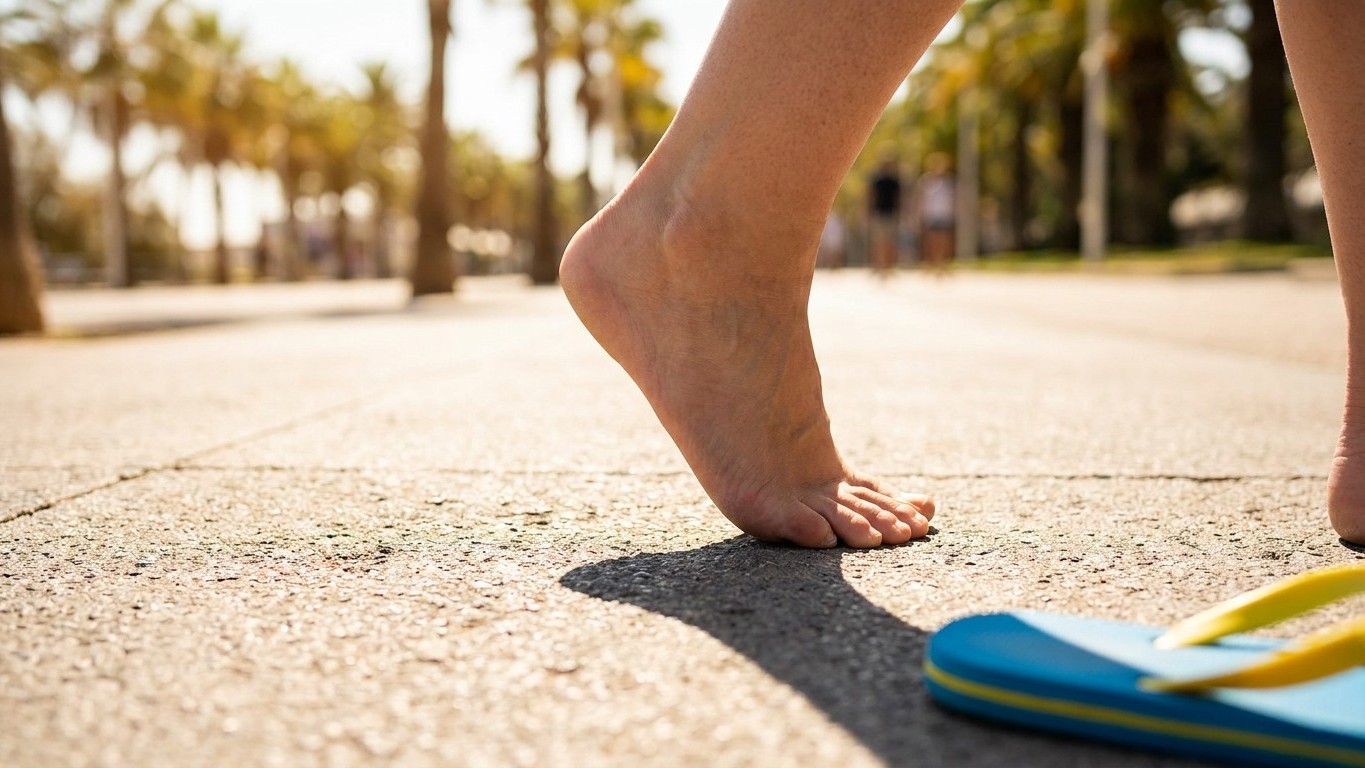
The culprit is the plantar fascia, a thick band of connective tissue running along the sole of your foot from heel to toes, and flip-flops force it to work overtime with every single step. Because there’s no strap holding the shoe to your foot, your toes have to curl and grip the sole just to keep it from flying off, especially when you pick up the pace. Do that for a few hours around a hot pavement or a beach car park, and that band of tissue becomes irritated and swollen. You won’t see it happening. You’ll just feel a stabbing pain under your heel the next morning, and wonder what on earth you did.
This is different from a blister or a strap rubbing against your skin, the kind of flip-flop damage everyone expects. The plantar fascia sits deep under the layers of fat and muscle in your foot, so the inflammation builds quietly for days before it announces itself. Podiatrists see a genuine seasonal pattern here: cases of plantar fasciitis and general foot strain tend to climb through the summer months, precisely when people swap supportive trainers for flat, unstructured sandals and then walk considerably further than usual, on holiday, at festivals, around city centres in the heat.
Key takeaways
- Flip-flops force your toes to grip constantly, creating a hidden repetitive strain injury in tissue you can’t see
- The plantar fascia inflammation builds silently for days before announcing itself as sharp heel pain
- Hard pavements and long summer walks amplify the damage in ways a short pool-to-bar stroll never would
Why a flat piece of rubber does so much damage
A proper walking shoe does several jobs at once: it cushions your heel strike, supports your arch, and lets your foot roll naturally from heel to toe. Flip-flops do none of this. The sole is flat and thin, offering almost no shock absorption, and there’s no arch support to speak of. Your foot compensates by changing how you walk, often shortening your stride and altering the angle at which your foot lands. Over an afternoon that’s a minor inconvenience. Over a fortnight of daily wear, it’s a repetitive strain injury waiting to happen.
The toe-gripping reflex is the part people underestimate most. Every step in a flip-flop requires a small, involuntary clench of the toes and the muscles along the underside of the foot to stop the sandal slapping off. That constant micro-gripping fatigues the flexor muscles and pulls on the plantar fascia where it attaches to the heel bone, the exact spot where most people report pain. It’s a bit like clenching your fist slightly all day without realising it. By evening, your hand would ache too.
Hard, flat surfaces make it worse. Pavements, tiled airport floors, cobblestones: none of them give the way sand or grass does, so every gripping step lands with full force on unsupported tissue. Add in a longer walk than you’d normally attempt (sightseeing, a festival site, a day exploring a new city) and the cumulative strain adds up fast, often without any single moment where it “should” have hurt.
The warning signs worth taking seriously
Heel pain that’s sharpest with your first steps in the morning, then eases slightly once you’re moving, is the classic signature of plantar fascia irritation, according to NHS guidance on plantar fasciitis. Some people also notice tenderness along the arch itself, or a dull ache that flares up again after standing for long periods later in the day. It rarely appears after one flip-flop outing. It’s the accumulation, day after day of a beach holiday or a summer of commuting in sandals, that tips things over.
None of this means flip-flops are inherently dangerous or that you need to abandon them by the pool. The issue is duration and terrain, not the shoe itself. A short walk from the sunbed to the bar is nothing like a two-hour walk along a seafront promenade or a day trudging round a theme park. The tissue simply wasn’t designed to be repeatedly strained without support for that length of time, and it doesn’t discriminate between fit people and unfit ones. Runners, office workers, retirees: anyone can end up with an inflamed heel after overdoing it in flat sandals.
What actually helps, beyond just “wear proper shoes”
Swapping to supportive trainers for anything beyond a short stroll is the obvious fix, but there are smaller adjustments that make a real difference too. Alternating footwear through the day, sandals for sitting around, something with arch support for actual walking, spares the fascia from hours of uninterrupted strain. Gentle calf and foot stretches before you set off also help, since tight calf muscles pull directly on the plantar fascia and increase tension at the heel. Rolling the sole of your foot over a cold water bottle or a tennis ball for a few minutes in the evening can ease inflammation that’s already started, and it costs nothing.
If pain persists beyond a week or two, or it’s severe enough to change how you walk, that’s the point to see a GP or podiatrist rather than pushing through it. Plantar fasciitis that’s left untreated can become chronic, and what started as a niggle after one long summer day can turn into months of discomfort. Most cases do settle with rest, appropriate footwear and simple stretching, but a professional can rule out other causes and suggest supportive insoles if your arches genuinely need the extra help.
One detail worth knowing: your feet swell slightly through the day, especially in heat, which is exactly when most people reach for their flip-flops in the first place. That afternoon swelling changes how your foot sits inside a shoe with no strap securing it, so the toe-gripping reflex actually intensifies the longer and hotter the day gets. If you’ve got serious walking planned, mid-morning or early evening in supportive shoes will always be kinder to that hidden band of tissue than a mid-afternoon trek in sandals.