
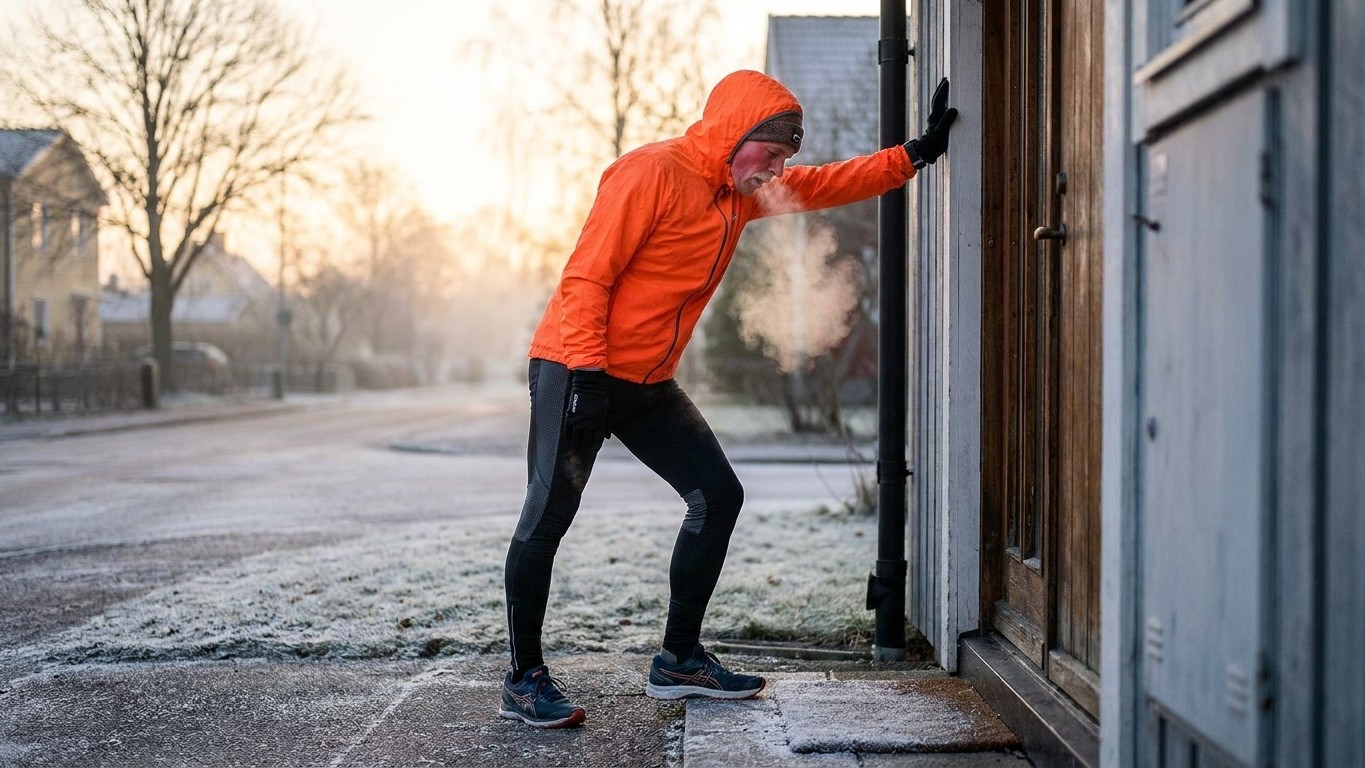
That tightening across your ribcage as you unlace your trainers isn’t a sign you’ve overdone it. It’s a textbook pattern of exercise-induced bronchoconstriction (EIB), a temporary narrowing of the airways that catches out recreational runners far more often than most people realise, and it has almost nothing to do with fitness levels.
The timing is the giveaway.
Key takeaways
- Why your chest only tightens after you stop running, not during—and what that timing actually reveals
- The surprising reason cold air is less to blame than the moisture loss in your airways
- How to tell if it’s unfitness or EIB, and why the distinction completely changes your training approach
Why the cold makes this worse, and why it’s not about willpower
The mechanism is more about moisture than temperature, despite what most runners assume. It’s not exactly clear what causes exercise-induced asthma. For a long time, the cause was thought to be cold air. However, recent studies found dry air to be a more likely culprit. Cold air contains less moisture than warm air. Breathing in cold, dry air dehydrates the air passages. This causes them to narrow, reducing air flow. Add in the fact that hard breathing pushes you into mouth breathing, and the problem compounds itself. When you exercise, your body demands more oxygen so you breathe faster and deeper. You usually breathe in through your mouth during exercise. Air that you breathe in from your mouth is dryer and cooler than when you breathe through your nose.
At a cellular level, this dehydration triggers a genuine inflammatory cascade rather than a vague discomfort. The primary mechanism involves airway dehydration and cooling during hyperventilation, leading to a hyperosmolar environment that triggers mast cell degranulation and release of inflammatory mediators like leukotrienes, histamine, and prostaglandins, causing bronchoconstriction. I find that detail genuinely reassuring for anxious runners: this isn’t “in your head” or a fitness failing. It’s your body’s chemistry reacting to an environmental stressor, in the same way skin reacts to a cold wind.
What surprises most people is how common this is even among those who consider themselves perfectly healthy. It can happen even without an asthma diagnosis, up to 20% of people in the general population (who may or may not have asthma) have exercise-induced asthma symptoms. Among competitive athletes the numbers climb even higher: studies suggest between 30% and 70% of elite athletes have exercise-induced asthma. Running outdoors in winter sits near the top of the risk list, alongside other cold-air sports. Some examples of cold weather exercise that may cause asthma symptoms include running outside in the winter months, ice skating, and playing hockey.
Distinguishing EIB from simply being unfit
The confusion is understandable, because both scenarios produce breathlessness. The distinguishing feature isn’t the discomfort itself but its shape over time. A body that’s merely deconditioned tends to recover steadily and predictably once you stop moving. EIB behaves differently: it can intensify after you’ve finished, rather than easing off immediately. The intensity pattern helps distinguish EIB from normal exercise responses – symptoms tend to worsen rapidly during the first few minutes after stopping exercise rather than improving immediately.
There’s also a secondary wave worth knowing about, one that catches people off guard hours later, long after they’ve showered and moved on with their day. Some people will have a second wave (“late-phase”) of symptoms 4 to 12 hours after stopping exercise. Late-phase symptoms are often less severe and can take up to 24 hours to resolve. If you’ve ever felt an odd tightness settle in mid-afternoon after a brisk morning run, this delayed reaction is the likely explanation, not a mystery ailment.
It’s also worth ruling out a lookalike condition, because the fix is completely different. Exercise-induced laryngospasm starts fast and goes away quickly when you stop exercising. Crucially, vocal cord problems usually cause trouble getting air into the lungs, while EIB typically causes trouble pushing the air out of the lungs. If your struggle is on the in-breath and resolves the second you stop, that’s a different conversation with your GP than one about airway inflammation.
What actually helps, beyond “just get fitter”
The most effective single change costs nothing and takes about ten minutes before you even start running. Before starting any physical activity, warm up for six to 10 minutes. A gradual build lets the airways adjust rather than being shocked by a sudden demand for cold, dry air. Covering your mouth and nose matters too, not for warmth alone but for humidity. Use a mask, scarf or gaiter to protect your airways from cold, dry air. National Jewish Health, one of the leading US respiratory hospitals, gives the same advice for anyone training through winter: wear a mask or scarf to warm cold air before breathing it.
Nasal breathing where possible also reduces the moisture loss that kicks off the whole cascade, since air passing through the nose arrives warmer and wetter than air gulped through an open mouth. None of this requires giving up winter running altogether. Regular exercise reduces exercise-induced bronchoconstriction severity, improves lung function, and decreases airway inflammation, so consistency actually works in your favour over a season, even if any single cold run still triggers tightness.
If the chest tightness is a regular fixture after every cold-weather session, rather than an occasional nuisance, it’s worth raising with your GP rather than assuming it’s simply a fitness issue to run through. Detailed medical history and clinical examination must be followed by basal spirometry and exercise challenge test for a proper diagnosis, and short-acting inhalers used ahead of a session can prevent the whole cycle before it starts, typically taken, as specialists note, fifteen to thirty minutes beforehand. Your ten-minutes-after chest isn’t a verdict on your training. It’s your airways asking for a bit more humidity than a British winter morning is willing to give them.
Sources : mayoclinic.org | oxygenadvantage.com