
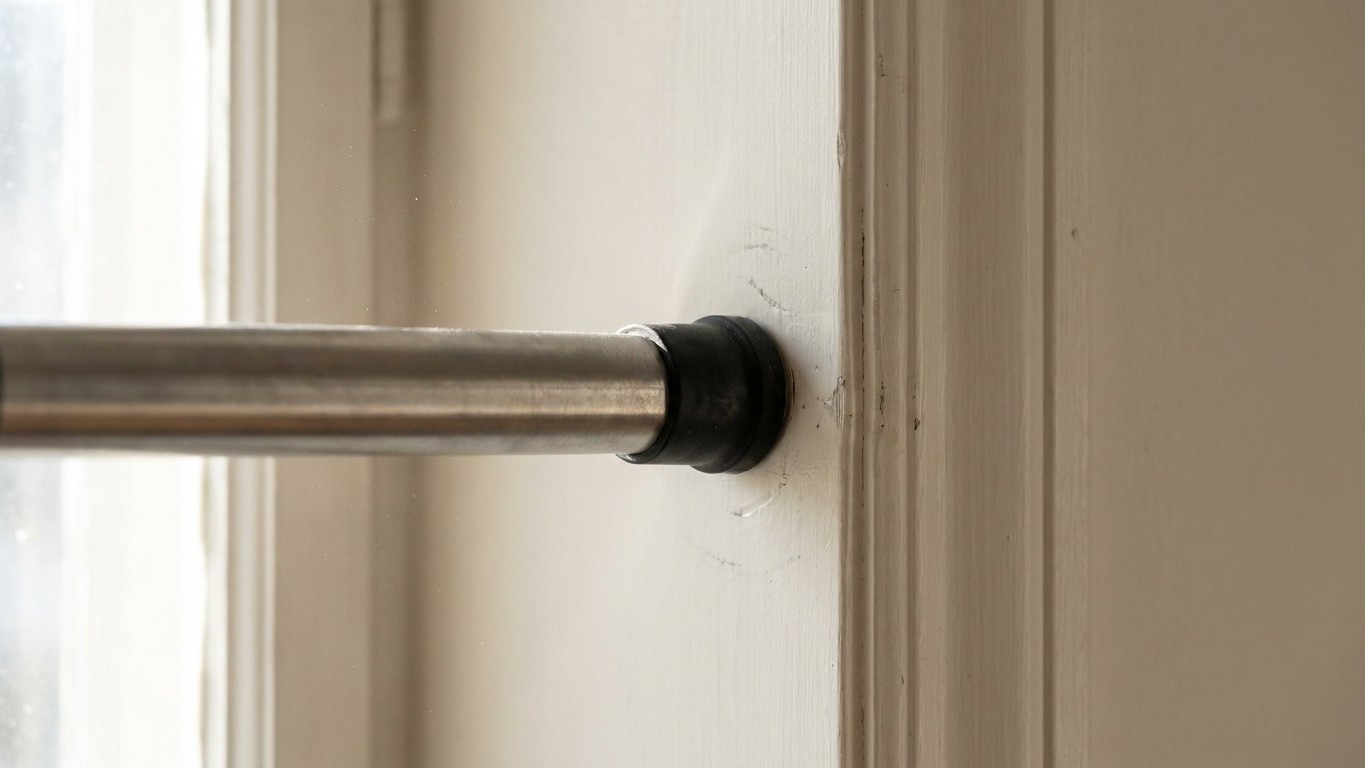
The bar didn’t fall. That’s the strange part. When I yanked down harder than usual mid-rep, the whole frame gave a sharp little judder, plaster dust drifted onto my shoulder, and for half a second I was convinced I’d be picking myself up off the hallway floor. What actually happens with these wedge-in bars has nothing to do with grip strength or rubber pads. It’s pure physics, and once you understand it, you either trust the thing completely or you take it down immediately.
Most doorway pull-up bars sold without screws work on a pressure principle rather than friction alone. Bars that use a tension-based setup without screws rely on friction and bodyweight balance, which limits their capacity, whereas screw-in or wall-mounted bars offer better stability and can safely hold more weight. The bar is slightly longer than the door opening, so once you twist or press it into place, it’s pushing outward against both sides of the frame with real force before you’ve even touched it. Your bodyweight doesn’t just hang from the bar. It increases the outward pressure at the contact points, which is exactly why the thing grips harder the moment you commit to a rep.
Key takeaways
- What happens when you pull down harder than expected on a wedged doorway bar
- The hidden cam mechanism that either saves you or fails catastrophically depending on orientation
- Why your doorframe might collapse even though the bar is rated for hundreds of pounds
The cam effect nobody mentions in the instruction leaflet
Some designs go a step further with a genuine cam or parallelogram mechanism at each end. Instead of a fixed wedge, the fittings rotate slightly under load, so pulling down actually increases the clamping force rather than loosening it. This is clever engineering, but it only works if you’re pulling in the direction the design intends. One long-running discussion among climbers described exactly this setup: a doorframe pullup bar that cams itself into the doorframe, producing a horizontal force on the frame itself, with users reporting loads well over 100kg being sustained without issue. But the same thread carried a pointed warning about orientation: with expandable in-frame bars, they can be used safely but they do need very careful attention, and because they expand by rotating the outer bar with respect to the inner one, you always need to make sure you’re doing pull-ups on the correct side, so that your pulling acts to tighten the grip rather than slacken it. Fit the bar back to front, and every rep is working against the mechanism instead of with it.
That’s what my too-fast pull actually revealed. The bar wasn’t sitting on the doorframe by luck. It was locked into a force relationship with the timber on either side, and a sudden jerky movement sends a spike through that system rather than a smooth, predictable load. Trahere, a fitness equipment site, puts the underlying issue plainly: your workout is often dynamic, and dynamic force spikes higher than your bodyweight, sometimes much higher, and even a small hop can create a sharp jolt at the top that can exceed the pull up bar weight limit the company printed, even if you weigh less than the rating. One fitness retailer specialising in this exact type of gear goes further with the numbers: physics tells us the peak force on the bar and frame can reach 1.5 to 2 times your bodyweight during the pulling phase, and a kipping motion multiplies that figure again. A twelve-stone person doing a lazy, controlled pull-up might be fine. The same person yanking explosively could be briefly loading the frame with the equivalent of eighteen or nineteen stone.
Why the frame gives before the bar does
Manufacturers rate their bars for hundreds of pounds, and those numbers are genuine, tested in controlled lab conditions. Your doorway wasn’t built to those standards, and it certainly wasn’t designed as gym equipment. A UK climbing forum thread on the subject captured the honest, slightly deflating answer to “how much would it take to break a well-built frame”: it depends, but for the trim, at worst you’re often looking at two little brad nails around 1.2mm thick and 15 to 30mm long holding things together, with the frame itself only being as strong as the wall framing behind it. The bar’s steel construction was never the weak link. Thin door casing, decades-old nails, or a hollow section of trim usually fail first, and when they do, there’s rarely any warning. As one contributor to that same discussion put it, describing a sudden failure: usually if it’s going to go, it goes with a bang, similar to the feeling of your toe suddenly parting company with a crucial microedge on a slab, absolutely no warning, and possibly dire consequences.
This isn’t theoretical scaremongering. Manufacturer safety documentation is unusually blunt about it: a doorway pull-up bar is not permanently fixed to the doorframe and can fall if incorrectly installed or if safe usage instructions are not followed every time it is used, and when using it, your full bodyweight is being held many feet above the floor, meaning any fall can cause serious or fatal injury. That’s not a reason to avoid these bars altogether. Thousands of people use them daily without incident. It’s a reason to treat the setup phase with more care than the box suggests.
Making the wedge trustworthy rather than lucky
A few habits make a genuine difference. Before buying, measure your trim width and door depth first, then press firmly on your door trim, since solid wood holds firm in a way that hollow or veneered trim simply doesn’t. Skip glass surrounds, sliding door tracks, or anything with a hollow core; several manufacturers explicitly state their bars are not suitable for hollow-core, glass, thin wood, or sliding doors. Once it’s up, resist the urge to launch straight into a full set. A staged approach recommended by fitness equipment specialists works well: after installation, don’t jump straight into max reps but test in stages, starting with a low load pulling down with your hands while your feet stay planted, then a half load hanging with one foot lightly touching the ground, then a full load dead hang for 10 to 20 seconds. If anything shifts, creaks, or leaves a fresh dent in the trim during that process, that’s your answer.
The genuinely counterintuitive lesson from my own jolt was that slow and steady isn’t just better for muscle tension, it’s better for the frame holding you up. A controlled dead hang and a smooth pull load the wood evenly across the whole contact surface. A sudden yank concentrates that same force into a fraction of a second, hitting the timber like a hammer blow rather than a steady push. If you’ve had any fall or impact from home gym equipment and you’re dealing with lingering pain, it’s always worth getting it checked by your GP rather than assuming it’ll settle on its own.
Sources : duonamic.com | bullbarfit.com