
Shoulder raises with a Resistance band are one of the most commonly prescribed “fixes” for swimmer’s shoulder, and one of the most commonly misapplied. Countless front crawl swimmers dutifully loop a band round a door handle, lift their arm out to the side or overhead for weeks on end, and wonder why the ache under the shoulder blade never quite goes away. The reason is straightforward: that exercise mostly loads the deltoid, while the actual culprit in the vast majority of swimmer’s shoulder cases is a chronically underworked muscle called the serratus anterior, sitting along the ribcage rather than on top of the shoulder.
Key takeaways
- A commonly prescribed exercise targets the wrong muscle entirely, leaving swimmers stuck despite months of effort
- The serratus anterior, not the deltoid, is the key to fixing most swimmer’s shoulder cases—and it requires a completely different approach
- Research shows consistent, varied strengthening work beats quick fixes, with 83% of swimmers becoming pain-free in just one year
Why the classic band exercise misses the target
Front crawl looks like an arm sport, but the shoulder blade does the real logistical work. During the glide phase, the upper trapezius, rhomboids, and serratus anterior show increased activity to stabilize and rotate the scapula upward to allow clearance of the humeral head. When that system falters, the picture changes noticeably during the stroke. During the pull-through phase, there was decreased serratus anterior activity with increased rhomboids activity, causing a net loss of scapular upward rotation and protraction in swimmers with impingement. That loss of upward rotation narrows the gap the rotator cuff tendons pass through with every stroke, which is where the pain signal usually starts.
A standard lateral or overhead band raise, the one most people default to at home, trains the deltoid and the superficial rotator cuff reasonably well. But it does very little to teach the shoulder blade to rotate and glide against the ribcage properly. Rounded shoulder posture and poor scapular control can also be due to serratus anterior weakness, and researchers have demonstrated a significant delay in serratus anterior activation in the painful shoulders of swimmers, resulting in an inability to stabilize the scapula against the thoracic wall causing scapular winging or scapular dyskinesia. Months of shoulder raises can leave that specific delay completely untouched, which explains why so many swimmers plateau despite consistent effort.
The muscle a good physio actually targets
The serratus anterior wraps around the side of the ribcage and anchors the shoulder blade against the chest wall, and it rarely gets attention in a generic gym programme. The main muscles of the upper body used when swimming front crawl are the latissimus dorsi, deltoids, trapezius, pectorals, biceps and triceps, and most gym-based programmes focus on developing strength in these muscle groups, yet there’s one muscle that often gets ignored despite playing a pivotal role in stroke efficiency and power. It works as part of a team rather than alone. The serratus anterior muscle works alongside the upper, middle and lower traps in what are known as ‘force couples,’ and when these relationships work together properly they provide stability for the shoulder and optimise scapula kinematics. A functional serratus does something quite specific for a front crawl swimmer: it helps the shoulder stay in position, with limited movement, during the catch phase.
This is exactly the pattern I hear about most often from physios who treat swimmers: the shoulder isn’t weak in the way people assume, it’s poorly sequenced. When the serratus tires or fails to fire, the upper trapezius steps in to compensate, which shrugs the shoulder blade upward instead of rotating it correctly. Swimmers need to avoid relying on the upper trapezius to do the work, because this muscle can easily switch on as soon as the serratus anterior fatigues and becomes overactive. This is one reason a band raise can feel like it’s “working” (you feel a burn near the neck and traps) while the actual mechanical fault stays uncorrected.
Retraining tends to start on land with closed-chain movements rather than isolated raises. A push-up plus is an effective intervention for strengthening the serratus anterior, and a version performed on the knees was more user friendly than the traditional version using less force while eliciting similar electromyography amplitudes. Overhead crawling patterns and single-arm plank work with active protraction of the shoulder blade are frequently added for the same reason, since research on overhead athletes has found that exercises performed with the arm elevated above the shoulder or eye level elicit greater activation of the serratus compared to exercises performed at or below the shoulder level.
Where band work still belongs, and what actually gets results
None of this means resistance bands are useless for swimmer’s shoulder. They just need to be aimed at the right job, alongside proper rotator cuff and scapular work rather than instead of it. A 2026 randomised controlled trial comparing 12-week band-based and weight-based prevention programmes in competitive swimmers found that the experimental groups demonstrated less imbalance compared to the control group, though neither preventive programme proved more effective than the other, and the control group showed a decrease in five isokinetic tests while swimmers who completed either prevention programme showed less imbalance in strength ratios. The type of tool mattered less than doing structured, varied work in the first place.
Real-world data backs this up too. A 2024 study followed high school and college swimmers, several of whom started with existing shoulder pain, and investigated the effects of preventative shoulder strengthening exercises, with twelve of the thirty-one swimmers reporting shoulder pain at the start, and after one year of performing a basic strengthening and stretching programme twice per week, ten of the twelve athletes were pain-free. That’s a strong result for a relatively simple, consistent approach, and it’s a good argument for patience over quick fixes.
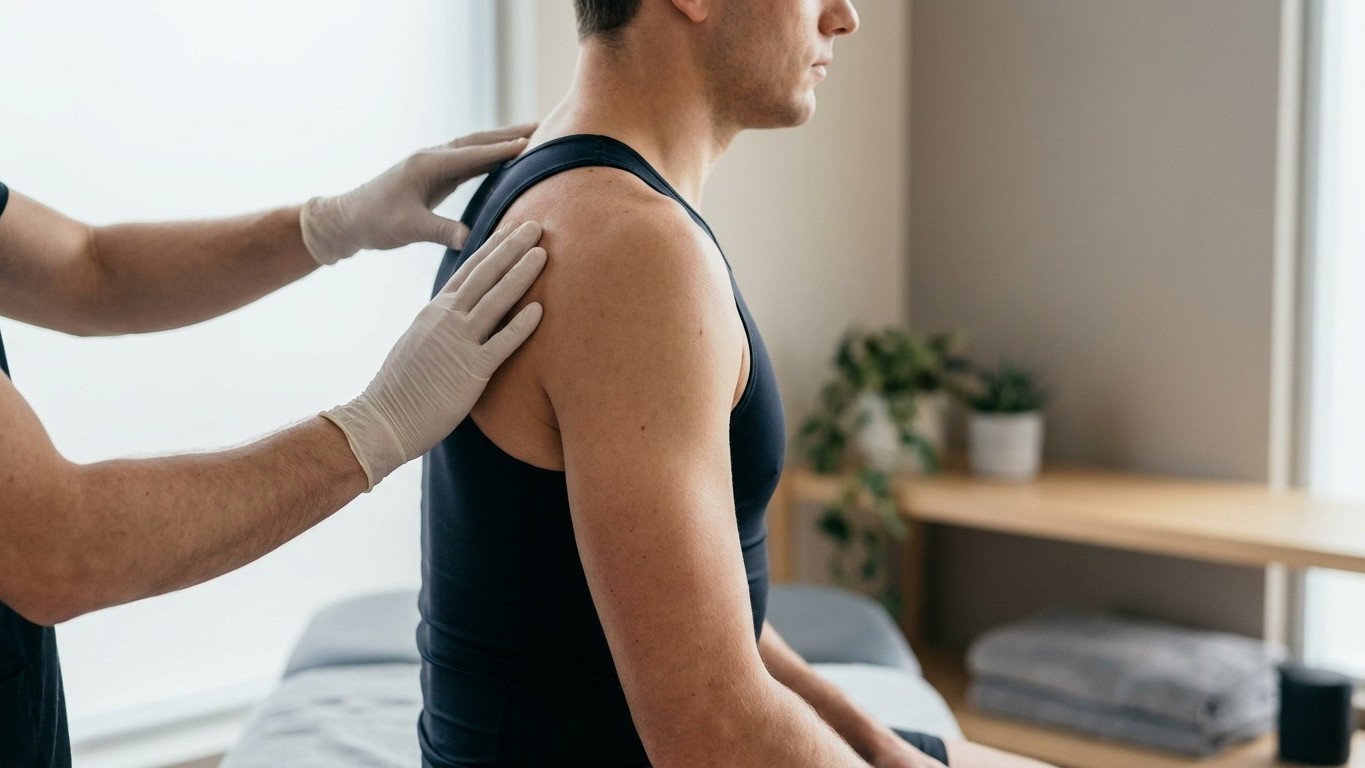
If you’ve been stuck on the same band exercise for months without improvement, it’s worth having a physiotherapist actually watch your shoulder blade move, ideally during a mock stroke or a wall slide, rather than assuming the fix lies in more sets or heavier resistance. A brief assessment can reveal within minutes whether your scapula is rotating and gliding as it should, something a mirror at home simply can’t show you. And if pain has been present for more than a couple of weeks, or is sharp rather than a dull ache, do see your GP or a chartered physiotherapist before changing your training load, since persistent shoulder pain occasionally has causes beyond muscular imbalance that need a proper clinical look.
Sources : pmc.ncbi.nlm.nih.gov | ncbi.nlm.nih.gov