
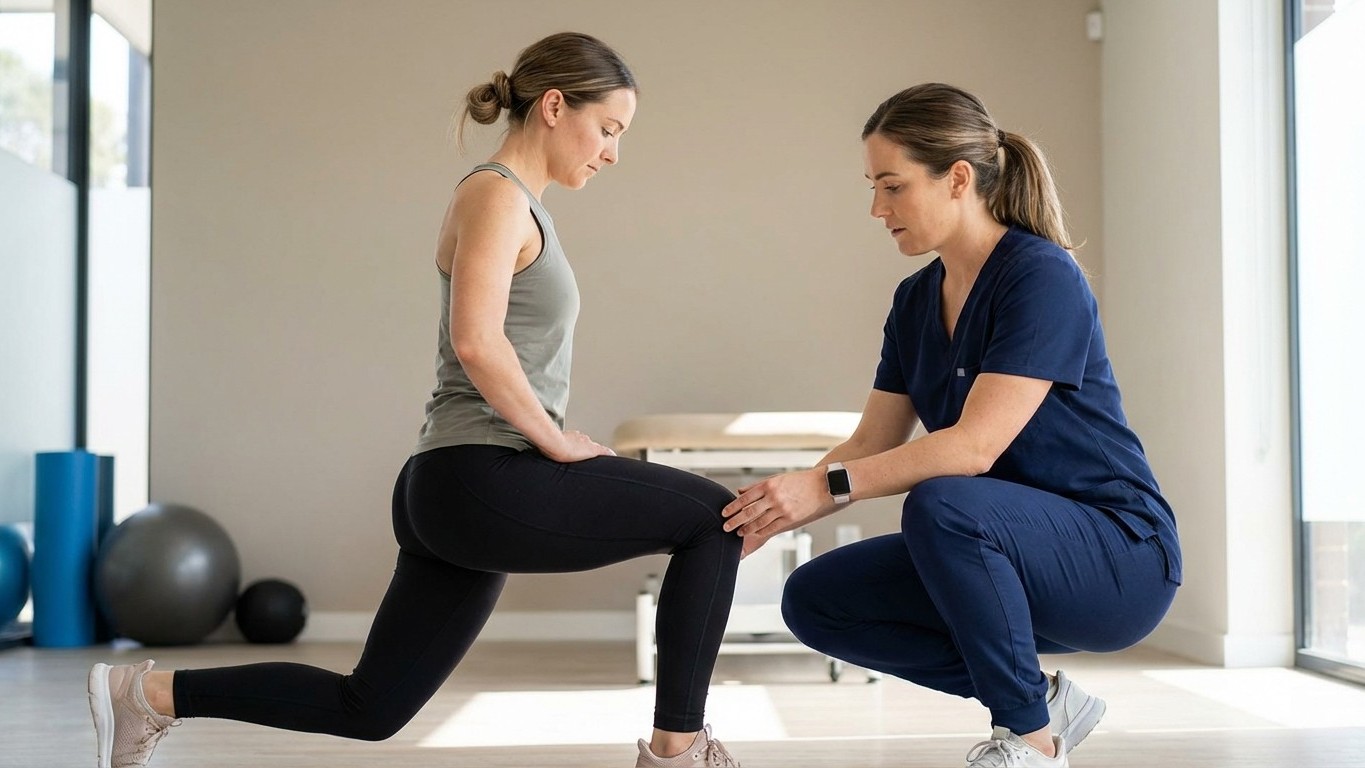
A year of daily reverse lunges sounds like a commitment worth celebrating. My physio had a different reaction when I finally booked an appointment about that persistent ache sitting just below my left kneecap. She watched me do three reps, tilted her head, and said: “You’ve been doing these every day?” The slight wince in her voice told me Everything.
Reverse lunges have a reputation as the “kinder” lunge variation, and physiologically, there’s truth to that. Stepping backward rather than forward reduces the shear force travelling through the knee joint, which is why they’re often recommended during rehabilitation programmes. The problem, as I discovered, isn’t the exercise itself. The problem is what a year of daily repetition, with subtle but consistent Technique errors, quietly does to the structures around your knee before you notice anything is wrong.
Key takeaways
- Daily repetition of the ‘safe’ exercise quietly accumulated micro-damage in tissues that never recovered
- The real culprit wasn’t the lunge itself, but a weak hip muscle causing a chain reaction of poor mechanics
- Switching to three sessions weekly with active recovery produced better results in six weeks than a year of daily work
What my physio actually saw
When she asked me to slow down and film my form from the side, the issues became visible almost immediately. My front shin was drifting forward as I descended, pushing my knee well past my toes under load. My trailing leg was barely bending at all, meaning I was essentially squatting on one leg rather than distributing work across both hip flexors and quads. And, perhaps most telling, I was using the same depth every single session without ever varying the stimulus or giving those tissues a proper rest.
She explained that the anterior knee pain I was experiencing had a name: patellofemoral syndrome, sometimes called “runner’s knee” in casual conversation, though it’s common in anyone who loads the knee repetitively without adequate recovery. The patella, your kneecap, sits in a groove and glides as you bend and straighten. When the muscles around it, particularly the vastus medialis on the inner quad, become fatigued or imbalanced relative to the outer quad, the kneecap starts tracking slightly off-centre. Do that a few hundred thousand times over twelve months, and the cartilage underneath begins to complain.
What surprised me most was that the pain didn’t start at the knee. According to my physio, the root cause traced back to my left hip. A relatively weak gluteus medius on that side meant my pelvis was dropping fractionally every time I stepped back, subtly rotating the femur inward and changing the angle at which everything below it was working. The knee was just where the stress collected.
The “daily” problem nobody warns you about
There’s a certain logic to doing something every day. Consistency builds habits, habits build results. And for skills like playing an instrument or learning a language, daily practice genuinely accelerates progress. But musculoskeletal tissue doesn’t work that way. Tendons, cartilage, and the synovial lining of joints need cyclical loading followed by recovery time to remodel and strengthen. The NHS guidance on exercise-induced injury consistently highlights overuse as one of the primary causes of lower limb problems in otherwise healthy adults.
What I had been doing, without realising it, was accumulating stress in tissues that never quite got the chance to adapt. The first few months had probably been fine. The months after that, the adaptations began lagging behind the demand. By month eight or nine, I was essentially maintaining an inflammatory state that never fully resolved between sessions.
My physio used an analogy I’ve thought about often since: bending a paperclip slightly, straightening it, and repeating. Any single bend is completely harmless. The paperclip breaks not because of one dramatic force, but because of accumulated micro-damage without recovery. Your connective tissue, she pointed out, is considerably more sophisticated than a paperclip, but the principle holds.
What I changed, and what actually helped
The rehabilitation process was, frankly, more interesting than the injury. Rather than abandoning reverse lunges entirely, we broke down the movement into its components. Single-leg balance work to address the hip instability. Targeted vastus medialis exercises (think terminal knee extensions) to correct the patellar tracking issue. Gradual reloading of the lunge pattern with deliberate attention to keeping the front shin more vertical and actually engaging the trailing leg.
The rest days mattered enormously. Moving from daily sessions to three times weekly, with active recovery on alternate days, made a noticeable difference within six weeks. Research published in sports medicine journals supports this approach: allowing 48 hours between loading sessions for the same muscle groups gives tendons and cartilage time to recover adequately, which actually produces better long-term strength adaptations than daily loading does.
She also introduced the concept of load variation, something I’d completely ignored. Varying the depth, tempo, and added resistance from session to session prevents tissue from adapting to one specific pattern of stress, which reduces the cumulative micro-damage that accumulates when you repeat exactly the same movement in exactly the same way, indefinitely.
The bigger lesson about “safe” exercises
The experience shifted how I think about exercise advice in general. Reverse lunges are genuinely well-tolerated by most people. They are lower-impact than forward lunges for the knee, and for many rehabilitation contexts, they’re a sensible choice. But “lower impact” is a relative term, not an unconditional one. Any exercise done with poor mechanics, at high frequency, without adequate recovery, can cause problems over time. The exercise being “good for you” doesn’t automatically make more of it better.
My knee is largely settled now, seven months on. The ache below the kneecap appears only when I skip my hip strengthening work for too long, which functions as a useful early warning system. The reverse lunge is back in my routine, three times a week, with attention to depth and form that I genuinely didn’t have before.
The question I keep returning to is how many people are quietly accumulating similar stress in joints and tendons right now, doing exercises they’ve read are “safe”, convinced that daily means optimal. If something that’s supposed to be good for your knees causes this kind of trouble under the wrong conditions, it raises an uncomfortable question about how well most of us actually understand the bodies we’re training.
Always consult your GP or a qualified Physiotherapist if you are experiencing persistent joint pain or discomfort during exercise.