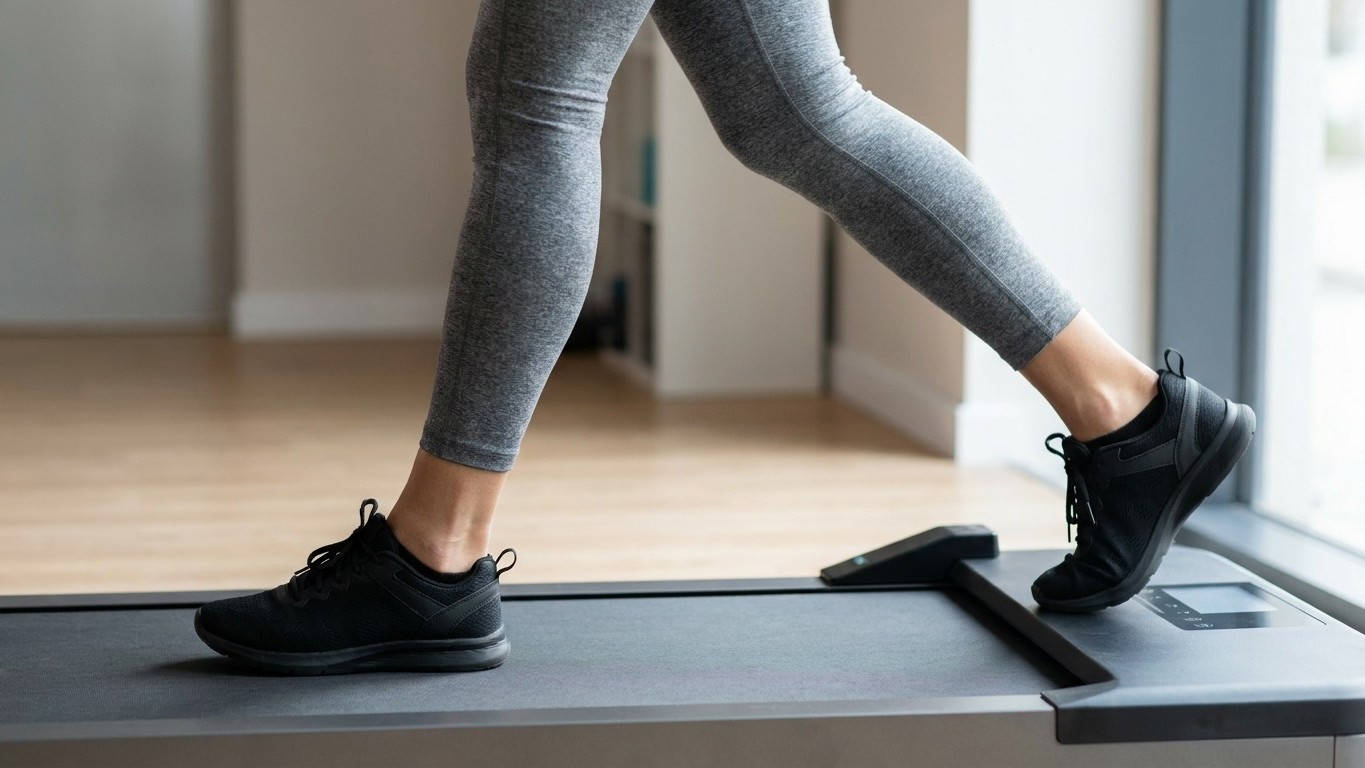
Regular treadmill users are, on average, walking and running on a surface that permanently sits at zero incline, and that single mechanical fact has real consequences for the muscles running along the back of the lower leg. The calf complex, specifically the gastrocnemius and the deeper soleus, depends on a full range of motion through the ankle to maintain its resting length. Flat-belt training, session after session, trains the ankle to operate in a shortened range. Over months, the muscle fibres and surrounding connective tissue begin to adapt to that restricted position, and what starts as mild tightness can quietly progress into a genuine loss of flexibility.
Key takeaways
- Your flat treadmill belt is training your ankle to operate in a dangerously compressed range—and your body is adapting to it
- Downhill descents demand the exact eccentric load your shortened calves can no longer handle
- A modest 2-3% incline and daily heel-drop exercises can restore calf length in 3-4 weeks
What actually happens inside the muscle
Muscle length is not fixed. It responds to the positions it is repeatedly placed in, a principle exercise physiologists refer to as “length-specific adaptation.” When you spend the majority of your training time on a flat surface, the calf is never required to lengthen under load the way it would when walking uphill, navigating uneven terrain, or descending a slope. The heel never drops below the toe. The ankle never fully dorsiflexes. And the body, being the efficient machine it is, sees no reason to maintain tissue length it is not using.
The result is a gradual shortening of the muscle’s functional range. This is not the same as a structural tear or an injury, but it is a genuine change in the tissue. The Achilles tendon, which anchors the calf to the heel bone, also becomes less compliant over time when not regularly placed under stretch. Tighter calves and a less elastic Achilles are a pairing that quietly increases the loading on the plantar fascia, which is one reason why many dedicated treadmill runners eventually develop heel pain or plantar fasciitis despite feeling otherwise fit and healthy.
Why spring slopes catch people out
The seasonal pattern is consistent. Winter months spent largely on flat treadmills are followed by spring walks in the hills, coastal paths with real gradients, or simply a return to outdoor running on roads that are never truly level. The lower leg, accustomed to operating within a compressed range of motion, suddenly meets demands it has not encountered in months.
Going uphill is actually the less problematic direction. The calf contracts concentrically and the ankle does not need to move far into dorsiflexion. The real exposure comes on the way down. Descending a slope requires the calf to lengthen under load, a movement called eccentric contraction, and if the tissue has lost flexibility, that eccentric demand can overload fibres that are no longer prepared for it. The soreness that follows a steep downhill walk, sometimes severe enough to affect walking the next day, is largely a product of that mismatch. Eccentric overload is also the primary mechanism behind Achilles tendinopathy, one of the more stubborn running injuries to rehabilitate.
There is a useful analogy here. A spring that has been kept partially compressed for months does not simply spring back to full extension the moment you release the pressure. It takes time, and forcing it risks permanent deformation. Calf tissue works along similar lines.
Restoring length before you hit the hills
The good news is that calf flexibility responds relatively quickly to targeted work, provided you approach it consistently and with some patience. Static stretching after sessions remains one of the most accessible interventions. A standing wall stretch with the knee straight targets the gastrocnemius, while bending the knee slightly shifts the emphasis to the soleus, which sits underneath and is often the tighter of the two muscles in treadmill regulars. Holding each position for at least 45 seconds, rather than the cursory 10-second stretch many people perform, appears to produce more meaningful changes in tissue length according to research on static stretch duration.
Adding incline to your treadmill sessions is an obvious but underused fix. Even a modest gradient of 2 to 3 percent meaningfully changes the ankle’s position during the stride cycle, reintroducing a degree of dorsiflexion that the flat belt eliminates. If your treadmill allows it, occasional sessions at 5 to 8 percent will begin to load the calf through a longer range and gradually reverse the shortening pattern.
Heel drops off a step deserve special mention. Standing with the ball of the foot on a step edge, allowing the heel to fall below the level of the toes under body weight, places the calf under a sustained loaded stretch that static floor stretching simply cannot replicate. Three sets of ten slow, controlled drops on each leg, done daily, can produce noticeable changes in ankle range of motion within three to four weeks. This is the same exercise physiotherapists commonly prescribe for Achilles tendinopathy, because restoring tissue length is part of the rehabilitation process for a problem that is, at root, a length-adaptation issue.
Incline treadmill training and a wider benefit you may not expect
Treadmill incline work does more than protect the lower leg. Research published in exercise physiology journals has found that walking at a 5 percent gradient at moderate speed can produce similar cardiovascular demand to running on the flat, with considerably less impact stress on the joints. For anyone managing knee discomfort or looking to vary training stimulus without increasing injury risk, that trade-off is worth knowing.
One detail worth keeping in mind: treadmill incline and real-world uphill walking are not perfectly equivalent in their demands. On a real slope, the body must also manage lateral stability, uneven footing, and changes in gradient, all of which recruit the ankle stabilisers and intrinsic foot muscles in ways a flat belt cannot replicate regardless of how steep the incline is set. Mixing even short outdoor walks into a predominantly treadmill-based routine remains the most complete way to maintain the full range of lower-leg function, not just calf length.
As always, if you are experiencing persistent heel pain, Achilles soreness, or calf tightness that is not resolving with stretching, do speak to your GP or a physiotherapist before increasing training load.