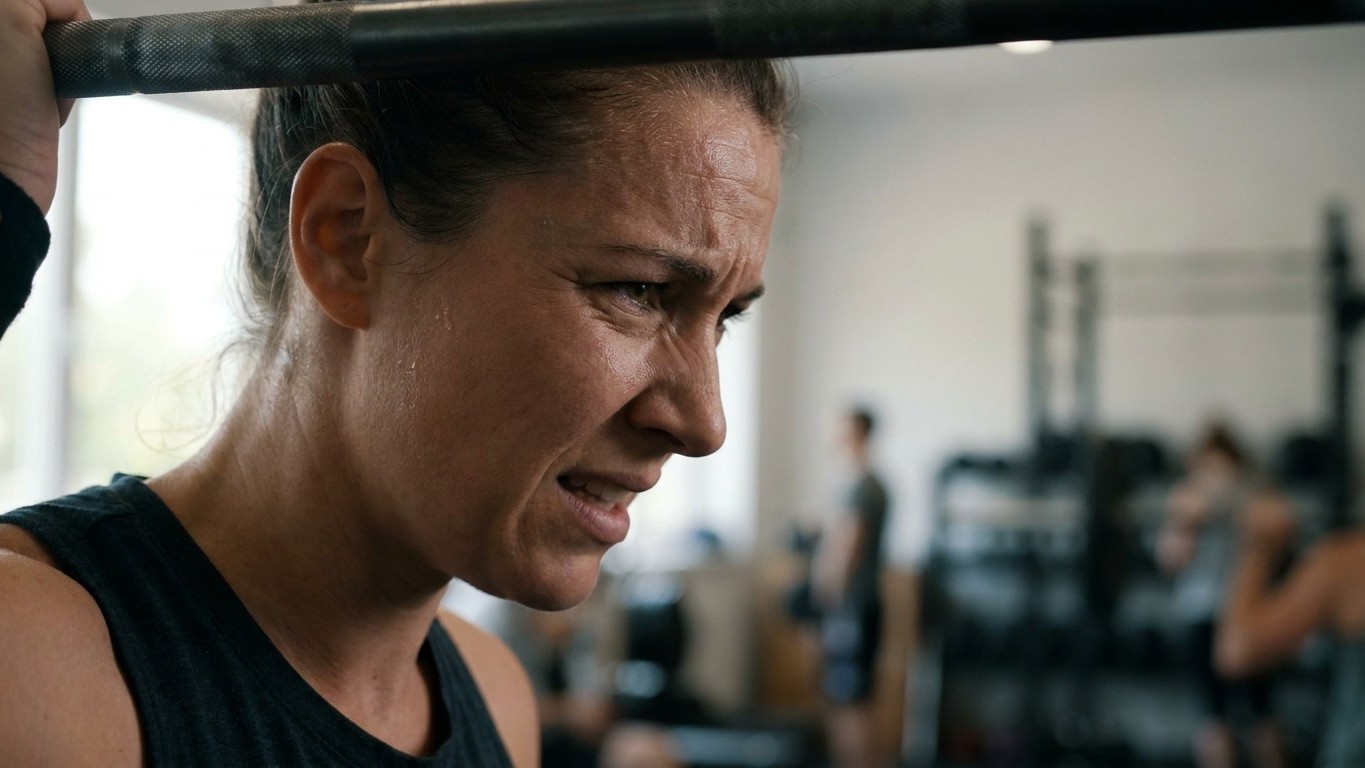
Holding your breath during a heavy overhead press feels like it gives you an extra edge, that split-second of core stability that helps the bar clear your head. But that reflex, known clinically as the Valsalva manoeuvre, does something less helpful behind your eyes: it sends a spike of pressure straight into the delicate structures at the back of your eyeball. For most people, most of the time, this is harmless. For a smaller group, especially those with short-sightedness or existing eye conditions, it’s worth understanding exactly what’s happening and why.
Key takeaways
- Holding your breath during heavy lifts creates a pressure spike in your eyes that mirrors straining during a cough—but far more intense
- People with high myopia face the greatest risk because their already-stretched retinas become vulnerable to sudden mechanical stress
- A simple breathing adjustment—exhaling steadily instead of locking your airway—removes the danger without sacrificing stability or strength
What actually happens when you grunt and brace
The Valsalva manoeuvre is simply the act of exhaling forcefully against a closed airway, essentially straining while holding your breath. Higher intraocular pressure has been reported during the Valsalva manoeuvre, in which air is forced against a closed windpipe and pressure increases in the chest, an action that occurs during coughing, vomiting, playing wind instruments and sometimes weightlifting. The pressure doesn’t stay confined to your lungs and abdomen. The accompanying rise in intrathoracic and intraabdominal pressure leads to a generalized increase in venous pressure, and ultimately in intraocular pressure via the episcleral veins draining the anterior segment of the eye.
The numbers involved are genuinely striking. One clinical study measuring intraocular pressure during different physical positions found the mean pressure while sitting was 16.4, standing 15.9, bending 20.4, lifting 17.6, and performing a valsalva 24.0, with only the pressure measured while bending and performing a valsalva significantly different from the pressure while sitting. Interestingly, that same research noted pressures were most elevated in response to performing a valsalva manoeuvre, though the changes measured under this condition were also the most variable, and whether this reflects actual physiologic differences between individuals or the difficulty of standardising the effort exerted is not clear. some people’s eyes tolerate the strain far better than others, and there’s no reliable way to predict which category you fall into without testing.
Separate research examining weightlifters found even bigger swings. According to reporting on eye pressure and gym training, lifting heavy weights, even with your legs, can cause intraocular pressure to increase by 26 mmHg even temporarily, though it returned to normal baseline levels within a minute post exercise after the weight was released. That’s roughly double a typical resting eye pressure reading, condensed into the few seconds you’re grinding through a lockout.
Why the overhead press is a particular offender
Not every exercise triggers this response equally. The movements that force your torso to brace hardest against a heavy load, and therefore push people into holding their breath instinctively, are the usual suspects. As one eye health resource puts it, deadlifts, squats, overhead presses, bench presses, and exercises involving breath-holding usually cause the highest eye pressure spikes. The overhead press sits near the top of that list because stabilising a loaded bar above your head demands rigid trunk pressure at exactly the moment your airway tends to seal shut.
For the vast majority of gym-goers, this transient pressure spike is a non-event. One ophthalmologist interviewed about the research put it plainly: whatever effects they are seeing are very short-term, and whenever you do this stuff, the pressure in the eye goes up, and when you stop, it goes down, with glaucoma taking a long time to develop, so these minor ups-and-downs in intraocular pressure are unlikely to cause any damage. That’s reassuring for healthy eyes doing occasional heavy lifts. The concern shifts, however, for people who already carry risk factors.
The eyes most vulnerable to this mechanical strain belong to people with high myopia, where the eyeball itself is elongated and the retina stretched thinner than usual. As one clinical explainer describes it, the eyeball is elongated, causing the retina to be stretched thinner than normal, and this structural thinning makes the retina more fragile and prone to tears, holes, and detachment. In a normal eye, a sudden pressure surge passes through without consequence. In a normal eye, this transient rise is usually tolerated, but in a highly myopic eye with a stretched retina, the sudden pressure surge can exert traction on already weakened retinal tissue.
From pressure spike to actual eye damage
The rare but well-documented worst-case scenario is called Valsalva retinopathy, a sudden bleed at the back of the eye triggered by that pressure surge. Medical literature describes it as typically a unilateral preretinal hemorrhagic retinopathy secondary to a sudden increase in intrathoracic or intraabdominal pressure, which leads to an increase in intraocular venous pressure, causing superficial retinal capillaries to rupture. One published case involved a young, otherwise healthy man who developed sudden vision loss after a weightlifting session. Doctors described how a 20-year-old male presented with sudden vision loss in the right eye after weightlifting, with initial visual acuity reduced to counting fingers at 10 cm and premacular hemorrhage confirmed by ocular ultrasound. He eventually needed surgery and, fortunately, recovered full vision. Cases like this remain uncommon, but they illustrate that the mechanism isn’t purely theoretical.
There’s also a longer-term angle worth flagging for anyone lifting heavy for years rather than months. A case-control study looking at people with substantial occupational lifting histories found a genuine dose-response relationship with retinal detachment risk. Researchers reported that for all indexes, the most exposed subjects showed an increased risk of retinal detachment compared with the unexposed, with dose-response relationships apparent. That study focused on repetitive manual lifting at work rather than gym training specifically, but the underlying mechanical stress on the retina is the same one triggered every time you grind through a heavy press without exhaling.
Breathing that protects your eyes without wrecking your lift
None of this means you need to abandon bracing altogether, your core still needs stability under a loaded bar. The fix is simpler than most lifters assume: breathe out steadily through the hardest part of the rep rather than sealing your airway shut. Practical guidance on this repeatedly points to the same few habits:
- Exhale in a slow, controlled stream as you drive the bar overhead, rather than holding air in against a closed throat
- Reserve a genuine, full Valsalva brace for true one-rep maximum attempts under supervision, not for everyday working sets
- If you have high myopia, glaucoma, a family history of retinal detachment, or you’ve had eye surgery, ask your GP or an optometrist whether heavy overhead work needs modifying
One resource summarising the exercise-eye pressure research noted how important proper breathing is when you lift since improper breathing and breath-holding increases eye pressure more, and that guidance holds up consistently across the studies. It’s a small technical adjustment, breathing out rather than locking your breath in, but it removes the single biggest driver of that pressure spike without costing you anything in terms of strength or stability.
If you wear a noticeably strong prescription, or you’ve noticed floaters, flashes of light, or a shadow creeping into your peripheral vision after a heavy session, that’s not something to wait out. Book an appointment with your GP or an optometrist promptly. Everyone else can simply remember the cue: exhale, don’t hold, and let your lungs do quiet work while your muscles do the loud work.
Sources : ncbi.nlm.nih.gov | ncbi.nlm.nih.gov