
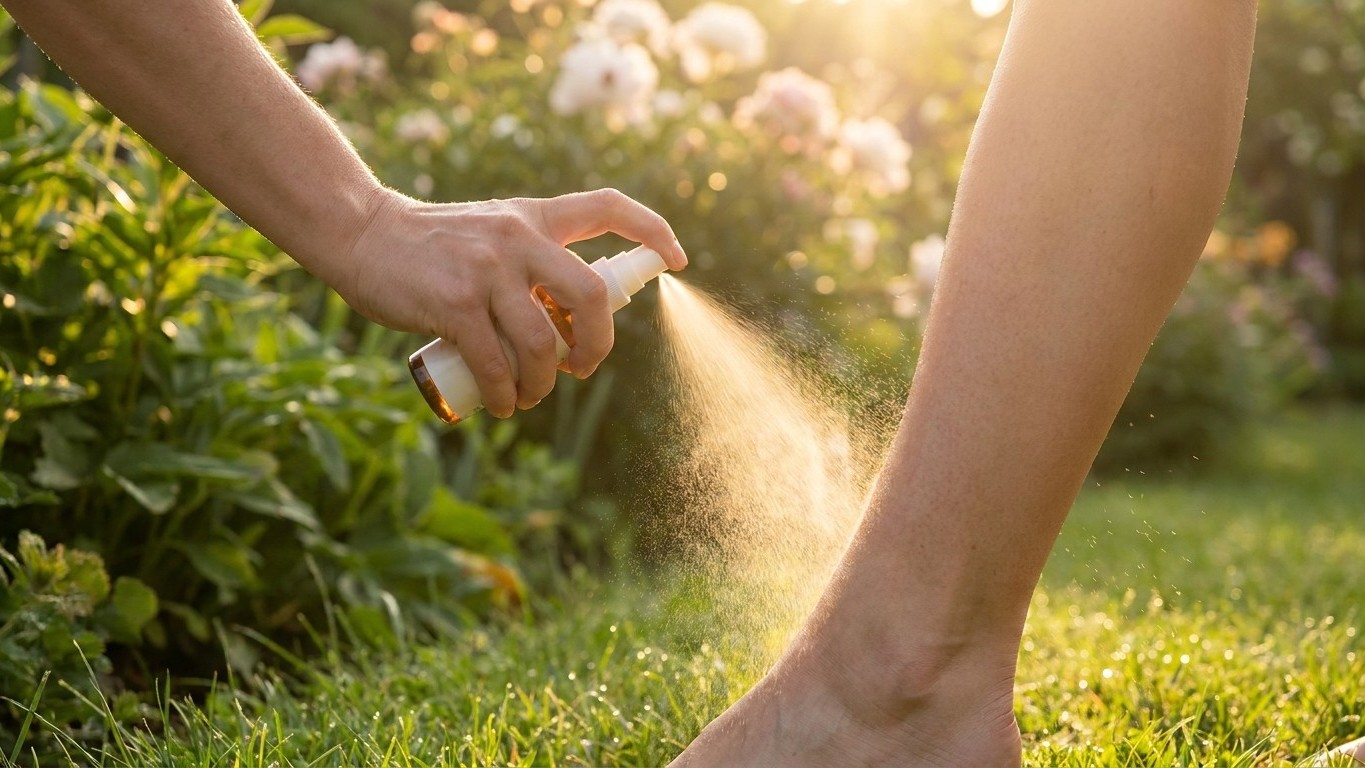
Reach for the repellent at 7am, not 10pm, if the tiger mosquito is the one you’re trying to outsmart. Unlike the common house mosquito that waits for darkness, Aedes albopictus hunts almost entirely in daylight, and the two hours or so after sunrise are one of its busiest feeding windows. Spray your ankles before an evening bike ride and you may well be protecting yourself against the wrong insect entirely.
Key takeaways
- Tiger mosquitoes follow a completely different schedule than the house mosquitoes we’ve learned to fear
- Studies from Asia, Europe, and North America show the same surprising pattern repeating over decades
- Our evening spray routines are based on outdated assumptions that don’t apply to this invasive species
A mosquito that broke the rules
Most mosquito species we grew up fearing, the ones that whine around your ears on a summer night, are crepuscular or nocturnal, timing their attacks for dusk and darkness. The tiger mosquito never got that memo. Although most mosquito species exhibit crepuscular activity by primarily host seeking at dawn and dusk, Aedes albopictus has been traditionally characterized as a diurnal or day-biting mosquito. A 2021 study published in PLOS Neglected Tropical Diseases, using human sweep netting and carbon dioxide traps across sites in New Jersey and Florida, set out to test exactly when this species actually feeds. The highest adult activity was observed at sunrise using human sweep netting, though it was not significantly different from solar noon and sunset.
That pattern isn’t unique to North America. Researchers reviewing decades of field studies from across Asia and beyond found a strikingly consistent story. In Hawley’s 1988 review of Ae. albopictus biology, field studies on diel activity patterns conducted in several countries in Asia reported peak blood feeding during daylight but rarely during the night hours. On the Chinese territory of Macao, Almeida et al. reported that Ae. albopictus displayed a bimodal biting peak activity during the morning and later afternoon. The same shape turned up on the other side of the world too: on La Réunion island, bimodal blood feeding activity for Ae. albopictus females was higher in the morning and afternoon peaks. Malaysian researchers found something similar again, with morning and evening twilight peaks for both sexes of Ae. albopictus.
What almost never turns up in these studies is heavy nighttime feeding. There’s one curious exception worth mentioning: in Japan, scientists recorded active Ae. albopictus behaviour through night-time nectar feeding between 2100 and 2130 hours, but that’s sugar feeding, not blood hunting. When it comes to biting people, the overwhelming weight of evidence points one direction. The vast majority of previously published investigations all incriminate Ae. albopictus as primarily diurnal.
Why we keep spraying at the wrong hour anyway
Old habits die hard, and mosquito habits die harder in our imaginations. Decades of associating bites with barbecues, camping trips and warm evenings have wired most of us to treat “mosquito time” as synonymous with nightfall. That assumption isn’t wrong for every species. Culex mosquitoes, the house mosquitoes, feed actively during sunrise and sunset and become busy after dark, so if you’re being bitten indoors after dinner, that culprit is probably a different insect altogether.
The tiger mosquito, though, plays by its own rules, and this mismatch between behaviour and public assumption has real consequences beyond a few missed bites. This has led to the acceptance of certain fallacies that have permeated vector control communities, particularly in the USA. Most modern adult mosquito control occurs after sunset in order to avoid negatively impacting day-flying insects like bees, butterflies, and other popular pollinators. Sensible for pollinators, but if the target species is out hunting in broad daylight, an evening spray programme is aiming at empty air. Health authorities in France have reached the same conclusion on the domestic front. Health authorities indicate a peak of aggressiveness at daybreak and dusk, and the French food and health safety agency ANSES specifies that it bites mainly in the morning and evening.
There’s a reason this species does so well hiding in plain sight, too. It has a fairly limited flight range, rarely moving more than 150 metres from where it was born, and its flight is silent, making it hard to spot before the bite lands. No warning buzz, no evening ambush you can brace for; just a sting on your calf while you’re watering the tomatoes at half past seven in the morning.
Timing your defence properly
None of this means you should abandon repellent for evening rides altogether, particularly if other species share your garden. But if the tiger mosquito is your main irritant (and across much of the UK and continental Europe now, it increasingly is) your priority window shifts firmly towards daylight hours. Aedes species, including Aedes aegypti and the Asian tiger mosquito, are daytime biters. French health guidance is specific about the practical steps: wear long, loose, light-coloured clothing, use skin repellents according to the label, and use mosquito nets where possible. The same guidance also nudges people towards restraint at the right moments, recommending that outdoor activity be scaled back during the hours the tiger mosquito is most active, rather than assuming darkness is the danger zone.
Since this species breeds in the smallest pockets of standing water, a plant saucer, a blocked gutter, an unemptied watering can, tackling the source matters just as much as timing your repellent. Around the home, empty, turn over, or cover any containers that hold water. Because of that limited flight range mentioned earlier, the mosquito biting you at breakfast most likely hatched within metres of your own back door, which is oddly reassuring: the fix is largely within your own garden fence, not somewhere out of reach.
If you take one practical change from all this, let it be a simple swap in routine: apply repellent before you step outside for that early jog or school run, not before an evening barbecue. Your GP or local pharmacist can advise on which repellent formulation suits your skin and circumstances, particularly for children or during pregnancy, and it’s always worth checking product labelling for age restrictions before use.
Sources : journals.plos.org | biorxiv.org