
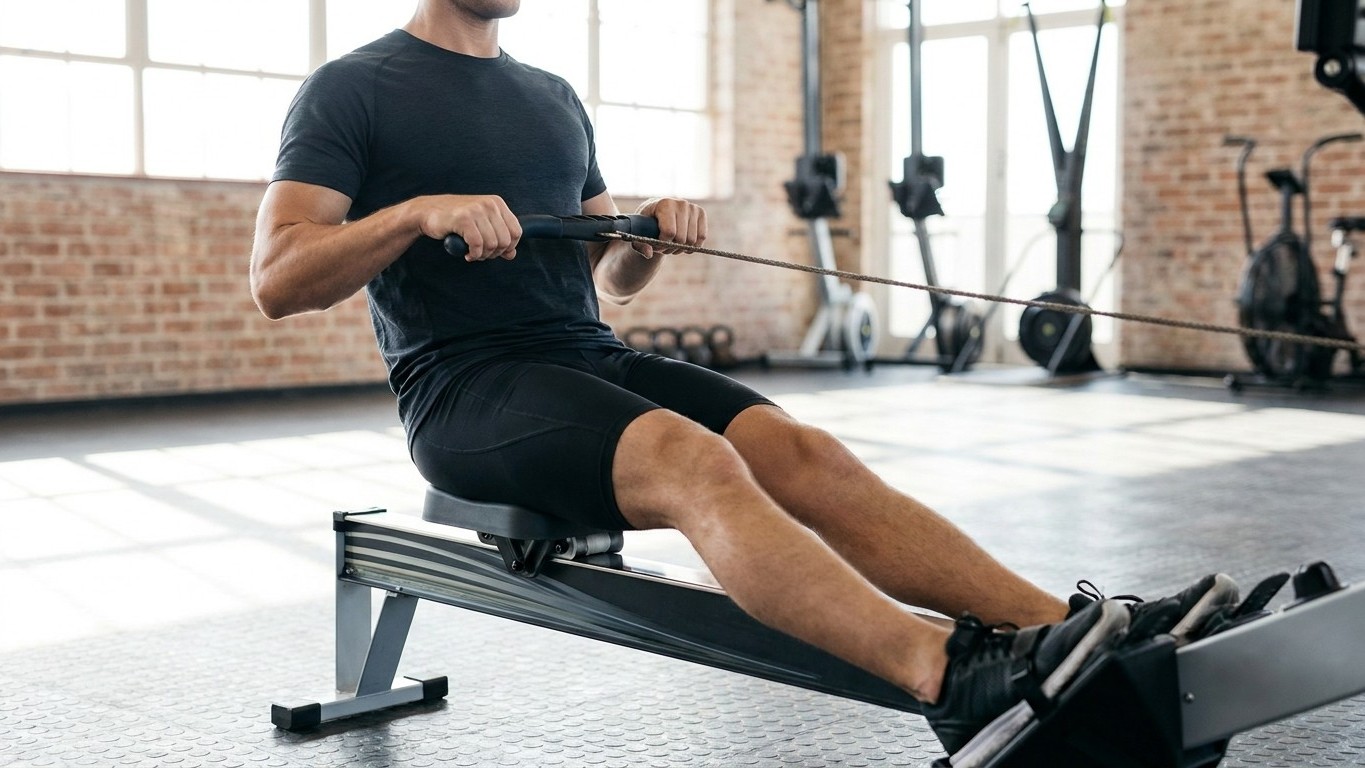
Yank the handle with your arms first and you’ve already lost the fight before the stroke even begins. Every ounce of power you’re supposed to generate from your legs gets redirected straight through Your Lower Back instead, and that’s precisely how so many rowing machine sessions end with a tight, aching lumbar spine rather than toned glutes and hamstrings.
The fix isn’t complicated, but it is precise. The body movement sequence is Legs, Body, Arms on the drive, and reversed as Arms, Body, Legs on the recovery. Get that order wrong, even slightly, and the load shifts from the muscles built to handle it (your quads, glutes, hamstrings) onto the ones that really shouldn’t be doing the heavy lifting at all.
Key takeaways
- 60% of rowing power comes from your legs, yet most people lead with their arms—here’s what that costs your spine
- There’s a specific three-movement sequence that separates effective rowers from those nursing chronic lower back pain
- A five-second bodyweight squat test reveals your actual injury risk before you touch the rowing machine
Why the order matters more than the effort
British Rowing puts numbers on this, and they’re worth remembering. Focus on your legs, because 60% of the power is from the legs, 30% from the body, and only 10% from the arms. Read that again: your arms, the part of the body most people instinctively rely on, are meant to contribute a tenth of the total force. Yet on a busy gym floor, watch ten people row and you’ll see at least half of them hauling on the handle with their shoulders from the very first inch of the stroke, torso static, legs barely bending.
The mechanics explain why this backfires. At the catch (the compressed, forward position), your shins should be roughly vertical, arms straight, body hinged forward from the hips. As the legs reach half their extension, the hip angle begins to open, and once the legs are fully extended and the back is vertical, the arms begin to draw the handle to the body, finishing about halfway up the torso. Skip that sequencing and pull with your arms while your legs are still folded underneath you, and you’re essentially trying to deadlift with your biceps. It doesn’t work on a barbell, and it doesn’t work here either.
The recovery, the return to the catch, gets ignored constantly, which is a shame because it’s where most of the injuries actually start. The recovery is initiated with the arms straightening, then the body pivots from the hips before the legs bend, flexing until the shins are vertical again. Rush this and bend your knees before the handle has cleared them, and you’ll find the handle has to travel awkwardly up and over, breaking the smooth rhythm of the stroke and creating unnecessary tension in the arms and shoulders. It’s a small technical slip with an outsized effect on how the whole stroke feels.
What a bent lower back actually costs you
This isn’t a minor aesthetic quibble about form. Research indicates that 30-50% of rowers will experience some type of lower back pain during a 12-month period, and low back injuries account for 15-25% of all rowing injuries. That’s a strikingly high figure for what’s often marketed as one of the gentlest cardio options in the gym.
The physiology behind it is fairly straightforward once you see it laid out. Lower back injuries from rowing occur when the muscles supporting the lumbar spine become strained, and these muscles can become injured if they’re relied upon to prop up a tired core or compensate for incorrect form. your lumbar spine was never designed to be the primary engine of the stroke. It’s a stabiliser, not a driver. Ask it to do the job your glutes and Hamstrings should be doing, and something eventually gives.
There’s also a fatigue factor that rarely gets mentioned outside sports science circles. World Rowing has highlighted a phenomenon researchers call spinal creep, where increased time on the rowing machine dampens the spinal tissues’ own protective reflex activity, associated with inflammation, meaning the lower back may become more vulnerable to injury through poor technique or inadequate recovery. Translated into plain English: the longer you sit slumped on the erg, the less your body warns you when your form is starting to slip. That’s exactly why a twenty-minute row done with sloppy sequencing in the final five minutes can undo the good work of the first fifteen.
Fixing it without overthinking it
You don’t need a rowing coach standing over you to correct this (though British Rowing’s technique guidance is genuinely worth a look if you want visual confirmation). Start by slowing everything down. Try legs-only rowing, where you row with arms straight and body fixed, using only the leg drive, which isolates the push and builds correct sequencing. Once that feels automatic, add the body swing, then finally the arms, layering the sequence back together piece by piece rather than trying to fix it all at once mid-stroke.
Pay attention to your pelvis, too, not just your knees and elbows. Biomechanical analysis has shown that pelvis position plays a crucial role in injury risk, with rowers advised to flex through the hips, rocking the trunk forward over the sit bones. If you find yourself rounding through the lower back rather than hinging cleanly at the hip, that’s usually the tell-tale sign the arms are trying to start the show too early.
One practical checkpoint recommended by sports Scientists studying rowing injuries: the ability to deep squat while keeping heels flat, shins relatively vertical and trunk upright demonstrates whether you can achieve a good catch position without overloading the lower back. If a bodyweight squat already feels like a stretch too far, that’s information worth acting on before you load up the resistance dial on the erg. It’s a five-second test that tells you more about your rowing risk than any split time ever will, and it’s free.
This article is for general information and doesn’t replace individualised advice. If you’re dealing with existing back pain or a previous injury, speak to your GP or a physiotherapist before starting or adjusting a rowing routine.
Sources : rp3rowing.com | litmethod.com