
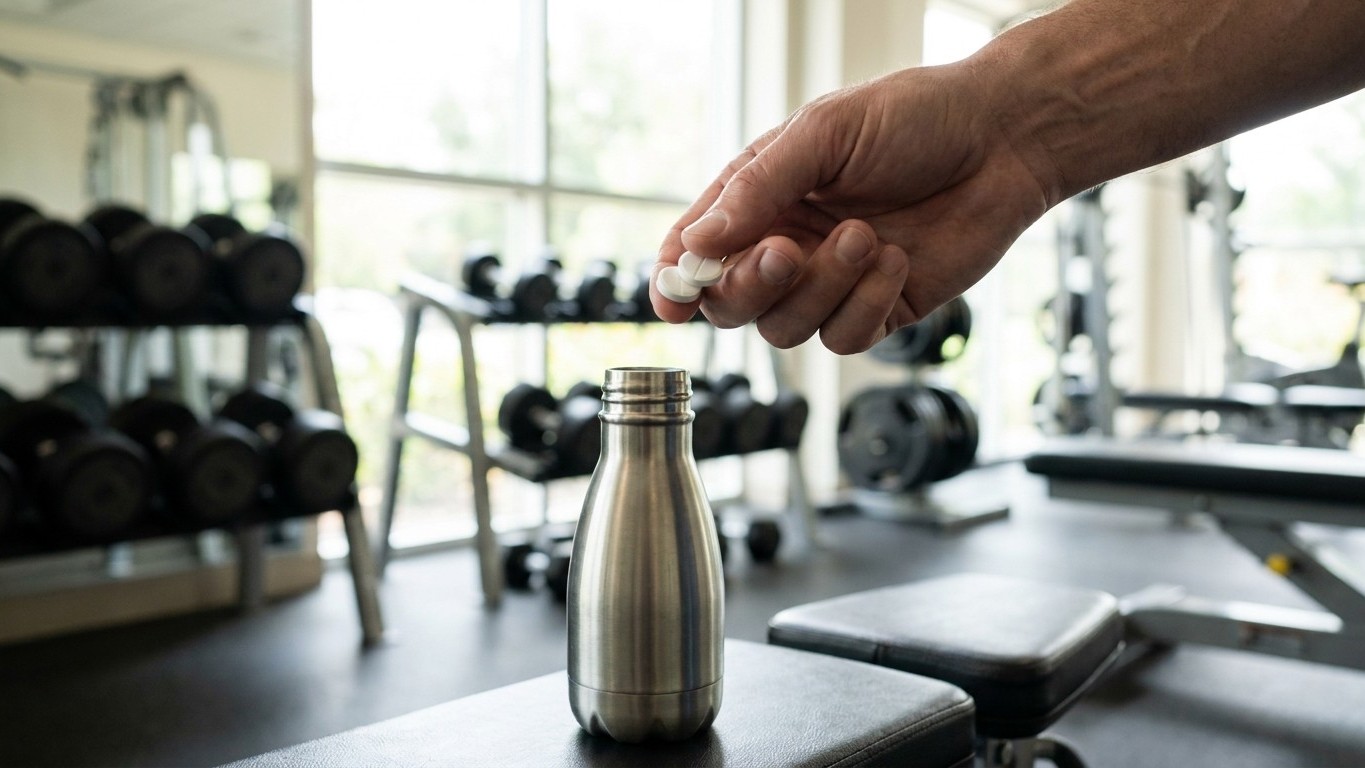
Reach for ibuprofen before your gym session to dodge the soreness before it even starts, and you may be quietly Sabotaging-your-muscle-growth/”>Sabotaging the very adaptation you’re training for. Research on resistance exercise shows that 1,200-mg ibuprofen taken before acute resistance exercise decreased both prostaglandin production and muscle protein synthesis 24 hours after exercise. The painkiller doesn’t just numb discomfort. It interferes with a biochemical signal your muscles need to rebuild stronger.
This isn’t a fringe finding from one small trial. A study examining ibuprofen and acetaminophen on muscle protein synthesis after high-intensity eccentric resistance exercise found that postexercise skeletal muscle fractional synthesis rate increased by 76% in the placebo group, but only 35% with ibuprofen and 22% with acetaminophen. In plain terms: both common painkillers cut the muscle-building response roughly in half, and the anti-inflammatory one hit harder.
Key takeaways
- Pre-workout ibuprofen reduces muscle protein synthesis by up to 65% compared to placebo
- NSAIDs suppress satellite cells for up to 8 days after intense exercise
- When you take the painkiller matters far more than whether you take it at all
Why blocking pain also blocks growth
Ibuprofen belongs to the NSAID family, and its whole mechanism of action explains the trade-off. NSAIDs work by inhibiting the activity of cyclooxygenase, a family of enzymes that regulate the formation of prostaglandins. That’s precisely why they relieve pain and swelling. But those same prostaglandins, particularly prostaglandin F2α and prostaglandin E2, are lipid mediators known to regulate protein turnover in muscle tissue. Switch off the inflammation, and you switch off part of the repair signal that tells muscle fibres to lay down new protein.
The effect goes deeper than protein synthesis alone. Follow-up work has demonstrated that NSAIDs inhibit satellite cell proliferation for up to 8 days after a bout of maximal eccentric exercise, and blunt anabolic signalling in the hours following a bout of unaccustomed high-intensity resistance exercise. Satellite cells are the stem cells that fuse into muscle fibres to help them grow and repair. Dampening their activity for the best part of a week is a much longer window of interference than most people taking a tablet before leg day would ever suspect.
A widely cited study from the Karolinska Institutet pushed this further over a full training block rather than a single session. Muscle strength was also impaired with high doses of anti-inflammatory drugs, though not to such a pronounced extent as the hypertrophy losses observed. The lead researcher noted that the findings matter precisely because the use of anti-inflammatory drugs is so globally widespread, not least amongst elite athletes and recreationally active individuals. This wasn’t a niche concern about occasional headache tablets. It was a warning about habitual, high-dose use woven into training routines.
Timing and dose change everything
Here’s where the story gets more nuanced than a blanket “never take ibuprofen near exercise” rule. Bone research offers a striking clue about why timing matters so much. In animals, inhibition of the enzyme responsible for prostaglandin synthesis by NSAIDs blocks the bone-formation response to loading when administered before, but not immediately after, loading. Human researchers tested exactly this in premenopausal women completing a nine-month weight-bearing exercise programme, comparing ibuprofen before exercise with placebo after, versus placebo before and ibuprofen after, versus placebo throughout. Taking the tablet before you move appears to matter more than taking it once you’ve finished.
Dose also seems to be a deciding factor. A review of the evidence concluded that large doses of NSAIDs used after high-intensity interval training can reduce muscle protein synthesis and hypertrophy, while lower doses have little to no effect on these factors. One trial using a more modest 400 mg on Training Days over six weeks found no meaningful difference in strength or muscle growth compared with placebo, whereas a study using the maximal over-the-counter dose of 1,200 mg daily significantly attenuated gains in quadriceps muscle mass compared with a low-dose provision of aspirin following 8 weeks of resistance training.
Age adds another twist. In older adults, the story looks reassuringly different: chronic use of ibuprofen or acetaminophen during resistance training did not compromise gains in muscle mass and strength, despite a reduction in acute protein synthesis, nor did it impair muscular and bone adaptations in older women. Some longer-term research in trained young men has even found the opposite of what you’d expect, with NSAID ingestion over 84 days of resistance exercise training increasing muscle cross-sectional area and volume gains compared to placebo. The picture, is genuinely mixed rather than uniformly damning, and researchers themselves openly debate how to interpret it.
What to actually do about it
None of this means ibuprofen is off-limits if you’re nursing a genuine injury or need it for an unrelated condition. Your GP’s advice on managing pain always takes priority over gym optimisation. But if you’re someone who pops a tablet purely as a pre-emptive strike against soreness before a routine session, the evidence suggests you’re trading a small, mostly psychological comfort for a measurable dent in the training adaptation you’re chasing.
The practical takeaway is about pattern, not panic. Occasional, low-dose use around an isolated hard session is unlikely to derail your progress, particularly if you’re older or the dose stays modest. The concern is habitual high-dose use, especially before rather than after training, sustained over weeks of a programme where every session is meant to compound on the last. If soreness is genuinely limiting your ability to train, that’s worth flagging to your GP or a physiotherapist rather than solving with a daily tablet, since delayed-onset muscle soreness typically settles within 48 to 72 hours regardless.
One detail worth remembering next time you’re tempted to reach for the packet before warming up: the research consistently points to timing as the lever that matters most, not just whether you take the drug at all. Save it for afterwards, if you need it, rather than before.
Sources : journals.physiology.org | ncbi.nlm.nih.gov