
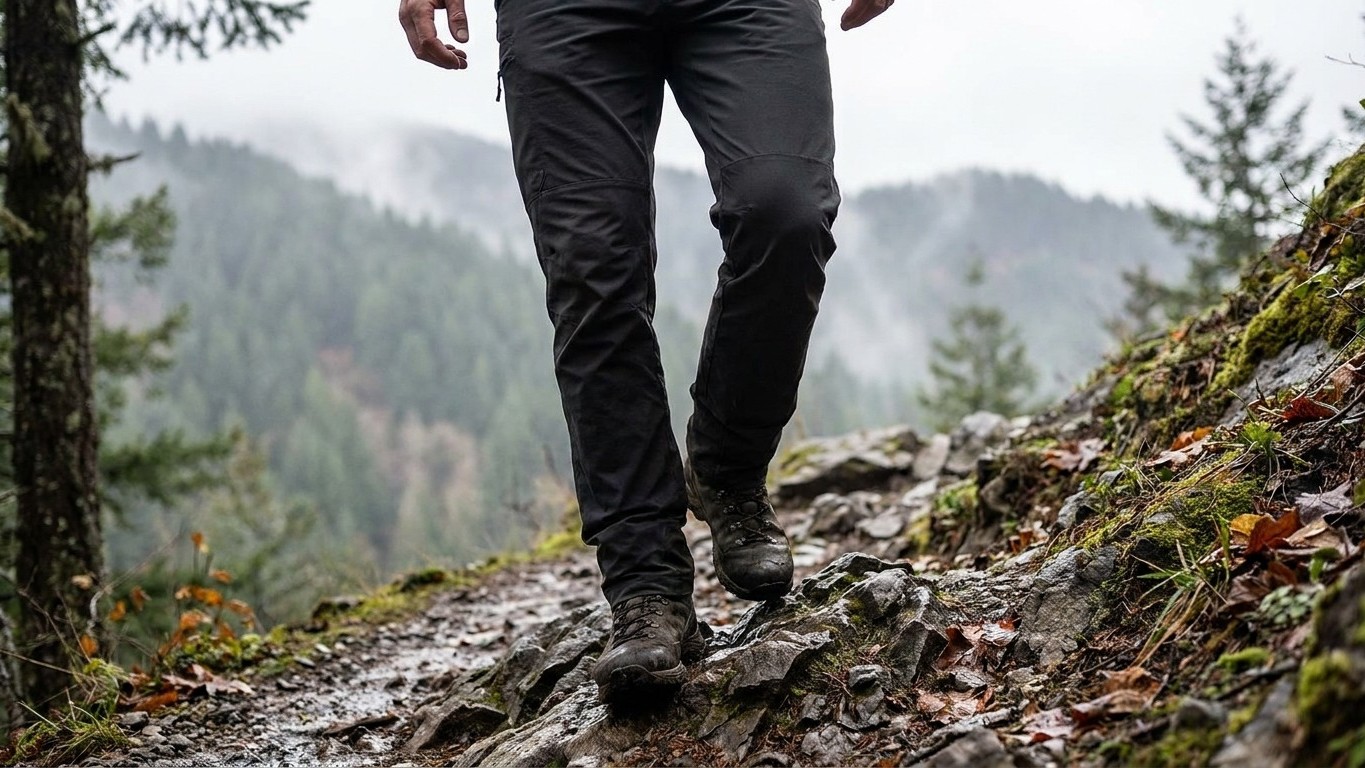
Runners and hikers often brace for the uphill slog, saving their energy for what they assume will be an easy freewheel back down. Their knees tell a different story. Biomechanical studies show that descending a slope places substantially greater mechanical demand on the knee than climbing the same gradient, and that mismatch between expectation and reality is precisely why so many people end a hike with sore, swollen or clicking knees rather than tired lungs.
Key takeaways
- Your muscles work fundamentally differently on descents—they brake against gravity instead of pushing, placing eccentric stress that uphill walking never demands
- The kneecap absorbs crushing force during downhill walking, concentrating pressure at the patellofemoral joint where ‘hiker’s knee’ develops
- Fatigue from descents doesn’t just cause pain; it measurably reduces leg coordination and balance, raising fall risk on the very terrain that needs your steadiest footing
Why the knee does most of the braking
Going uphill, your leg muscles mostly shorten as they contract, a concentric action that’s mechanically efficient and relatively kind to joints. Coming down, the story flips entirely. When you walk uphill, your quad contracts concentrically because the muscle shortens each time you step, but when you walk downhill, your quad contracts eccentrically because the muscle lengthens each time you step, requiring a lot of control. That eccentric lengthening under load is what makes descents so punishing: the quadriceps aren’t just moving the leg, they’re acting as a brake against gravity with every single step.
A 2020 biomechanics study using musculoskeletal simulations quantified exactly how much extra work this braking involves. Downhill walking overall induced more (32% at −9°, 19% at −6°, and 13% at −3°) eccentric contractions in lower limb muscles compared to level walking, whereas uphill walking led to eccentric contractions similar to level walking at low grades and only 17% more at high grades. a gentle uphill stroll barely troubles your muscles differently to flat ground, while even a modest downhill grade forces them to work substantially harder in a way that’s known to cause muscle damage and soreness.
The knee joint itself bears the brunt of this. Among all the lower limb muscles, the knee extensors had the largest increases in eccentric contraction during downhill walking. And it isn’t only the muscles doing extra work. Sloped walking induces greater peak joint moments and joint compression forces in the hip, knee and ankle joints compared to level walking. Researchers have also found a neat division of labour between the two directions of travel: the ankle joint generates the most positive work in uphill walking, whereas the knee joint generates the most negative work in downhill walking. Your ankle does the pushing on the way up; your knee does the catching on the way down, and catching is harder on cartilage than pushing.
The kneecap takes the pressure personally
This extra loading tends to concentrate behind the kneecap, at the patellofemoral joint, where the patella glides against the femur. Physiotherapy clinics that treat hikers regularly describe how quadriceps muscles must work overtime to control your descent, while your kneecap experiences increased pressure against your thighbone, a combination that primes the area for the dull, aching pain many walkers recognise as “hiker’s knee” (patellofemoral pain syndrome). One US clinic’s summary of the difference between the two directions puts it plainly: walking downhill creates up to three times more force on your knees than walking uphill, making it particularly challenging for those with developing knee issues. That’s a striking multiplier for what feels, subjectively, like the “easy” half of the walk.
There’s a less obvious consequence too, and it has nothing to do with pain. Sustained eccentric loading on a descent appears to blunt the sensorimotor systems that keep you steady on your feet. In a treadmill study simulating a 20-degree decline, thirty minutes of downhill walking measurably leads to a decline in leg dexterity and to a reduction in postural ability in the anterior–posterior direction, even though it barely raised participants’ heart rate or perceived effort. The researchers noted this matters because prolonged eccentric muscle activity, as experienced during downhill walking, might interfere with proprioceptive mechanisms and, therefore, contribute to heightened fall risk in descents. Tired, achy knees near the end of a long descent aren’t just uncomfortable, they may genuinely be less coordinated.
What actually helps
The good news is that most of this strain is modifiable rather than inevitable. Strengthening the muscles around the hip changes how much work the knee has to do on its own. Physiotherapists who specialise in hiking injuries point out that engaging your gluteal muscles as you descend a slope will decrease the force exerted by the quadriceps, which will decrease the compression force pulling through the patella. That’s a genuinely useful cue for the trail itself: think “glutes” rather than “brakes” on the way down.
Beyond glute activation, a few practical habits make a measurable difference:
- Shorten your stride on descents rather than lengthening it, which reduces the braking force through each landing.
- Use trekking poles to redistribute some load away from the knees and onto the arms and shoulders.
- Build eccentric quad strength off the trail (slow, controlled squats or step-downs) so the muscle can absorb load without transferring excess stress to the joint.
- Take short breaks on long descents, since fatigue is when both pain and the loss of leg dexterity tend to creep in.
None of this means downhill walking is dangerous for healthy joints, most people manage thousands of descents a year without lasting harm. But it does explain why so many hikers are baffled to find their knees complaining more on the way down than the way up ever managed. If knee pain persists beyond a day or two of rest, becomes sharp rather than achy, or comes with swelling or instability, it’s worth getting it looked at by your GP or a physiotherapist rather than assuming it will simply walk itself off.
Sources : pmc.ncbi.nlm.nih.gov | ncbi.nlm.nih.gov