
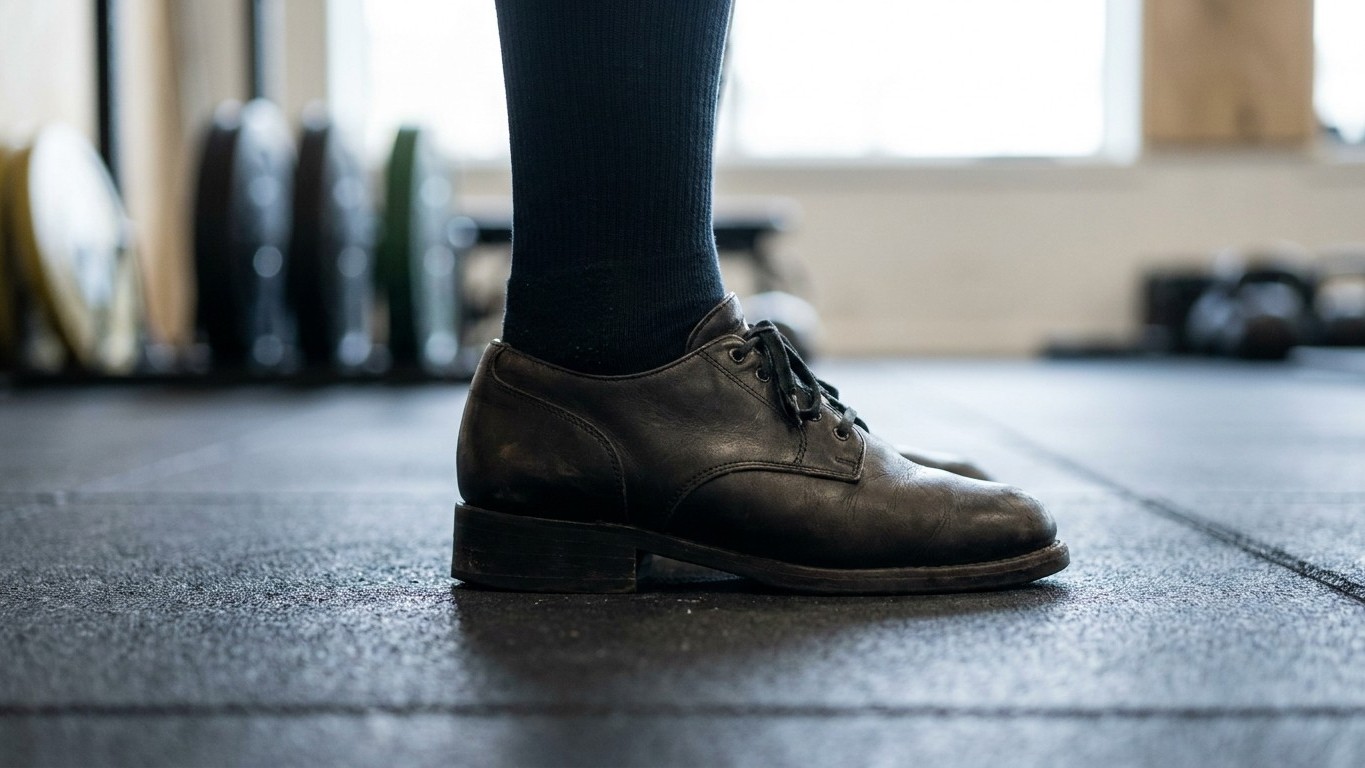
The knees cave inward. That’s what fifteen seconds of slow-motion footage showed me, filmed from behind as I racked up a set of back squats in my usual road-running trainers. My coach didn’t say a word for a moment. She just rewound it and played it again, pointing at the exact moment my heels lifted a centimetre off the platform as I hit depth. Years of unexplained knee soreness suddenly made sense.
Running Shoes Are built to do one job brilliantly: absorb repeated vertical impact as your foot strikes the ground thousands of times over a run. That soft, springy midsole is a genuine asset at 12km/h on tarmac. Under a loaded barbell, moving slowly and bearing far greater force through a static base, that same cushioning becomes a liability. The foam compresses unevenly under load, and every small shift gets amplified up the chain into the ankle, knee and hip.
Key takeaways
- A coach’s slow-motion footage exposed what years of knee pain couldn’t explain—and it all came down to shoe choice
- Research reveals how soft midsoles create instability patterns that load directly onto your knees under a barbell
- The solution isn’t expensive—it’s about understanding what your feet need to do when they’re bearing heavy load
Why a spongy sole sabotages a stable squat
Physiotherapists who work with strength athletes describe the mechanism in fairly blunt terms. Running shoes are comfortable, but not as stable for the demands of squatting under load. A firmer, flatter base minimises the opportunity for lateral movement in the knees, which helps reduce one common driver of knee pain during heavy lifting. Squatting in trainers is a bit like trying to do calf raises on a trampoline. The ground itself is unreliable, so your body improvises, and that improvisation usually shows up as the knees drifting inward, a pattern known as dynamic valgus.
This isn’t just gym folklore. Research modelling barbell squat biomechanics has found that people with rearfoot instability show genu valgus and greater medial knee contact force, which may increase the risk of musculoskeletal and soft tissue damage such as meniscus wear during barbell squats. The load and range of motion through the hip, knee and ankle were all significantly larger in those with unstable rearfoot mechanics, and the effect grew more pronounced as the weight on the bar increased. A soft, compressible heel effectively recreates that same instability, even in someone with structurally normal feet, because the surface underneath the foot is no longer trustworthy.
There’s a second layer to this. Separate research comparing footwear during squatting has shown that weightlifting shoes provide lateral stability that running shoes lack, thanks to a wider base and a less flexible midsole, whereas running shoes are cushioned and absorb energy during exercise. Every joule of force your shoe soaks up in compression is a joule that isn’t being transferred efficiently through your legs into the floor and back up as upward drive. Your body compensates for that energy leak somewhere, and the knee joint often takes the hit.
What a raised, rigid heel actually changes
The elevated heel on a proper weightlifting shoe isn’t cosmetic. The elevated heel was added to weightlifting shoes decades ago after the squat became the preferred catching position for the clean and snatch, and it was found to allow the lifter to catch the barbell lower with improved balance. Practically, that heel wedge reduces how much your ankle needs to bend forward to reach depth, which matters enormously if your ankle mobility is average or below, as most desk-bound adults’ is.
A comparative study looking at squat kinematics found that peak ankle flexion was affected by weightlifting shoes as expected given the raised heel, and this made it easier for participants to maintain proper squat form, with the thighs and hips closer to vertical, less forward lean, and the knees tracking more easily over the toes. Participants in that same research reported that squats felt easier to perform in weightlifting shoes than in running shoes. None of that guarantees good technique on its own, obviously. A rigid sole won’t fix a hip that refuses to internally rotate, or a lifter who’s never been taught to brace properly. But it removes one variable that was actively working against you.
It’s worth being honest about the limits of the evidence here too. A review of the literature on weightlifting shoes concluded that increased knee flexion as a result of the raised heel is only weakly supported by evidence, and a more upright trunk isn’t supported at all, though weightlifting shoes have been shown to improve the perception of stability without necessarily improving force production. In plain terms, the shoe changes how confident and grounded you feel far more reliably than it changes your raw output on the bar. For someone whose knees ache after every session, that psychological steadiness matters just as much as the millimetres of ankle range it buys you.
Getting it right without overspending
You don’t need to walk out and buy the priciest lifting shoe on the shelf. A flat, hard-soled shoe, or even lifting barefoot on a suitable gym floor where that’s permitted, achieves much of the same stability benefit. Peer comparisons between flat-soled and heeled rigid shoes have found little difference in knee pain outcomes between a flat shoe and a heeled one, since both offer a rigid base to lift from. The heel wedge is really about depth and ankle comfort, not knee protection specifically, so anyone with restricted ankle mobility gets more out of it than someone who already squats ATG with flat feet.
Since swapping shoes, my knees have stopped complaining after leg day, and I no longer feel that vague wobble at the bottom of a heavy rep. Filming yourself from behind, even on a phone propped against a plate, will tell you more about your squat in thirty seconds than months of guessing ever could. If knee pain persists despite fixing footwear and technique, it’s worth getting it properly assessed by a physiotherapist or your GP rather than assuming a shoe swap alone will resolve it. Some knees need more than firmer ground beneath them.
Sources : ncbi.nlm.nih.gov | pubmed.ncbi.nlm.nih.gov