
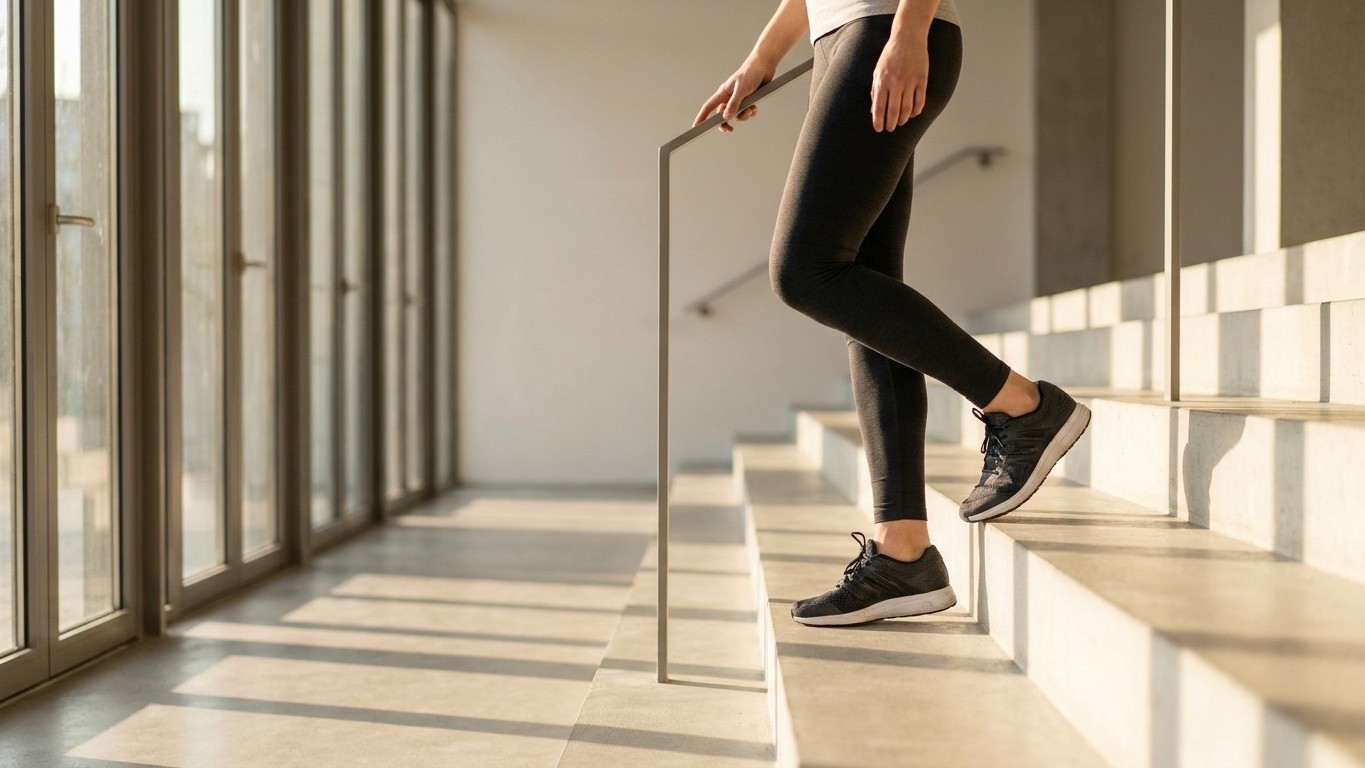
Walking down stairs works your quadriceps harder than walking up them. That sounds backwards, but it’s basic muscle physiology: descending is an eccentric exercise, meaning your muscles lengthen under load rather than shorten. A physiotherapist explained this to me after I mentioned I always took the lift down from my third-floor flat and saved my stair-climbing for the way up, thinking that was the only bit that counted. I’d had it the wrong way round for years.
Here’s what happens biomechanically. When you climb up, your quads, glutes and calves contract and shorten to push your body upward, that’s concentric work, the kind most people associate with “proper” exercise. When you go down, those same muscles are still firing, but now they’re lengthening as they control your descent and absorb the impact of each step. Your quadriceps act like a brake, resisting gravity rather than fighting it. This eccentric loading places more mechanical tension on individual muscle fibres than concentric movement does, which is part of why downhill walking or running tends to leave you more sore the next day than the uphill equivalent, a phenomenon well documented in exercise science literature on delayed onset muscle soreness.
Key takeaways
- Descending stairs works your muscles differently than ascending—and science suggests it might matter more than you think
- A physio explained why taking the elevator down was costing you a major strength-building opportunity you didn’t know existed
- The movement that feels easiest could be doing the hardest work at the tissue level
Why the descent matters more than I realised
Eccentric contractions are also thought to build strength and muscle resilience more effectively per unit of effort, because the fibres are under greater tension even though you’re using less energy overall. Research published by the American College of Sports Medicine has long noted that eccentric exercise produces greater strength gains and muscle adaptation than concentric exercise alone, which is why physiotherapists often prescribe slow, controlled lowering movements (think the downward phase of a squat) when rehabilitating injured knees or hips. Stair descent is essentially a free version of that same principle, built into something as mundane as leaving your building.
There’s a joint-health angle too. Going down stairs places more compressive load on the knee joint than going up, which is precisely why people with existing knee osteoarthritis or patellofemoral pain are often told to prioritise lifts or escalators for descending, while stairs going up may still feel manageable. My physio was clear that this cuts both ways: for someone with healthy knees looking to build strength and stability, controlled descent is a genuinely useful stimulus, but for someone managing joint pain, it can aggravate symptoms faster than climbing does. It’s not that going down is universally “better”, it’s that it’s a different, often underused, kind of load.
What I got wrong for years
I’d assumed the lift was a neutral shortcut, a way of skipping the “boring” half of the journey while still banking the benefits of the climb. In reality, I was avoiding the exact movement that would have done more for my quad strength and knee stability, assuming my knees were in good working order to begin with. The upward climb was raising my heart rate and working my glutes and calves, which is genuinely valuable for cardiovascular fitness, but I was quietly skipping the eccentric training effect entirely, several times a day, without noticing.
This isn’t really about stairs being a secret miracle exercise. It’s a small, repeatable example of how our intuitions about effort and benefit don’t always map onto what’s happening at a tissue level. We tend to associate exercise with exertion, breathlessness, sweat, so anything that feels easy (like walking downstairs) gets mentally filed as “not really counting”. Eccentric loading disrupts that assumption because it can feel less taxing cardiovascularly while still doing meaningful work on the muscle fibres themselves.
How to actually use this information
None of this means you should hunt for extra staircases to descend. The point is simpler: if stairs are already available to you, in the office, at a train station, at home, using them both ways gives you a more complete stimulus than climbing alone. If you’re building strength deliberately, focus on control rather than speed, taking each step down slowly rather than letting momentum carry you, which increases the time your muscles spend under eccentric tension. If your knees are sensitive or you have a diagnosed joint condition, that’s a conversation for your GP or a physiotherapist rather than something to self-manage based on a general health article, because the right advice really does depend on your individual joint history.
Soreness after stair descent, particularly if you’re not used to it, is normal and typically resolves within a day or two, but sharp or persistent pain in the knee isn’t something to push through. The distinction between productive muscle fatigue and joint irritation is exactly the kind of thing a GP or physio can assess properly, and it’s worth getting checked rather than guessing.
One detail that stuck with me from that conversation: eccentric muscle damage, the microscopic tearing that leads to next-day soreness, is actually part of how muscles adapt and grow stronger over time, provided there’s adequate recovery between sessions. So that faint ache in your thighs after a few flights down isn’t a sign you did something wrong. It’s evidence you did something your legs weren’t quite used to, which, within reason, is usually the whole point.