The gym bag is gathering dust in the hallway, the direct debit has finally been cancelled, and frankly, I’ve never felt stronger. That might sound like the beginning of a Fitness influencer’s origin story, but it’s a situation a growing number of us are arriving at after realising that the most effective Workout space we own is the one right beneath our feet: our own home. The 10 bodyweight moves at the heart of this piece aren’t a secret, but what your trainer Actually says about them, especially if you ask them honestly, might surprise you.
Key takeaways
- 52% of adults now prefer home workouts over gyms—and science proves bodyweight training works just as well
- These 10 moves cover every major movement pattern your body needs, with zero equipment required
- Progressive overload at home isn’t about heavy weights—it’s about tempo, reps, and variations that keep challenging your muscles
Why the gym is no longer the default
Exercising at home is now more popular than going to a gym, with around 52% of adults exercising regularly at home compared to 28% at a gym, and at-home exercisers are over 21% more likely to work out once a week or more. Convenience, not cost, is the primary driver of that shift. And the science backs the decision up. Research in the Journal of Sports Science and Medicine confirms that bodyweight and home-based training produces equivalent strength and cardiovascular improvements to gym training for beginners and intermediate exercisers. The advantage of a commercial gym, when it finally does materialise, is reserved for advanced lifters who need very heavy barbells and specialist machines. That advantage shifts toward gyms only for those who need heavy barbells and specialised equipment.
The other thing Trainers tend to be candid about when you press them is that gym anxiety is a real barrier. Gyms can be genuinely intimidating places for newcomers, who can easily feel out of place surrounded by imposing equipment and toned bodies. Working out at home eliminates those feelings entirely, you build exercise confidence at your own pace, without judgment. That psychological safety is worth more to long-term consistency than any cable machine.
The 10 moves and what makes them work
Home workouts that focus on bodyweight exercises are an effective way to build strength and muscle mass, improve aerobic fitness, and manage body fat. The moves below aren’t arbitrary. They cover every major movement pattern your body performs: pushing, pulling, squatting, hinging, and carrying. Miss one and you create imbalances; hit all of them and you have a complete programme.
The foundational list — squats, lunges, push-ups, glute bridges, planks, mountain climbers, burpees, tricep dips, reverse lunges, and hollow body holds — covers the full body without a single piece of equipment. Squats strengthen the legs, core, and lower back, making everyday movements like sitting and lifting feel easier, while lunges work the legs and glutes and help with balance and stability. Glute bridges strengthen the glutes, hamstrings, and core, and help support the lower back and hips. Meanwhile, the bodyweight exercises in circuit training are compound exercises, meaning the movements require activation from different muscle groups, rather than isolating individual muscles, they work your major muscle groups simultaneously.
The plank deserves a particular mention. Most people treat it as a core exercise and nothing more, but held with intention, hips level, glutes squeezed, ribs drawn in, it becomes a full anterior chain challenge. The hollow body hold is its underrated sibling: harder, more demanding, and the foundation of gymnastic strength that will make every other exercise feel more controlled.
What your trainer actually says
Here’s where it gets interesting. Ask a personal trainer privately whether you need a gym to get fit, and most will tell you the truth: the gym is a tool, not a prerequisite. Home workout exercises are just as practical as gym workouts, scientific research has repeatedly demonstrated this. What the gym does provide that home training struggles to replicate is progressive overload on demand: adding a 2.5kg plate is simpler than reinventing a movement pattern. But that problem is entirely solvable.
Progressive overload is the process of gradually increasing the load or stress placed on your muscles during strength training, this controlled approach builds muscle mass and improves strength and endurance over time. At home, you don’t need a gym membership or fancy equipment: progressive overload with bodyweight training is all about gradually making your workouts tougher by adding reps, Slowing Down Your tempo, cutting rest periods, or moving on to trickier variations — the same principle that powers strength gains in the weight room, just adapted to home training.
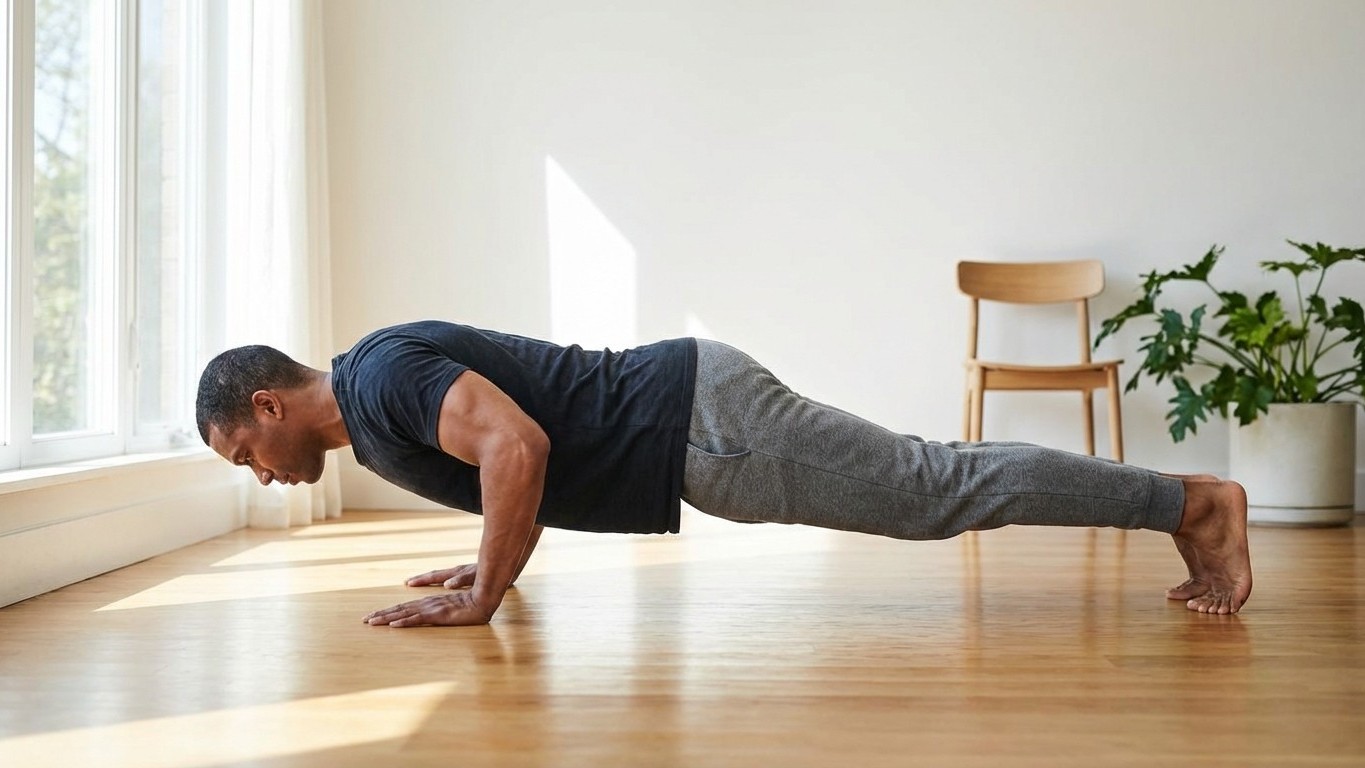
Take the push-up. A wall push-up becomes an incline push-up, which becomes a knee push-up, which becomes a full push-up, which becomes a decline push-up, all using the same movement pattern with progressively more difficulty. That progression alone can keep you challenged for months. Slowing down your reps, using a 3-second lowering phase, builds strength without heavy weights. Your muscles genuinely cannot tell the difference between a slow, controlled bodyweight squat and a barbell back squat in terms of the mechanical tension produced. Your legs don’t care whether resistance comes from a barbell or your own bodyweight — they only respond to mechanical tension, which is the physical force placed on your muscle fibres when they contract to overcome resistance, and it is widely considered the primary driver of muscle growth.
One thing trainers are consistent about: form comes before volume, always. Good form helps you stay safe; when working out at home, look for guides or how-to videos from trusted sources, and if something feels painful, stop and speak with your doctor. Do your routine two to four times a week, taking 48 hours off between sessions, you don’t build muscle while exercising; you build it while resting. That 48-hour window is non-negotiable, and most people who train at home skip it.
Making it genuinely sustainable
Completing two sets of 10 to 15 reps of each exercise, with 30 seconds to one minute of rest between each move, should take about 15 to 20 minutes, which, frankly, is the best argument for home training you’ll ever hear. No commute, no waiting for equipment, no post-workout shower queue. Home training is ideal for people who work from home, allowing you to train in short bursts throughout the day, helping you balance work and exercise.
The one honest limitation worth acknowledging: staying motivated can be more challenging without the structured environment and external encouragement that accompanies visiting a gym, and knowing you’re paying for a membership is sometimes the spark you need to get there. If social energy is what gets you out of bed, a hybrid approach, mostly at home, with occasional gym sessions for variety or community — is a completely valid strategy.
Consistency, as ever, is the variable that matters most. A 15-minute workout you actually do beats a 60-minute plan you skip. The gym was never the point. Showing up was. And as it turns out, showing up is considerably easier when the commute is just the walk from the kitchen to your living room floor.
As always, consult your GP before beginning a new exercise programme, particularly if you have any existing health conditions or have been inactive for a long period of time.