
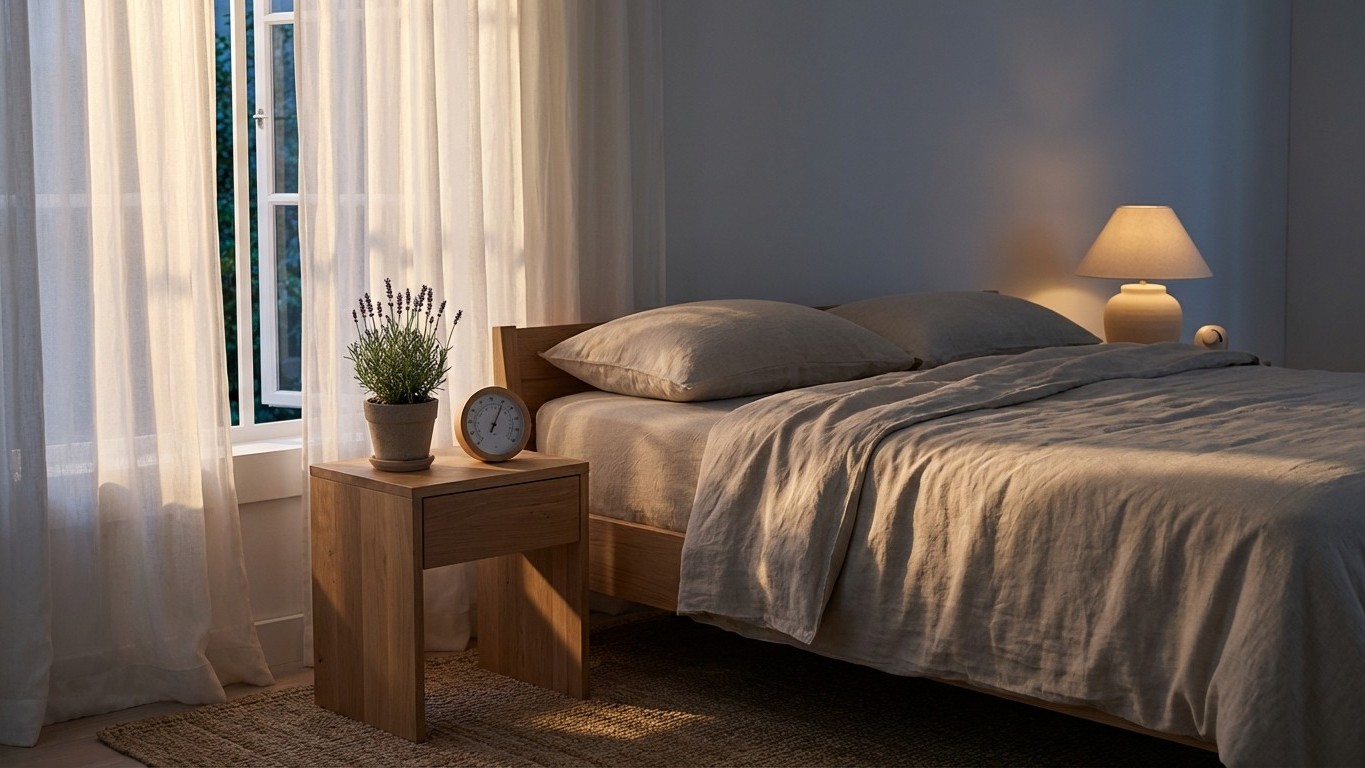
Your bedroom is either working for you or against you every single night. Most people focus on sleep hygiene habits, the herbal teas, the screen-free evenings, the meditation apps — yet overlook the physical space where sleep actually happens. The air temperature, the quality of darkness, the ambient sounds, the subtle scents drifting through the room: all of these influence your nervous system in ways that are measurable, well-documented, and, crucially, very much within your control without spending a fortune or reaching for anything synthetic.
Sleep science has made it clear that the brain doesn’t switch off in a vacuum. It responds to environmental cues at every stage of the night, from the moment you dim the lights to the deepest phases of slow-wave sleep. This article walks through the four main physical levers of sleep quality, light, temperature, sound, and scent, and shows you how to adjust each one using natural, practical approaches. There are also sections tailored to specific situations: the perimenopausal woman dealing with night sweats, the anxious teenager, the older adult whose sleep architecture has shifted. The goal is a bedroom that actively supports rest, not one that merely fails to prevent it.
Why Your Sleep Environment Shapes Every Night You Have
The link between environment and sleep cycles
Sleep is not a single, uniform state. Over the course of a night, the brain cycles through light sleep, deep slow-wave sleep, and REM (rapid eye movement) sleep roughly every 90 minutes. Each phase serves a different biological purpose, from cellular repair to memory consolidation, and each is sensitive to different environmental inputs. Light, even at very low intensities, can suppress the release of melatonin, the hormone that signals to the brain that it’s time to sleep. While many assume blackout curtains are essential, there are effective ways to learn how to sleep better naturally without blackout curtains. Temperature fluctuations interrupt the deep sleep stages, which is why finding the best room temperature for sleep is crucial for maintaining quality rest. Sudden noise spikes (a lorry passing, a partner’s phone notification) trigger brief micro-arousals that fragment sleep architecture even when you have no conscious memory of waking, though exploring white noise alternatives natural can help mask these disruptive sounds. Poor air quality and ventilation can also significantly impact sleep quality, as factors like sleep air quality ventilation co2 levels directly affect how restorative your sleep cycles are. Smell operates differently: the olfactory system has a direct pathway to the limbic brain, which governs emotion and memory, which is why essential oils for sleep bedroom environments can shift the nervous system toward calm within minutes.
The effects of a poor sleep environment
The consequences stack up faster than most people realise. Even modest, chronic sleep fragmentation, the kind caused by a room that’s slightly too warm, or streetlight seeping under the curtains — is associated with increased levels of cortisol, impaired glucose metabolism, and reduced immune function. A room that’s just two degrees too warm can reduce the proportion of slow-wave sleep in a night significantly. These aren’t dramatic, acute effects; they’re quiet, cumulative ones that erode wellbeing over months and years. The encouraging flip side is that improving your sleep environment tends to produce noticeable results within days, not weeks.
Light: The Most Powerful Signal Your Bedroom Sends
Understanding light’s role in sleep regulation
The human circadian rhythm is anchored primarily by light. Specialised photoreceptors in the retina, distinct from those used for ordinary vision, detect light intensity and wavelength, and relay that information directly to the suprachiasmatic nucleus, the brain’s master clock. Blue-wavelength light (400–490 nanometres) is the most suppressive of melatonin, which is why evening screen use delays sleep onset. Natural sunlight contains far more blue light than most indoor artificial lighting, but the issue isn’t natural light per se, it’s about timing.
Reducing blue light naturally in the evening
The most effective and completely free approach is to shift your lighting gradually as evening progresses. Warm-toned lamps (those with a colour temperature below 3,000 Kelvin) replace the cooler overhead lighting that dominates most British living rooms. Candles emit almost no blue-spectrum light and create a genuinely calming atmosphere, there’s a reason candlelit environments feel instinctively restful. If you use screens in the evening, activating night mode reduces blue emission somewhat, though it doesn’t eliminate the alerting effect of screen content itself.
Optimising morning light exposure
Getting bright natural light into your eyes within the first hour of waking, even on an overcast British morning, outdoor light is vastly brighter than indoor lighting — anchors your circadian rhythm and makes it easier to fall asleep at a consistent time that evening. Opening the curtains immediately, or stepping outside briefly, costs nothing and has a measurable effect on sleep timing over weeks. This is the natural side of the equation that’s often overlooked when people focus only on reducing evening light.
Sleeping better without blackout curtains
Blackout curtains are the obvious solution to early morning light intrusion, but they’re expensive, aesthetically limiting, and not always practical in rented properties. There are effective alternatives. Layering existing curtains with a temporary lining, using adhesive window film, or wearing a well-fitted sleep mask (the latter being genuinely one of the highest-value, lowest-cost sleep tools available) can all reduce light intrusion substantially. For a fuller guide on how to sleep better naturally without blackout curtains, there’s a dedicated resource covering these techniques in detail, including solutions for rooms that face east or that catch summer dawn light from 4am onwards.
Temperature: The Physical Trigger for Deep Sleep
What is the ideal temperature for sleep?
The body needs to drop its core temperature by roughly 1–2°C to initiate and sustain sleep. This is why falling asleep in a warm room is so difficult, and why hot summer nights are so disruptive. Research consistently points to a bedroom ambient temperature of around 16–18°C as optimal for most adults, though individual preference varies somewhat. Children and older adults often do better at the slightly warmer end of that range. For an in-depth look at the evidence and practical ways to hit that target in a typical British home, the guide on best room temperature for sleep goes considerably further than this overview can.
Natural techniques for cooling or warming the bedroom
In summer, cross-ventilation is your primary tool: opening windows on opposite sides of the room (or house) in the evening draws cooler air through as outdoor temperatures drop. A bowl of ice in front of a fan is a time-honoured trick that genuinely works for short periods. Breathable natural bedding, linen, cotton percale, or bamboo-derived fabrics, allows heat to dissipate from the body rather than trapping it. In winter, the temptation is to pile on the duvets, but a lower tog duvet combined with warmer pyjamas often produces better sleep than a heavy tog that causes the body to overheat once core temperature rises.
Bedding habits and ventilation
Airing the bed daily, pulling back the duvet for at least 20 minutes each morning, reduces humidity in the mattress and bedding, which itself affects thermal comfort overnight. Ventilating the room briefly before sleep, even in winter, refreshes oxygen levels and lowers carbon dioxide concentration, which has a direct effect on sleep depth. This is also relevant to air quality more broadly, discussed below.
Sound: Creating Acoustic Calm Without Expensive Solutions
The impact of noise on deep sleep
Sound is processed by the sleeping brain throughout the night, even during deep sleep. The auditory system never fully switches off, evolutionarily, it was too important as an early-warning system. Sudden, unpredictable sounds are far more disruptive than constant background noise because of the startle response they trigger. Traffic, neighbours, early-morning deliveries: these cause micro-arousals that reduce the proportion of restorative slow-wave sleep without necessarily waking you fully. Over time, this produces the classic “I slept eight hours but still feel exhausted” pattern.
Natural solutions for noise reduction
Heavy curtains, rugs, and soft furnishings absorb reflected sound in a room, reducing the acoustic liveness that makes sudden noises feel sharper. Positioning the bed against an interior wall rather than an exterior one (or a shared wall with neighbours) reduces exposure to structure-borne sound. Ear plugs remain one of the most effective and inexpensive options for light sleepers, though they require a settling-in period of a few nights. Some people find them uncomfortable; foam plugs tend to be softer than the wax alternatives and cause less pressure.
Natural alternatives to white noise
White noise machines have become popular, but they’re not the only option, and for some people, the mechanical quality of synthesised white noise is itself slightly alerting. Natural soundscapes (rain, gentle water, wind through trees) tend to be more effective for most people, and these are freely available. The white noise alternatives natural guide explores this in practical detail, including options that work well for children and for people who live in particularly noisy urban environments.
Scent and Air Quality: The Underestimated Dimension
How scent affects relaxation and sleep onset
The olfactory system’s direct connection to the limbic brain means that scent can shift physiological arousal relatively quickly, faster, in some cases, than other sensory inputs. Lavender has been the most studied natural scent in sleep research; several trials have found modest but consistent reductions in sleep onset time and improvements in subjective sleep quality with lavender exposure. The effect isn’t sedative in the pharmacological sense; it appears to operate via the parasympathetic nervous system, gently reducing heart rate and anxiety. The key word is “consistent” — the effect builds with regular use, making it part of a ritual as much as a direct intervention.
Natural scents for the bedroom
Beyond lavender, Roman chamomile, bergamot, vetiver, and sandalwood all have some evidence base for relaxation, though the research is less extensive. Fresh flowers (jasmine is worth noting, one small study found jasmine-scented rooms associated with reduced sleep movement and increased reported sleep quality) can provide subtle scent without any diffusion equipment. For a thorough guide to which essential oils are worth using and how to use them safely in a bedroom context, the article on essential oils for sleep bedroom covers both the evidence and the practical application in detail.
One note of caution: synthetic air fresheners and heavily scented candles with paraffin bases introduce combustion byproducts and volatile organic compounds into the room, which rather defeats the purpose. Natural beeswax or soy candles, or cold-air diffusion of pure essential oils, are cleaner options.
Improving indoor air quality naturally
CO2 levels in a closed bedroom rise steadily throughout the night as you breathe, and elevated CO2 is associated with lighter, more fragmented sleep. The simplest solution is ventilation: leaving a window slightly ajar, or ventilating the room immediately before sleeping. Certain houseplants (snake plants, peace lilies, spider plants) do contribute modestly to air quality, though their effect on CO2 in a sleeping room has been somewhat overstated in popular coverage, they’re a supplement to ventilation, not a replacement. Reducing sources of indoor air pollution (synthetic textiles, flame-retardant-treated furniture, plug-in air fresheners) matters more than adding any single plant.
Adapting Your Sleep Environment to Specific Needs
Night sweats, stress-related insomnia, and hormonal changes
Women going through perimenopause or menopause often find that standard sleep environment advice doesn’t go far enough, because the problem isn’t the ambient temperature, it’s the body’s thermoregulatory system misfiring internally. Layering bedding (so you can shed a layer quickly in the night) and using moisture-wicking natural fabrics directly against the skin help manage the aftermath of a hot flush without requiring you to get up and cool the whole room. Keeping a small fan on the bedside table for personal use gives immediate relief without disturbing a partner. Stress-related insomnia often responds well to scent ritual and acoustic calm, because both work via the autonomic nervous system — shifting from sympathetic (fight-or-flight) to parasympathetic (rest-and-digest) dominance.
Children, teenagers, and older adults
Children’s sleep is particularly sensitive to temperature and light, as their circadian systems are still maturing. Teenagers tend to have a biologically later sleep phase, so reducing evening light exposure is even more important for them than for adults, bright overhead lighting in a teenager’s room from 8pm onwards actively delays their sleep timing. For older adults, sleep becomes lighter and more fragmented with age regardless of environment; optimising all four environmental factors together (rather than addressing just one) tends to produce the most meaningful improvement.
Building a Natural Evening Routine Around Your Bedroom
The environment and the routine are not separate things, they work together. A bedroom that has been cooled, darkened, and lightly scented sends signals to the nervous system before you’ve even done anything deliberately relaxing. The sequence matters: start dimming lights 60–90 minutes before you intend to sleep, ventilate the room while you’re in the bathroom or kitchen for your wind-down routine, and allow any diffused scent to be present in the room as you arrive there. These transitions, repeated consistently, become conditioned cues — the brain learns to associate them with sleep onset in the same way it learns to associate the smell of coffee with waking up.
A simple pre-sleep check covers the essentials: temperature in the 16–18°C range, no light sources above a faint amber glow, any intrusive sound managed (window closed if traffic is heavy, or a gentle natural soundscape playing softly), and a consistent scent if that’s part of your routine. The full toolkit of natural sleep remedies — from herbal supplements to breathing techniques, works considerably better when layered on top of an environment that’s already primed for rest.
Common Mistakes and Persistent Myths
The most widespread mistake is treating the bedroom as a multi-purpose room. Working from a desk in your bedroom, watching television in bed, or scrolling on a phone before sleep all create a conflict of associations that undermines the brain’s conditioning toward sleep in that space. The bedroom’s psychological function as a sleep sanctuary is worth protecting, even in a small flat where this requires some creative arrangement.
A common myth is that you can “catch up” on sleep quality by spending more hours in bed. Sleep duration and sleep quality are related but distinct, and no amount of extra time in an overheated, bright, or noisy room compensates for fragmented sleep architecture. Another persistent idea is that alcohol helps sleep, it does reduce sleep onset time, but it suppresses REM sleep and causes rebound arousal in the second half of the night, leaving most people feeling less restored despite having slept.
People also underestimate how quickly small environmental changes take effect. A sleep mask, a slightly lower thermostat setting, and a lavender diffuser cost relatively little and can produce noticeable changes within a week, not because of placebo, but because the brain’s response to environmental cues is both immediate and cumulative.
Frequently Asked Questions
How can you improve indoor air quality naturally for better sleep?
Ventilate the room before sleeping, even briefly in winter, to reduce CO2 accumulation. Add a few indoor plants for marginal benefit, but treat them as a supplement rather than a solution. Avoid synthetic air fresheners, heavily fragranced cleaning products, and new synthetic textiles that off-gas volatile organic compounds. If you live in an area with outdoor air pollution, ventilating at quieter traffic times (early evening rather than rush hour) reduces the trade-off.
What is the best natural temperature for promoting sleep?
For most adults, somewhere between 16°C and 18°C is the sweet spot. This supports the body’s natural core temperature drop at sleep onset. The full reasoning, and practical ways to achieve this in different home types, is covered in the dedicated best room temperature for sleep guide.
How can you limit light and noise naturally without expensive equipment?
For light: a good-quality sleep mask costs a few pounds and is among the most effective tools available. Layering curtains, using warm-toned lamps in the evening, and avoiding screens for the last hour before bed cost nothing. For noise: strategic room arrangement, soft furnishings, ear plugs, and free natural soundscape apps address the majority of situations without any specialist equipment.
The question most people don’t ask, but probably should, is not “how do I fix my sleep?” but “what is my bedroom actually communicating to my brain each night?” Starting there, and working through each sensory channel systematically, tends to surface small changes that compound into something genuinely meaningful. Sleep is not a problem to be solved once; it’s an environment to be maintained.