
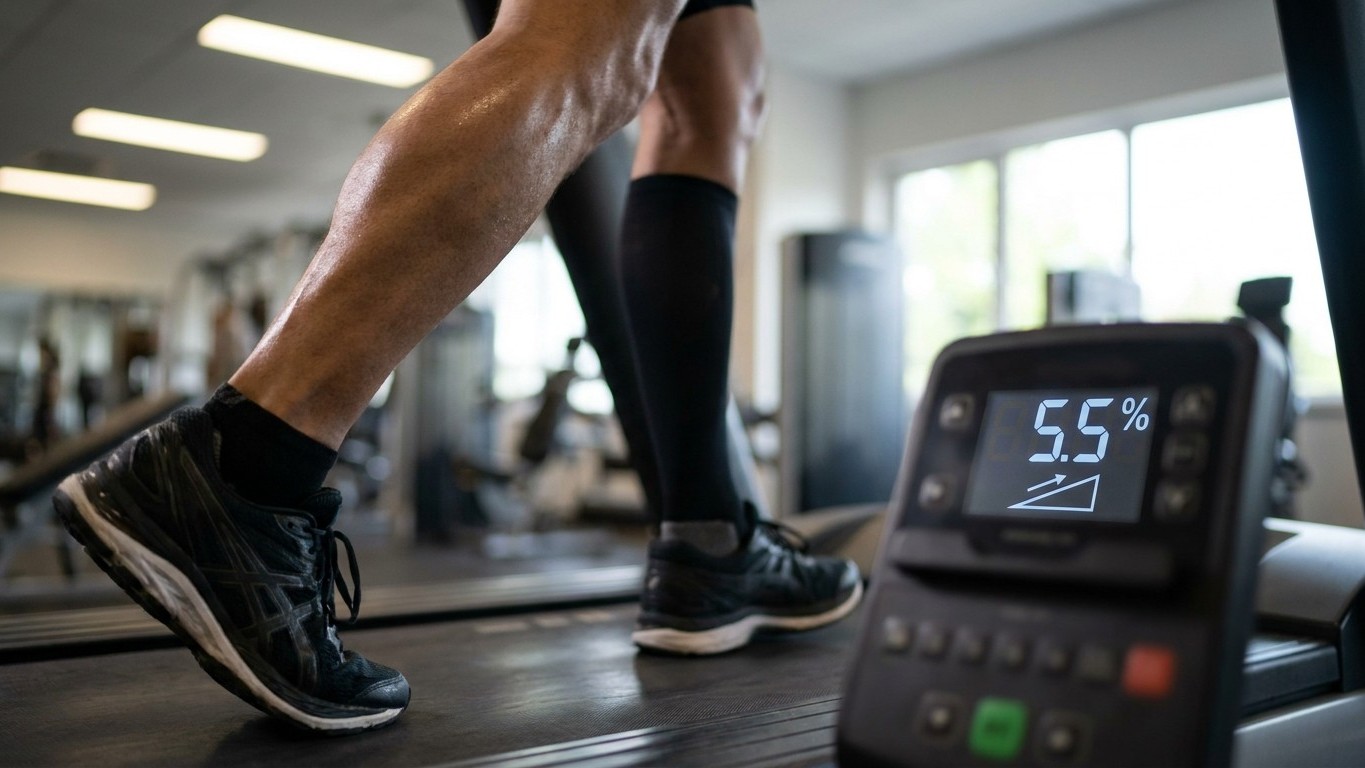
The 1% incline rule is one of those gym truisms that circulates so widely it starts to feel like physiology law. Set your treadmill to 1% gradient, the logic goes, and you’ll offset the lack of wind resistance, replicating outdoor running conditions more faithfully. A study published in the Journal of Sports Sciences in the late 1990s is typically credited with establishing this benchmark, and since then it has embedded itself in every beginner running guide and personal trainer script you’ll ever encounter. The rule isn’t wrong, exactly. But after three weeks of logging my own sessions with a bit more rigour than usual, I started to wonder whether “not wrong” is doing a lot of heavy lifting here.
Key takeaways
- The famous 1% rule comes from 1990s research about wind resistance—but it’s being used for the wrong reasons
- Your calves barely activate at 1% incline, despite being muscles you ‘use every day’ when running
- A simple three-component protocol (1% warm-up, 2-3% steady state, 5-6% bursts) unlocks biomechanical demands that flat treadmills hide
Where the 1% rule actually comes from
The original research tested runners at various speeds and concluded that a 1% gradient on a treadmill closely approximates the energetic cost of running outdoors on flat ground. The reasoning holds at moderate paces, roughly 8 to 12 minutes per mile. At those speeds, the absence of air resistance on a treadmill is a genuine variable, and the slight incline compensates for it aerobically. The study was methodologically sound for its time, and the advice it generated is genuinely useful for anyone whose main goal is cardiovascular accuracy.
The problem is that most recreational runners don’t think about 1% in terms of energy expenditure equivalence. They think about it as “the correct setting”, full stop. And that subtle cognitive shift changes how they use it. A flat treadmill feels wrong, so 1% gets dialled in, locked, and forgotten. The incline becomes background noise rather than a training variable.
What three weeks of closer attention actually revealed
Over 21 days, I ran six sessions per week and alternated between three protocols: flat (0%), the standard 1%, and varied inclines between 2% and 6%, kept at the same perceived exertion level. I tracked heart rate, session RPE (rate of perceived exertion), and, less scientifically but no less honestly, how my legs felt the following morning. The results were not dramatic. They were, however, instructive.
The biggest surprise was calf fatigue. At 1% and below, my calves were largely quiet, recovering overnight without complaint. The moment I introduced even 2-3% inclines consistently, they started registering effort in a way that felt oddly unfamiliar for muscles I supposedly use every day. This isn’t a minor point. The gastrocnemius and soleus muscles are trained primarily through loaded dorsiflexion and plantarflexion, and treadmill running at low gradients, on a moving belt, actually reduces the demand on the posterior chain compared to road running on varied terrain. Research published in the Journal of Biomechanics has noted that treadmill surfaces alter lower limb mechanics, including reduced ankle push-off compared to overground running.
By week three, my calves were visibly more fatigued after incline sessions, but my flat-ground running felt noticeably more fluid. That’s the adaptation cycle working exactly as it should, and it only became visible because I stopped treating 1% as an immovable default.
The case for using incline as a genuine training tool
Walking or running at an incline significantly increases the activation of the glutes, hamstrings, and calves compared to flat surfaces. A gradient of 5% or above starts to meaningfully challenge hip extension mechanics in ways that flat treadmill running simply doesn’t replicate. For runners dealing with weak posterior chains, which sports physiotherapists frequently cite as a contributor to knee pain and IT band issues, this matters.
There’s also a caloric consideration, though it’s rarely framed this way. A 2019 review in Gait & Posture confirmed that walking on a treadmill at inclines between 5% and 15% produces substantially higher energy expenditure than flat walking at the same speed. That’s not a reason to spend every session grinding up a 15% slope, but it does suggest that even modest incline variation, say, two or three minutes at 4-5% folded into a 30-minute run, adds a stimulus that the flat-plus-1% protocol entirely misses.
The most underused treadmill feature, in my view, is incline as a recovery tool for injured runners. When knee pain makes high-impact flat running uncomfortable, a brisk walk at 8-10% incline can maintain cardiovascular fitness and strengthen the posterior chain with less joint loading. A number of sports medicine practitioners use incline walking protocols during return-to-run rehabilitation for this reason.
How to actually use this without overcomplicating your routine
You don’t need to scrap the 1% rule. For easy-paced aerobic runs where cardiovascular accuracy is the goal, it remains a reasonable default. The shift worth making is treating it as a starting point, not a ceiling.
A practical approach: keep your warm-up and cool-down at 1%, run your steady-state middle section at 2-3%, and add one or two short incline bursts (90 seconds at 5-6%) per session if your programme allows it. This structure preserves the original intent of the 1% research while layering in the biomechanical demands that flat treadmill running chronically under-delivers.
One thing worth knowing before you experiment: if you have Achilles tendon sensitivity or a history of calf strains, increase incline gradually over several weeks. The load on the Achilles rises sharply with gradient, and the adaptation timeline for tendon tissue is considerably slower than for muscle. Your calves might feel fine after two sessions at 6%; the tendon is a different story, operating on a six-to-twelve-week remodelling cycle. That’s the nuance the 1% rule, in its neat simplicity, never bothered to mention.
Always consult your GP or a qualified sports physiotherapist before making significant changes to your training, particularly if you have an existing injury or health condition.