
Most people who struggle to sleep are searching for the wrong solution. They download white noise apps, buy weighted blankets, try melatonin gummies, and wonder why nothing sticks. Instead, they should focus on learning how to fall asleep faster naturally and following proven sleep hygiene tips natural by addressing what happens at 8 p.m., not midnight. A consistent, well-designed natural sleep routine works because it speaks directly to your body’s chronobiology, the internal clock that governs when you feel alert, when you feel drowsy, and how deeply you sleep once you do drift off. This isn’t about rigid self-discipline. It’s about working with your biology rather than against it.
The seven-day plan in this article is designed to do exactly that: introduce gradual, sustainable changes across the key pillars of evening wellness, light exposure, nutrition, environment, mental preparation, and natural relaxation techniques. No medication, no expensive gadgets, no overnight transformation promises. Just a practical, evidence-informed framework you can adapt to your own life.
Why a Natural Evening Routine Changes the Quality of Your Sleep
What the science actually tells us
Your body begins preparing for sleep hours before you actually lie down. Melatonin production typically rises in the early evening in response to dimming light, core body temperature starts to fall, and cortisol levels should be declining steadily. When you scroll through your phone at 10 p.m., argue with someone online, or eat a heavy meal at 9:30, you’re interrupting each of these processes simultaneously. This is why it’s crucial to reduce blue light for better sleep naturally in the hours leading up to bedtime. The result isn’t just difficulty falling asleep, it’s fragmented sleep architecture, meaning less time in the deep and REM stages where physical repair and memory consolidation happen.
Research published in sleep medicine journals consistently shows that behavioural interventions, including structured bedtime routines, are among the most effective tools for improving sleep quality in adults without clinical sleep disorders. Implementing the best bedtime routine for adults requires consistency of timing that matters as much as the specific habits involved. When you perform the same sequence of calming activities at the same time each evening, your nervous system learns to associate those cues with sleep onset, a process sometimes called stimulus control.
Natural routines versus conventional approaches
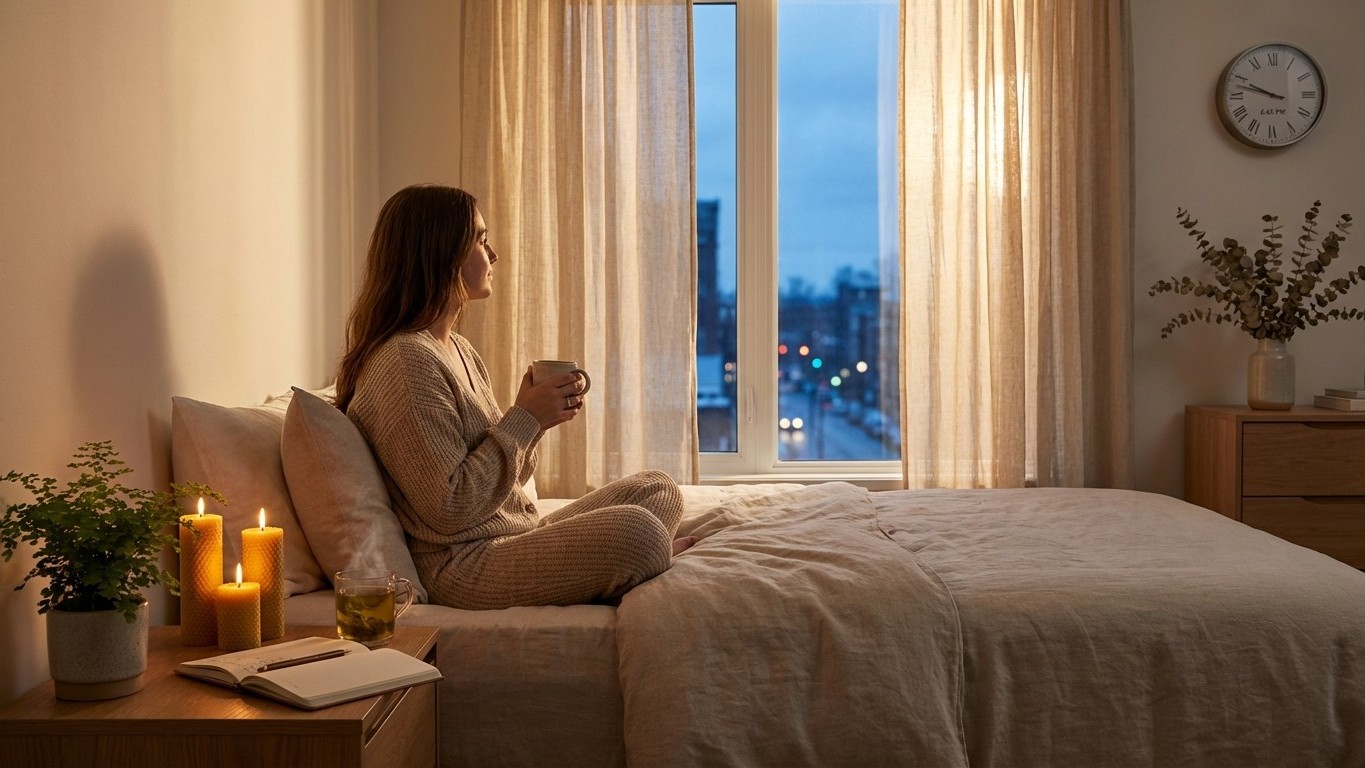
A “conventional” evening routine for many adults looks something like this: finish work late, eat dinner while watching television, scroll social media in bed, take a sleep aid when things feel desperate. Each element, harmless in isolation, compounds into a pattern that confuses the circadian system. Natural alternatives aren’t about removing pleasure from your evenings, but rather about structuring what to do one hour before bed in a way that supports your biology. A warm bath, a cup of chamomile tea, ten minutes of journalling, these can genuinely be enjoyable. The difference is that they support your biology rather than fighting it.
Exploring natural sleep remedies reveals a broad toolkit available to anyone willing to be consistent. The evening routine is the connective tissue that holds all those individual remedies together into something that actually works over time.
Sleep Hygiene: The Foundation Everything Else Rests On
What sleep hygiene actually means
Sleep hygiene is a term that gets used so frequently it’s almost lost its meaning. At its core, it refers to the set of behaviours, environments, and scheduling choices that either support or undermine sleep quality. It’s worth understanding this not as a checklist of dos and don’ts, but as a systems perspective: every element of your evening environment sends signals to your brain, and those signals are either coherent (preparing you for sleep) or contradictory (keeping you alert).
Good sleep hygiene tips natural approaches emphasise that these habits work cumulatively. One good evening won’t transform your sleep. Two weeks of consistent practice, on the other hand, can produce measurable improvements in how quickly you fall asleep and how you feel the following morning.
Core principles for a natural evening
A few principles underpin nearly everything that follows. First, consistency of timing: going to bed and waking at roughly the same time every day (including weekends) synchronises your circadian rhythm more powerfully than any supplement. Second, the two-hour wind-down window: the ninety minutes to two hours before your target bedtime should involve progressively lower stimulation, dimmer light, and calmer activity. Third, environmental coherence: your bedroom should be cool (around 16 to 18 degrees Celsius is the range most often cited in sleep research), dark, and quiet, and ideally reserved for sleep rather than work or entertainment.
These aren’t arbitrary rules. They reflect how human sleep evolved, in response to natural light cycles, temperature drops at nightfall, and the absence of artificial stimulation after dark. Recreating some version of those conditions, even partially, is one of the most effective things you can do.
Natural Habits to Build Into Your Evening
Offline rituals: baths, reading, meditation, and dim light
A warm bath taken sixty to ninety minutes before bed has a curious effect: the subsequent cooling of your core body temperature as you get out actually accelerates sleep onset. This isn’t folk wisdom, the thermodynamic mechanism has been studied and replicated. The bath doesn’t need to be long. Even twenty minutes at around 40 degrees can make a noticeable difference for people who have trouble switching off.
Reading physical books (rather than tablets) in dim light is another reliable wind-down tool. The cognitive engagement is gentle enough to distract from anxious thoughts without being stimulating enough to keep you alert. Meditation and breathing exercises, meanwhile, work by activating the parasympathetic nervous system, shifting your physiology from the “fight or flight” mode that many of us spend the working day in, towards the calmer “rest and digest” state that precedes good sleep. Even five minutes of slow, deliberate breathing can shift your heart rate variability in a measurable direction.
Light management deserves particular attention. Overhead lighting in most British homes is far too bright for evening hours. Switching to side lamps, candles, or specifically warm-toned bulbs (under 3000 Kelvin) from around 8 p.m. can help your melatonin production proceed naturally. If you’re serious about this, reduce blue light for better sleep naturally by adjusting device settings and considering amber-tinted glasses for evening screen use.
What you eat and drink in the evening matters more than most people realise
The gut-brain axis means that what happens in your digestive system in the evening has direct consequences for your sleep quality. Large, high-fat meals within two to three hours of bedtime are associated with more frequent night-time waking and reduced slow-wave sleep. This doesn’t mean you need to stop eating after 6 p.m., it means the composition and timing of your evening meal deserves some thought.
Foods rich in tryptophan (turkey, dairy, oats, nuts) can support serotonin and melatonin synthesis. A small carbohydrate-containing snack in the early evening may assist tryptophan’s uptake across the blood-brain barrier. Herbal teas, chamomile, valerian root, passionflower, lemon balm, have genuine evidence behind them, albeit modest. Chamomile contains apigenin, a compound that binds to GABA receptors in the brain with mild anxiolytic effects. Valerian has been studied more extensively, with several trials suggesting modest improvements in sleep onset.
Alcohol is worth addressing plainly: it may help you fall asleep faster, but it disrupts the second half of the sleep cycle significantly, reducing REM sleep and causing earlier morning waking. If better sleep is the goal, keeping alcohol to earlier in the evening, or reducing it altogether, will produce noticeable results within days.
Your environment as a natural sleep tool
Scent is an often underestimated environmental factor. Lavender, in particular, has been the subject of multiple small trials showing associations with reduced anxiety, longer sleep time, and improved sleep quality scores. Whether via a pillow spray, an oil diffuser, or dried lavender sachets, introducing calming aromas into your bedroom is one of the lower-effort adjustments available. Essential oils should always be used appropriately, diffused rather than applied directly to skin without a carrier oil, and kept away from pets and young children.
Beyond scent, consider noise. Consistent background noise (a low fan, gentle rain sounds) can mask the irregular urban sounds that cause micro-arousals during sleep. Blackout curtains or a sleep mask address light pollution, which is genuinely disruptive to melatonin production even at low intensities.
Mental preparation: the part most routines overlook
Racing thoughts at bedtime are among the most commonly reported causes of insomnia. The standard advice to “just relax” is, of course, entirely useless to anyone in that state. More effective is a structured approach: a brief journalling session of ten to fifteen minutes earlier in the evening, during which you write down tomorrow’s tasks, unresolved concerns, and a few things you’re genuinely grateful for. The task-offloading element has been studied specifically, one small but intriguing study found that writing a to-do list before bed reduced time to sleep onset compared to writing about completed tasks. The brain, it seems, wants reassurance that it won’t forget things before it’s willing to let go.
Gratitude practice is sometimes dismissed as self-help cliché, but the evidence for its effects on wellbeing and sleep quality is more robust than its reputation suggests. A short, specific practice (three things that actually went well today, not generic positives) done consistently appears to shift cognitive patterns over time.
A Seven-Day Natural Evening Routine Plan
Days 1 and 2: Diagnosis and small first steps
Before changing anything, observe. Spend the first evening writing down what your current routine actually looks like: what time you eat, when screens go off (if they do), what mood you’re typically in at bedtime, and how long it takes you to fall asleep. This isn’t about judgement, it’s about identifying your specific pressure points. On day two, make one single change: set a consistent bedtime target and stick to it. Nothing else. Just the anchor point of a regular sleep and wake time is enough to begin resetting your circadian rhythm.
Days 3 and 4: Introducing natural rituals
Now add two or three new elements. A herbal tea in the early evening. A warm bath at a consistent time. Switching off overhead lights and moving to lamps after 8 p.m. If you want to explore how to fall asleep faster naturally, day three is a good moment to introduce a five-minute breathing exercise at the point you get into bed. The 4-7-8 technique (inhale for four counts, hold for seven, exhale for eight) is simple and reasonably well-evidenced for reducing sympathetic nervous system activation.
These days will likely feel slightly effortful. That’s normal. Habit formation requires conscious attention before it becomes automatic, neurologically, you’re establishing new neural pathways, which takes repetition.
Days 5 and 6: Adjusting and personalising
By now you’ll have some data. What’s working? What feels forced or impractical? This is the moment to personalise. Some people find meditation genuinely helpful; others find it frustrating and counterproductive. Some respond strongly to environmental changes like blackout curtains or scent; others don’t notice much difference. The goal is to identify your most effective levers and drop what doesn’t fit your life.
This is also a good point to consider whether your evening meal timing or composition is contributing to poor sleep, and to review your blue light exposure more systematically. The best bedtime routine for adults is ultimately the one that’s sustainable given your actual schedule and preferences, not the theoretically perfect one that falls apart after a week.
Day 7: Taking stock and committing to the long term
One week is enough to begin noticing changes, though not enough to transform sleep patterns entirely. Most sleep researchers suggest that meaningful, stable improvements from behavioural interventions typically emerge after two to four weeks of consistent practice. Use day seven to write a brief review: what Changed, what didn’t, what you want to continue, and what you’ll adjust. Committing your plan to paper (or a notes app) increases follow-through, according to implementation intention research.
The framing that serves people best here is incremental progress rather than perfection. Missing a night, or a week, doesn’t erase the gains you’ve built.
Common Mistakes and a Practical Checklist
Where people go wrong in the first weeks
The single most common mistake is trying to change everything at once. A ten-step routine introduced overnight almost always collapses by day three. Related to this is the perfectionism trap: one bad night triggers the conclusion that “this isn’t working,” when in reality, sleep quality naturally varies and the trend over multiple nights is what matters.
Another frequent error is inconsistency on weekends. Staying up two hours later on Friday and Saturday effectively gives you social jet lag, a misalignment between your biological clock and your social schedule that can take several days each week to recover from. You don’t have to be rigid about this, but keeping the variation within about an hour makes a substantial difference.
Finally, many people underestimate how long stimulating content stays with them. A stressful email read at 10 p.m., an upsetting news story, or an intense conversation can keep your cortisol elevated for thirty to sixty minutes regardless of what you do afterwards. A genuine digital disconnection window matters.
A natural routine checklist
- Set a consistent bedtime and wake time, including weekends
- Stop eating large meals within two to three hours of bedtime
- Dim lights and switch to warm-toned lamps from 8 p.m.
- Replace screen time with reading, bathing, or gentle movement in the final hour
- Include a calming ritual: herbal tea, breathing exercise, journalling, or gratitude practice
FAQ and Further Reading
Common questions about natural evening routines
How long before a natural evening routine improves sleep? Most people notice some improvement within the first week, particularly in how quickly they fall asleep. More substantial changes, fewer night-time wakings, better mood the following day, feeling genuinely rested — typically emerge after two to four weeks of consistent practice. The nervous system adapts gradually, not overnight.
Which natural gestures are most effective before bed for falling asleep faster? The evidence most reliably supports: consistent bedtime, reduced light exposure in the final two hours, a warm bath sixty to ninety minutes before sleep, and a structured wind-down activity (reading, gentle breathing, or journalling) that displaces screen use. No single gesture is magic in isolation, it’s the combination and consistency that produces results.
Is a natural routine enough if I have chronic insomnia? A natural evening routine addresses behavioural and environmental factors that are often contributing to poor sleep, and can be highly effective for subclinical insomnia and poor sleep hygiene. For diagnosed chronic insomnia, Cognitive Behavioural Therapy for Insomnia (CBT-I) is the treatment most strongly supported by evidence. Please consult your GP if sleep difficulties are significantly affecting your daily functioning, a natural routine is a complement to, not a substitute for, professional support when that’s needed.
What’s the best herbal tea for sleep? Chamomile and valerian are the most studied, with modest but real evidence behind them. Passionflower and lemon balm also appear in the literature with promising results. The ritual of making and drinking warm tea in itself contributes to wind-down, regardless of the specific herb.
Dive deeper into the natural sleep toolkit
The evening routine is a framework, and every section within it opens into a richer area of practice. If you want to explore the broader landscape of plant-based and behavioural approaches, the complete guide to natural sleep remedies covers everything from herbal supplements to body temperature management in one place. For a detailed breakdown of the science and practice of sleep hygiene specifically, sleep hygiene tips natural goes considerably deeper into the evidence base. If your main challenge is the moment of trying to fall asleep and feeling your mind resist, how to fall asleep faster naturally offers twelve concrete techniques you can trial immediately. And for a minute-by-minute template you can adapt to your own schedule, best bedtime routine for adults provides the most granular practical structure available.
Sleep is not a passive state you fall into when you’re exhausted enough. It’s an active biological process your body is preparing for all evening. The question worth sitting with, perhaps tonight, is simply this: what does the last two hours before bed currently look like for you, and what one thing might you do differently?