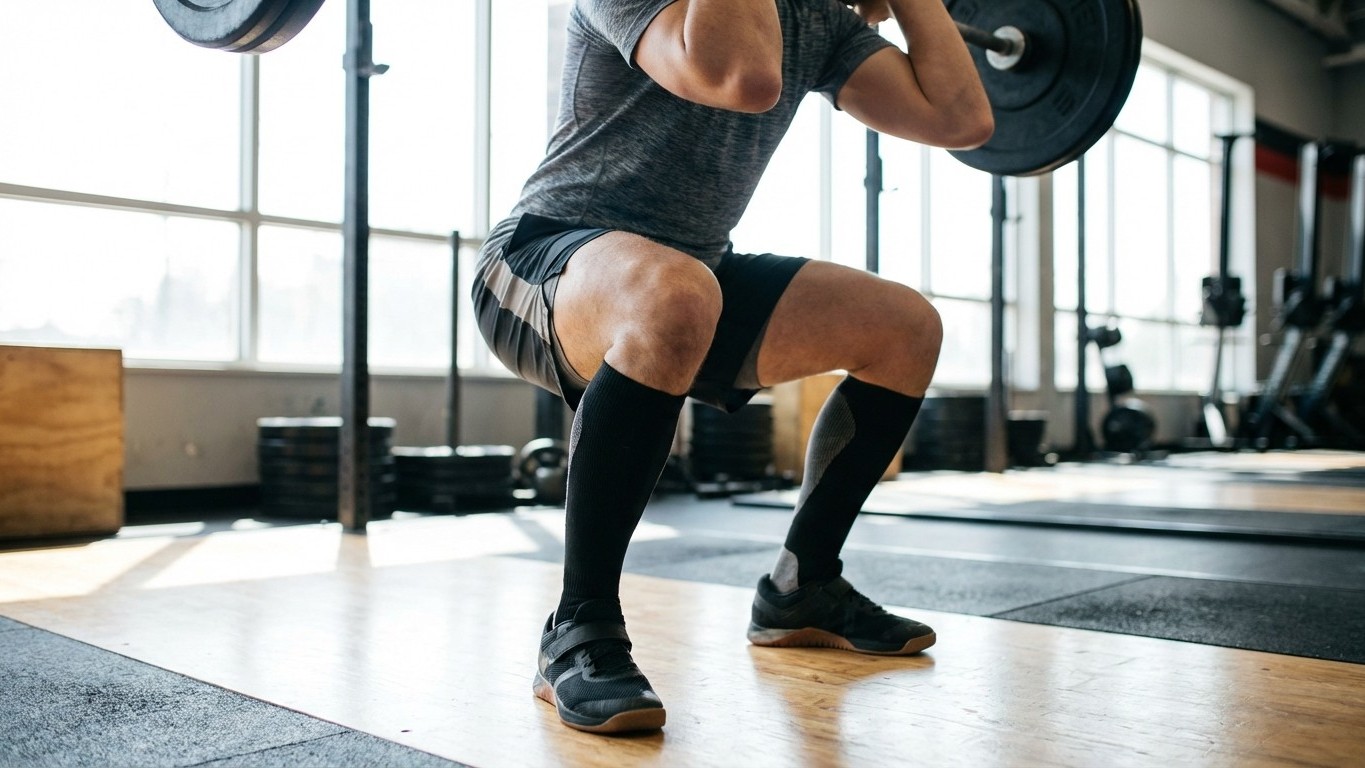
My squat form looked fine, at least from where I was standing. Feet shoulder-width apart, chest up, depth reasonable. I’d been doing it for years. Then a strength coach watched me do three reps and said, almost casually, “your knees are caving inward on the way up.” I hadn’t noticed. My knees certainly had.
That inward collapse, technically called valgus knee collapse, is one of the most common squat errors in gyms across the country, and it’s one of the most insidious because it often doesn’t hurt immediately. The damage accumulates quietly over months and years, loading the medial structures of the knee in ways they simply aren’t designed to tolerate under heavy load. By the time you feel it, something has usually been ground down or strained that could have been avoided entirely.
Key takeaways
- You might be making this common squat mistake without realizing it—and your knees are paying the price
- The damage from valgus knee collapse accumulates quietly over months and years before any pain shows up
- Three unglamorous exercises can rewire your squat form in just four weeks
What valgus collapse actually looks like
The movement is subtle enough that many people genuinely can’t see it happening in real time. As you drive upward from the bottom of the squat, the knees drift inward toward each other rather than tracking over the second and third toes. Sometimes it’s both knees, sometimes just the dominant side. Video yourself from the front doing a set of five at working weight, and the chances are reasonable you’ll see something you didn’t expect.
The mechanism behind it tends to involve a combination of weak hip abductors, limited ankle mobility, and sometimes a simple lack of conscious cue. The glutes and the muscles around the hip, particularly the gluteus medius, are supposed to actively push the knees outward during the ascent. When they’re not firing properly, or not strong enough relative to the load you’re lifting, the knees take the path of least resistance and fall in. Tight ankles make this worse by forcing compensations through the whole chain upward.
A physical therapist I spoke to described it to me this way: imagine the knee as a hinge that only wants to open and close in one plane. Valgus forces it to rotate slightly as it bends under load. Do that a thousand times and the stress on the medial collateral ligament, the patellofemoral joint and the cartilage starts to tell a story you’d rather not read.
The fixes that actually work
The good news is that this is genuinely correctable, and you don’t have to strip your training back to nothing while you sort it out. The approach that worked for me, and that sports physiotherapists broadly recommend, runs in parallel: strengthen the weak links, address the Mobility restrictions, and retrain the movement pattern with a conscious cue until the new pattern Becomes automatic.
For the strength side, banded clamshells, side-lying hip abductions and single-leg glute bridges are the unglamorous workhorses. They feel almost embarrassingly easy compared to your working squat weight, which is exactly why people skip them. Spend four weeks doing three sets of fifteen on each of these three or four times a week, and the difference in how your glutes fire during a squat is genuinely noticeable. The hip abductors wake up.
Ankle mobility deserves more attention than it usually gets in this conversation. A simple test: kneel on one knee with your front foot flat on the floor, and push your knee forward over your toe as far as possible without the heel lifting. A reasonable range is around five inches between the wall and your toes. Many people can’t get close. Daily calf stretching combined with a drill where you drive the knee forward over the toe while keeping the heel down (sometimes called a wall ankle mobilisation) can make a measurable difference within a few weeks.
The cue that changed my squat most immediately was deceptively simple: “push your knees out” or “spread the floor with your feet.” You’re not Actually moving your feet anywhere, but the mental intention of rotating them outward activates the external rotators of the hip and keeps the knees tracking correctly. Used in conjunction with a light resistance band placed just above the knees during warm-up sets, you get immediate feedback every time the knees start to drift inward.
When to slow down and when to push through
There’s a distinction worth drawing between the discomfort of learning a corrected movement pattern and actual pain that signals something needs attention. Muscle soreness in the glutes and outer hips after addressing this is completely expected, even welcome. Sharp pain inside or around the knee during squatting is not something to push through, and that’s where a conversation with your GP or a physiotherapist becomes the right move rather than an optional extra. (Please do consult a healthcare professional if you’re experiencing knee pain during exercise, this article is informational, not a substitute for clinical assessment.)
Reducing load temporarily while you retrain the pattern is also just pragmatic. Ego-driven loading while your knees are caving is, bluntly, how rotary forces stack up into real injury. Coming back to a weight you’ve comfortably squatted before, this time with correct mechanics, is one of those decisions that feels like a step backward and absolutely isn’t.
The bigger lesson from one coaching session
What struck me most after that conversation with the coach wasn’t that I’d been doing it wrong. It was that I’d been doing it wrong for years and had no idea, because no one had watched, and I hadn’t thought to look. Most recreational gym-goers train in isolation, never get their movement assessed, and accumulate small errors under heavy loads until those errors become symptoms.
Even a single session with a qualified strength coach or a sports physiotherapist can surface things you simply cannot see in yourself. The squat is a deeply human movement pattern, one we do instinctively as toddlers before chairs and desks shorten our hips and stiffen our ankles. Relearning it properly isn’t a concession to weakness. It’s the most interesting rehabilitation project available to anyone who cares about moving well into their forties, fifties and beyond.