
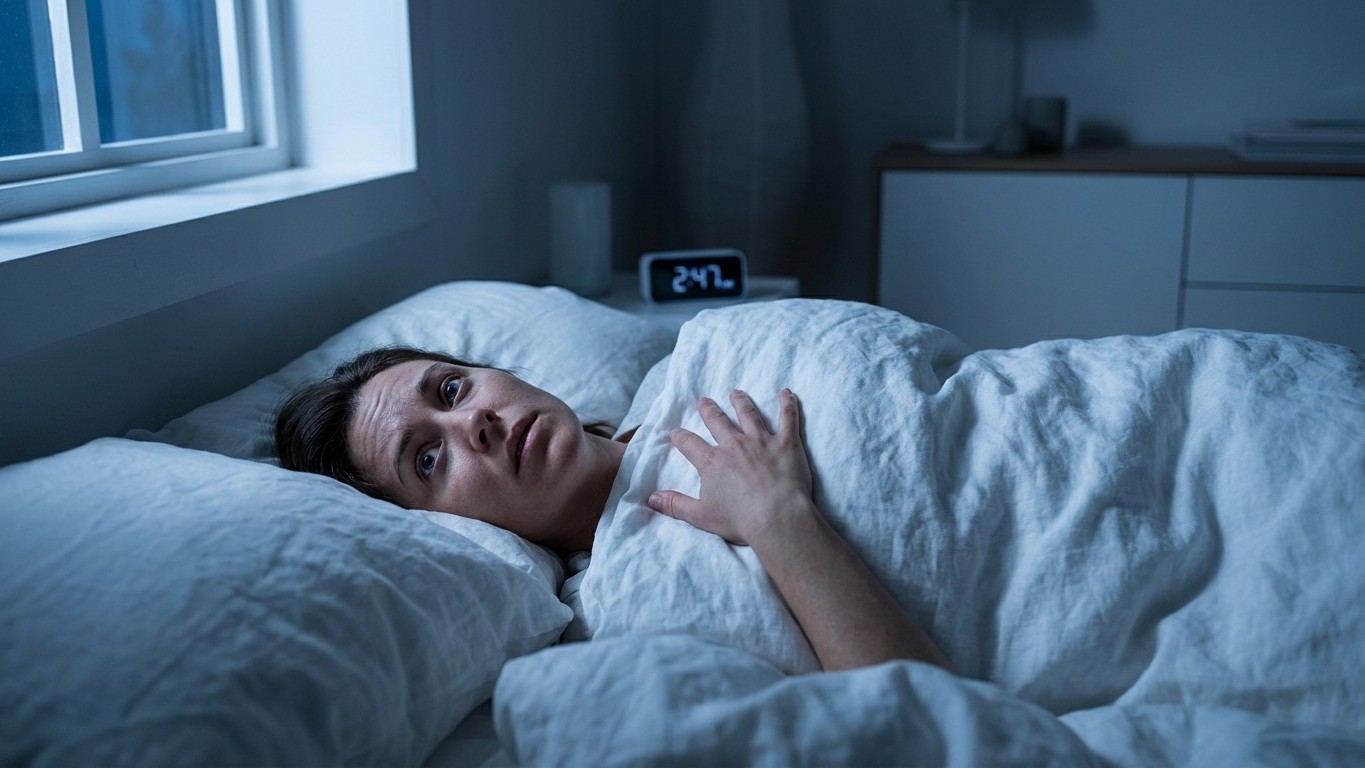
You wake at 2 or 3 in the morning, heart pounding, thoughts already racing. The room is dark and quiet, yet your mind is anything but. This pattern, waking from sleep gripped by unease or outright panic, affects a surprising number of people and rarely gets the focused attention it deserves. The good news is that a natural remedy for middle of the night anxiety does exist, and often several of them, used in combination, can help you drift back to sleep without reaching for medication.
This guide covers what is actually happening in your body during these episodes, what you can do in the moment, and how to reduce how often they occur.
Comprendre l’anxiété nocturne : pourquoi se manifeste-t-elle au milieu de la nuit ?
Les mécanismes biologiques de l’anxiété nocturne
Sleep is not a uniform state. Throughout the night, your brain cycles through lighter and deeper stages roughly every 90 minutes. Anxiety-driven awakenings tend to cluster in the second half of the night, when REM sleep dominates and the brain is highly active. During REM, emotional memories are processed, which can amplify feelings of worry or dread.
Cortisol, the body’s primary stress hormone, follows a natural curve that begins rising in the early morning hours, well before dawn. If your system is already primed by chronic stress, this early cortisol surge can trigger a sudden, jarring awakening rather than a gentle transition towards waking. Your nervous system interprets this hormonal shift as a threat signal, and the anxiety response follows automatically.
Reduced melatonin levels in the second half of the night compound the problem. With less of this calming hormone circulating, the brain loses some of its natural buffer against anxious thoughts, making it harder to simply roll over and fall back asleep.
Facteurs courants déclencheurs la nuit
Certain patterns reliably feed nocturnal anxiety. Alcohol is a notable one: it fragments sleep architecture and suppresses REM in the first half of the night, creating a rebound effect later that intensifies arousal and emotional sensitivity. Blood sugar fluctuations, common after late-night snacking on refined carbohydrates, can also trigger an adrenaline response that pulls you out of sleep abruptly.
Psychological factors matter just as much. Unresolved worries about work, relationships, or finances do not disappear at bedtime. They go underground, often surfacing with startling clarity at 3 a.m., when the usual distractions of daily life are absent and the mind has nowhere to hide. For more on this specific pattern, the guide on natural remedies for waking up at 3am explores these causes in detail.
Premiers gestes naturels pour calmer l’anxiété et faciliter le rendormissement
Respiration consciente et exercices simples à faire dans le lit
The single most accessible tool you have is your breath. Slow, extended exhalations activate the parasympathetic nervous system, the branch responsible for calming the body after a stress response. The 4-7-8 technique is one well-known approach: inhale for 4 counts, hold for 7, exhale slowly for 8. The extended exhale is the active ingredient here, not the specific numbers.
Box breathing offers a gentler alternative if breath-holding feels uncomfortable. Inhale for 4 counts, pause for 4, exhale for 4, pause for 4, and repeat. Stay lying down, eyes closed, and focus entirely on the physical sensation of air moving in and out. When thoughts intrude, which they will, simply return your attention to the breath without frustration.
Progressive muscle relaxation is worth adding to your toolkit. Starting at your feet, tense each muscle group for 5 seconds, then release. Work slowly upward. The contrast between tension and release draws awareness away from anxious thoughts and towards physical sensation, which is exactly the shift the brain needs.
Mots et auto-apaisement mental : phrases, visualisation, gratitude
Your internal narrative during a night-time anxiety episode has enormous power. Short, grounding phrases, repeated slowly, can interrupt the spiral. Something like “I am safe. This will pass. My body knows how to rest” is not magical thinking; it is a deliberate redirection of attentional resources. The key is to keep the phrases simple and present-tense.
Guided imagery works well for many people. Picture a place where you feel genuinely calm, a particular stretch of coastline, a woodland path, a quiet room you love. Build the scene in detail: textures, sounds, temperatures. This kind of constructive mental engagement occupies the narrative-seeking parts of the brain that would otherwise loop through worries.
A brief gratitude practice, recalling two or three specific things from the day that felt good, shifts emotional tone without requiring much effort. The specificity matters; vague positive thoughts carry less neurological weight than concrete ones.
Remèdes naturels à court terme : que faire immédiatement pour retrouver le calme ?
Tisanes et infusions apaisantes en cas de réveil nocturne anxieux
If you are prepared in advance, a thermos of warm herbal tea left on the bedside table can help enormously. The warmth itself is calming, triggering the same physiological response as a warm bath. Chamomile contains apigenin, a compound that binds to benzodiazepine receptors in the brain, producing a mild sedative effect. Lemon balm and passionflower are also well-studied options with a reasonable evidence base for mild anxiety and sleep disturbance.
Avoid anything caffeinated, obviously, and be cautious with valerian at night-time; some people find it paradoxically stimulating, particularly in higher doses. Start with a single herb rather than combination blends, so you can identify what actually helps your particular system.
Usage ponctuel des huiles essentielles : protocoles simples sans danger
Aromatherapy is not a cure, but the evidence for lavender essential oil and anxiety reduction is more solid than its reputation as a wellness fad might suggest. A small diffuser running lavender or Roman chamomile in the bedroom, or a single drop on your pillow, can create a sensory cue associated with calm. Keep application minimal: a little goes a long way, and overwhelming scent can itself become stimulating.
Never apply undiluted essential oils directly to skin, and avoid diffusing for more than 30 minutes in a closed room. If you share a bedroom with children, check safety guidelines for the specific oil before use.
Aliments réconfortants et sans risque la nuit
If hunger is contributing to your wakefulness, a small, protein-rich snack can stabilise blood sugar without disrupting sleep further. A few almonds, a small portion of plain yoghurt, or a piece of cheese are practical choices. Tryptophan-rich foods like turkey or milk are often cited, though the conversion pathway to serotonin and melatonin is complex and unlikely to produce dramatic effects within a single night.
Keep portions genuinely small. A heavy snack in the middle of the night raises core body temperature through digestion, which works against sleep rather than towards it.
Techniques naturelles pour prévenir les réveils anxieux
Routine du coucher et environnement propice à la sérénité nocturne
Prevention requires a different set of strategies, applied consistently in the hours before sleep. A cool, dark room remains the foundation: core body temperature needs to drop for sleep to deepen, and even modest light exposure suppresses melatonin production. Blackout curtains and a temperature between 16 and 19 degrees Celsius are worth prioritising.
The 90-minute wind-down window before bed, during which screens are dimmed and stimulating content avoided, significantly reduces cortisol levels at sleep onset. This is not about being rigid; it is about giving your nervous system a reliable signal that the threat-monitoring mode can be reduced. For a comprehensive approach to this, the article on how to stay asleep naturally provides practical strategies that build on these foundations.
Gestion des pensées anticipatrices et prepping mental en soirée
Worry tends to be future-oriented, circling around what might happen. A brief evening “worry dump”, writing down pending concerns and a single concrete next action for each, has been shown in research to reduce pre-sleep cognitive arousal. The act of externalising thoughts onto paper appears to signal to the brain that those concerns are registered and do not need to be held in working memory overnight.
Limiting news consumption in the evening is practical, unglamorous advice that genuinely makes a difference for anxiety-prone individuals. The news cycle is designed to activate threat responses; choosing when you engage with it is a legitimate form of mental hygiene.
Compléments naturels : options valables pour l’anxiété nocturne
Focus sur la glycine, la L-théanine et la passiflore
Among the natural supplements with a reasonable evidence profile for sleep and anxiety, three stand out. Glycine, an amino acid found naturally in foods like bone broth and gelatine, has been studied for its ability to lower core body temperature and improve sleep quality. Typical doses in research trials range from 3 grams taken before bed.
L-theanine, an amino acid found primarily in green tea, promotes relaxed alertness without sedation by increasing alpha brain wave activity. It is particularly useful for people whose anxiety takes the form of mental hyperactivity rather than physical tension. Studies have used doses between 100 and 400 milligrams, generally taken in the evening.
Passionflower (Passiflora incarnata) has a longer traditional history and a growing research base. It appears to work through the GABA system, similarly to some pharmaceutical anxiolytics but with a much milder and better-tolerated profile. It is available as a tea, tincture, or capsule. The wider range of sleep-supporting supplements is explored in the guide to natural sleep remedies.
Précautions et interactions à connaître
Natural does not mean without risk. Passionflower can interact with blood-thinning medications and should be avoided during pregnancy. L-theanine is generally well tolerated but has not been studied extensively in people taking psychiatric medications. Glycine is considered very safe for most adults, though as with any supplement, starting with the lower end of the studied dose range is sensible.
Please consult your GP before introducing any new supplement, particularly if you take prescribed medication or have an existing health condition. This is not a formality; interactions can be clinically significant.
Quand consulter ? Limites des remèdes naturels face à l’anxiété nocturne
Signes d’alerte à ne pas ignorer
Natural remedies are genuinely helpful for mild to moderate anxiety-driven sleep disruption. They are not adequate for all presentations. If your night-time awakenings are accompanied by chest pain, shortness of breath, or a racing heartbeat that persists for more than a few minutes, seek medical assessment promptly. These can indicate cardiac or respiratory causes that need investigation.
If your anxiety is severe, affecting your ability to function during the day, or if you are experiencing panic attacks regularly, a conversation with your GP is the right starting point. Cognitive Behavioural Therapy for Insomnia (CBT-I) has a strong evidence base and is now recommended as a first-line treatment in many clinical guidelines, often more effective than medication in the long term. For a broader perspective on symptoms that warrant attention, the article on natural remedies for insomnia outlines when self-help approaches may not be sufficient.
FAQ : vos questions sur les remèdes naturels contre l’anxiété nocturne
Quels remèdes naturels peut-on utiliser au moment d’un réveil anxieux ? The most immediately accessible options are controlled breathing (particularly the 4-7-8 technique or box breathing), grounding phrases, progressive muscle relaxation, and, if prepared in advance, a cup of chamomile or passionflower tea. Lavender aromatherapy can support these practices.
Pourquoi l’anxiété se manifeste-t-elle si souvent au milieu de la nuit ? The combination of a rising cortisol curve in the early morning hours, high REM activity in the second half of sleep, and the absence of daytime distractions creates a biological window of vulnerability. Chronic stress narrows this window further, making awakenings more likely.
Les tisanes sont-elles vraiment efficaces contre l’anxiété nocturne ? They are modestly effective and well suited to combination with other techniques. Chamomile, passionflower, and lemon balm have the best-supported evidence. They work best as part of a broader approach rather than as a standalone solution.
Les huiles essentielles peuvent-elles aider à se rendormir ? Lavender has genuinely encouraging research behind it for mild anxiety and sleep quality. Apply conservatively, keep the diffusion time short, and manage expectations: it is a supporting tool, not a treatment.
Anxious nights have a way of feeding themselves: one poor night increases worry about the next, which makes the next one more likely. Breaking this cycle takes patience, but the tools described here are genuinely useful, and most people see meaningful improvement within two to three weeks of consistent application. What might shift the balance for you is not necessarily the same as what works for someone else, and a degree of personal experimentation, done thoughtfully, is how you find your own most reliable path back to sleep.
Disclaimer: This article is for informational purposes only and does not constitute medical advice. Please consult your GP or a qualified healthcare professional for personalised guidance.