
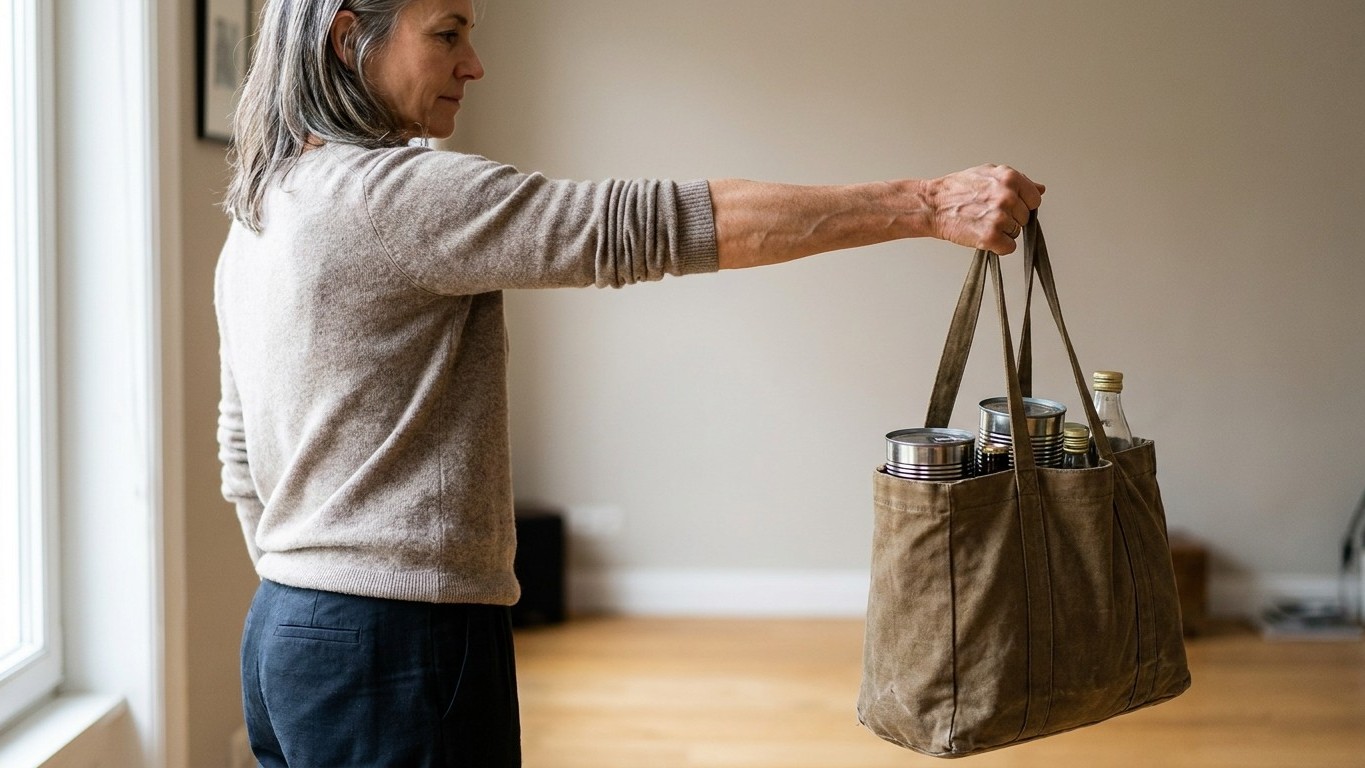
Doctors don’t reach for the bathroom scales first when someone over 50 walks in with a “normal” BMI. They reach for a dynamometer, or in the absence of one, ask patients to grip and hold something heavy, like a loaded shopping bag, for as long as they can. If your arm gives out well before thirty seconds, that’s not a sign you need to hit the gym harder for vanity’s sake. It’s a red flag for muscle loss that a normal weight can hide completely.
Key takeaways
- Your weight can stay perfectly normal while your muscle quietly disappears—a dangerous trap one in four older women fall into
- A weak grip predicts mortality risk better than weight, habits, or existing health conditions combined
- You can run this test at home right now with tinned goods and thirty seconds—and resistance training can reverse the damage
Why the scales lie to you after 50
Body mass index was never designed to spot what happens to muscle as we age. It measures weight relative to height, full stop. It cannot tell the difference between a kilogram of muscle and a kilogram of fat, which becomes a real problem once you understand what happens to our bodies from the third decade of life onwards. After 50 years of age, approximately 1% to 2% of muscle mass is expected to be lost per year, and muscle strength decreases at an even greater rate. Fat quietly fills the space muscle leaves behind, so the number on the scales, and the BMI calculation that follows, can stay perfectly stable while the underlying composition of your body changes dramatically.
This is precisely what researchers mean by “normal weight obesity”, a term for people whose BMI sits comfortably in the healthy range but whose body fat percentage tells a different story. One study comparing adults with identical BMI, age and gender found something striking: participants in the “normal weight obesity” group displayed a higher prevalence of the risk of sarcopenia than the control group across both genders, at 0.6% vs. 14.1% in males and 1.4% vs. 36.5% in females. That’s not a rounding error. That’s roughly a quarter of normal-weight women carrying hidden muscle loss that no scale, tape measure or standard health check would ever catch.
What a weak grip actually predicts
Grip strength isn’t just about opening jam jars. It’s become one of the most studied, cheapest and most reliable proxies clinicians have for overall skeletal muscle health, precisely because the muscles in your forearm and hand tend to decline in step with muscle everywhere else in your body. A major analysis pooling data from more than 50,000 participants found an overall summary hazard ratio of 1.7 for all-cause mortality when the weakest quarter of grip strength was compared with the strongest quarter. That’s not a subtle statistical whisper, that’s a substantial difference in survival odds tied to something as ordinary as how hard you can squeeze.
The Tromsø Study in Norway, which followed nearly 7,000 adults aged 50 to 80 for 17 years, reached a similar conclusion: a 1 SD reduction in grip strength was associated with a hazard ratio of 1.17 for all-cause mortality in a model adjusted for age, gender and body size, and this association was similar across all age groups, in men and women, and robust to adjustment for a range of lifestyle-related and health-related factors. your grip strength tells doctors something about your risk that your weight, your habits and even your existing health conditions don’t fully explain on their own.
This is why grip strength has earned a place in formal frailty assessments. The Fried Frailty Index, one of the most widely used assessments in geriatric medicine, uses grip strength as one of its five criteria, and simply put, if your grip is weak, you’re more likely to be frail, and therefore at higher risk for falls, fractures, and early death. Clinical thresholds exist too. Under the widely used European consensus criteria, probable sarcopenia is defined by grip strength cut points of 27 kg or less for men and 16 kg or less for women, roughly the force needed to keep a heavy bag from slipping from your fingers.
Running the test yourself, honestly
You don’t need clinical equipment to get a rough sense of where you stand. Fill a sturdy bag with tinned goods or bottles until it weighs somewhere between four and six kilograms, roughly a heavier weekly shop. Let it hang straight down at arm’s length, stand tall, and time how long you can hold it without your grip loosening, your shoulder hiking up, or your fingers starting to burn and slip. Thirty seconds without visible strain is the rough benchmark worth aiming for; struggling well before that point, especially if one side is noticeably weaker than the other, is worth mentioning to your GP.
A few things skew the result, so be fair to yourself: test both hands separately, do it when you’re not already fatigued from exercise, and don’t grip a handle that’s too thin or too thick for your hand size, since an awkward hold will tire you out for reasons that have nothing to do with muscle mass. If you want something closer to what a physiotherapist would use, a cheap hand dynamometer does the same job with proper calibration and gives you a number in kilograms you can track over months rather than a vague sense of “that felt hard”.
What you do with a poor result Matters More Than the test itself. Resistance training twice a week, even modest sessions with resistance bands or light dumbbells, has consistently been shown to slow or partially reverse age-related strength loss, and protein intake spread across the day supports the muscle-building signal that exercise triggers. Neither requires a gym membership or a dramatic lifestyle overhaul, just consistency over the kind of timescale muscle actually rebuilds on, which is months, not weeks.
One detail that surprises most people: grip strength in your dominant hand isn’t always the stronger side by much once sarcopenia sets in, because the condition tends to erode strength symmetrically across the body rather than sparing whichever hand you write with. A gap of more than 10% between hands is sometimes used clinically as its own warning sign, independent of how heavy the bag felt in the first place. This article is intended for general information and isn’t a substitute for a proper assessment. If your grip is fading faster than it used to, your GP can arrange the tests that actually confirm what’s going on.
Sources : ncbi.nlm.nih.gov | nature.com