
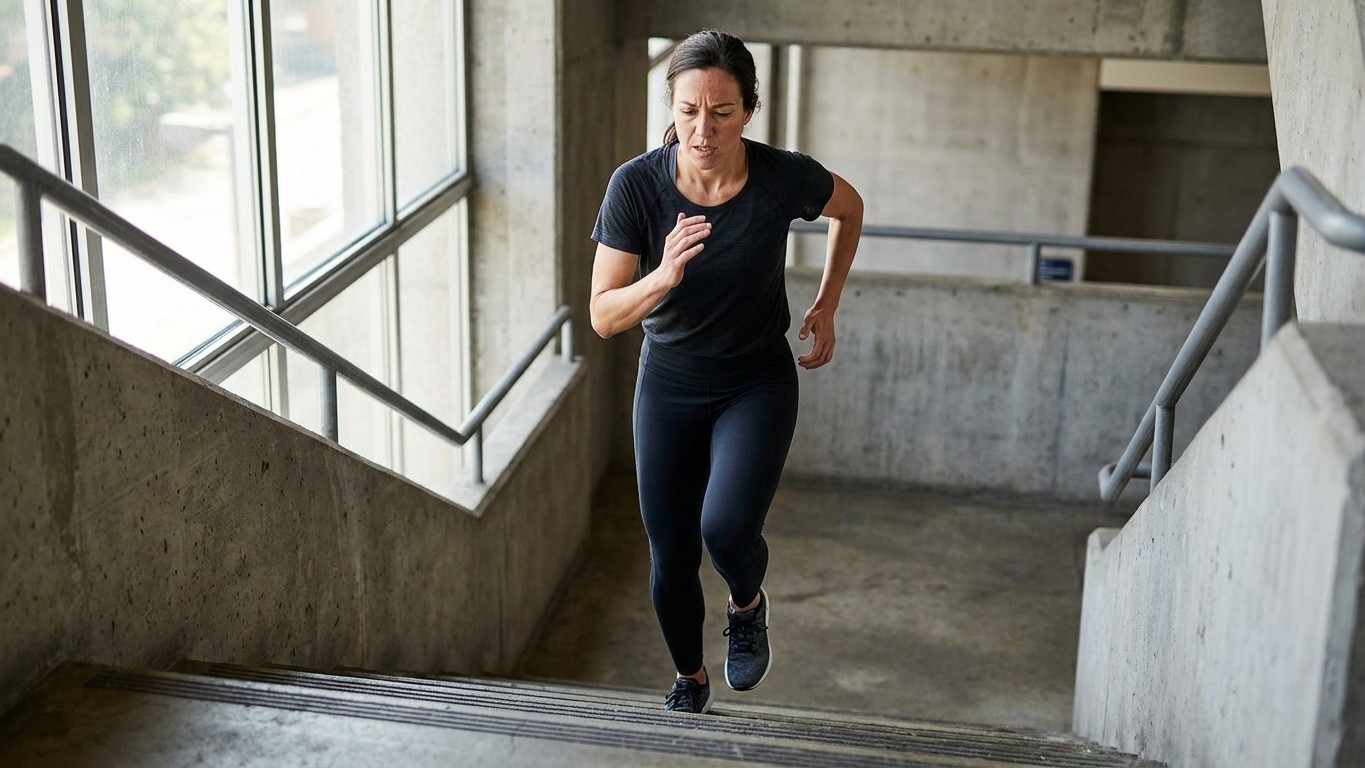
Blood tests taken after six to eight weeks of regular stair climbing have shown a 17.1% rise in VO2 max and a 7.7% drop in LDL cholesterol among previously sedentary women, changes that many months of steady treadmill jogging often fail to produce for the same lipid marker. Relative to controls, the stair climbing group displayed a 17.1% increase in Vo2max and a 7.7% reduction in low density lipoprotein cholesterol. That’s not a fluke result from a single small trial either. It’s the kind of finding that makes you reconsider your relationship with the office lift.
The appeal of stairs isn’t really about burning more calories than a treadmill session, minute for minute it probably burns less. The real story is what happens metabolically when you repeatedly ask your heart and legs to work hard in short, sharp bursts, several times a day, rather than in one continuous steady-state block.
Key takeaways
- Six weeks of stair climbing produced dramatic VO2 max gains that treadmill running couldn’t match
- The metabolic shift comes from repeated short bursts of intense effort, not total calorie burn
- LDL cholesterol dropped significantly, but there’s a catch: results vary depending on your starting fitness level
What six to eight weeks of stair climbing actually changes
The most cited trial on this, led by Colin Boreham and colleagues, took sedentary young women and had them climb a public stairwell of 199 steps, five days a week. Stair climbing was progressively increased from one ascent a day in week 1 to five ascents a day in weeks 7 and 8. Training took place five days a week on a public access staircase (199 steps), at a stepping rate of 90 steps a minute. Each ascent took about two minutes to complete. Crucially, subjects agreed not to change their diet or lifestyle over the experimental period, which means the lipid and fitness shifts genuinely came from the stairs alone, not a side effect of eating better because they suddenly felt virtuous.
A separate controlled trial on home-based stair climbing found similar gains beyond just the lungs and legs. Relative to controls, stair climbing improved aerobic fitness (V̇O2max +1.63 mL.min−1.kg−1), body composition (weight −0.99 kg), and serum lipids (LDL cholesterol −0.20 mmol.L−1; triglycerides −0.21 mmol.L−1), with similar risk reductions for home and gym-based groups. Interestingly, only the home-based protocol reduced fasting blood glucose, hinting that climbing stairs scattered through daily life, rather than in one dedicated gym block, might carry its own metabolic advantage.
None of this means the treadmill is pointless. Steady cardio still builds endurance and burns fat effectively over time. But stairs seem to nudge specific numbers, LDL cholesterol chief among them, in a way that flat, continuous running sometimes doesn’t touch at all, at least according to earlier lipid research on aerobic training in men, where maximal oxygen uptake was not significantly affected by 12 weeks of training despite the exercise being sustained and regular.
Why the up-and-down motion seems to matter
Climbing stairs recruits the glutes and quads against gravity in a way flat walking or jogging simply doesn’t demand. Each ascent is essentially a mini resistance session disguised as cardio, and that combination of strength loading plus elevated heart rate may explain why lipid panels respond differently. Stair climbing is reported to be effective at increasing the maximum rate of oxygen attainable during physical exercise (VO2 max), cardiorespiratory fitness, and the strength of the lower extremities, as well as reducing cholesterol.
There’s also a glucose angle worth mentioning, particularly relevant if you’ve ever felt that sluggish, foggy dip after lunch. Research into postprandial blood sugar found that a single bout of climbing 21 stairs (up and down) for around six minutes was effective in reducing postprandial glucose increases in men with impaired glucose tolerance. Three short stair sessions spaced through the working day, morning, lunchtime, mid-afternoon, line up almost perfectly with when most of us eat and then sit back down at a desk.
The caveat nobody puts in the headline
Not every trial agrees, and I’d be doing you a disservice as an evidence-based editor if I glossed over that. A more recent systematic review covering so-called “exercise snacks”, short bursts including stair climbing performed multiple times a day, found something less flattering. Contrary to what past research has found, the new study found that short bursts of activity did not appear to have an effect on cardiometabolic health, such as body composition, blood pressure and blood lipids. Fitness itself still improved, but the lipid and blood pressure story was murkier than the older, smaller trials suggested.
What explains the gap? Population differences matter enormously. Genuinely sedentary young adults starting from a low baseline, like the women in the Ulster stairwell study, tend to show bigger jumps than people who already do some incidental activity. Duration matters too, most trials run somewhere between four and twelve weeks, and results can regress once the novelty (and the accompanying motivation) fades. The honest takeaway is that VO2 max improvements from stair climbing are well established and fairly consistent, while cholesterol and blood pressure changes are promising but not guaranteed for everyone.
There’s a mortality angle too that’s harder to dismiss. Harvard researchers reviewing large population data reported that people who climb more than five flights of stairs daily may have a lower risk of cardiovascular disease, which suggests the habit matters over years, not just over a six-week experiment with a blood draw at each end.
Making it work without overthinking it
If you fancy testing this on yourself, the protocols that worked in these trials weren’t extreme. A handful of ascents daily, building gradually, five days a week, for roughly six to eight weeks. Taking the steps two at a time raises the intensity slightly by increasing hip and knee flexion demand, though there’s no dedicated trial isolating that specific variation, so treat it as sensible practice rather than proven science.
People with existing joint problems, heart conditions, or who feel breathless doing far less than five flights should speak to their GP before ramping up stair use as a deliberate training method, particularly given that one study noted the higher the staircase, the higher the blood pressure response during climbing. For most healthy adults, though, the lift button might just be the easiest bit of exercise equipment you’ve been avoiding for years, sitting there in the lobby, doing nothing for your LDL cholesterol at all.
Sources : researchgate.net | pubmed.ncbi.nlm.nih.gov