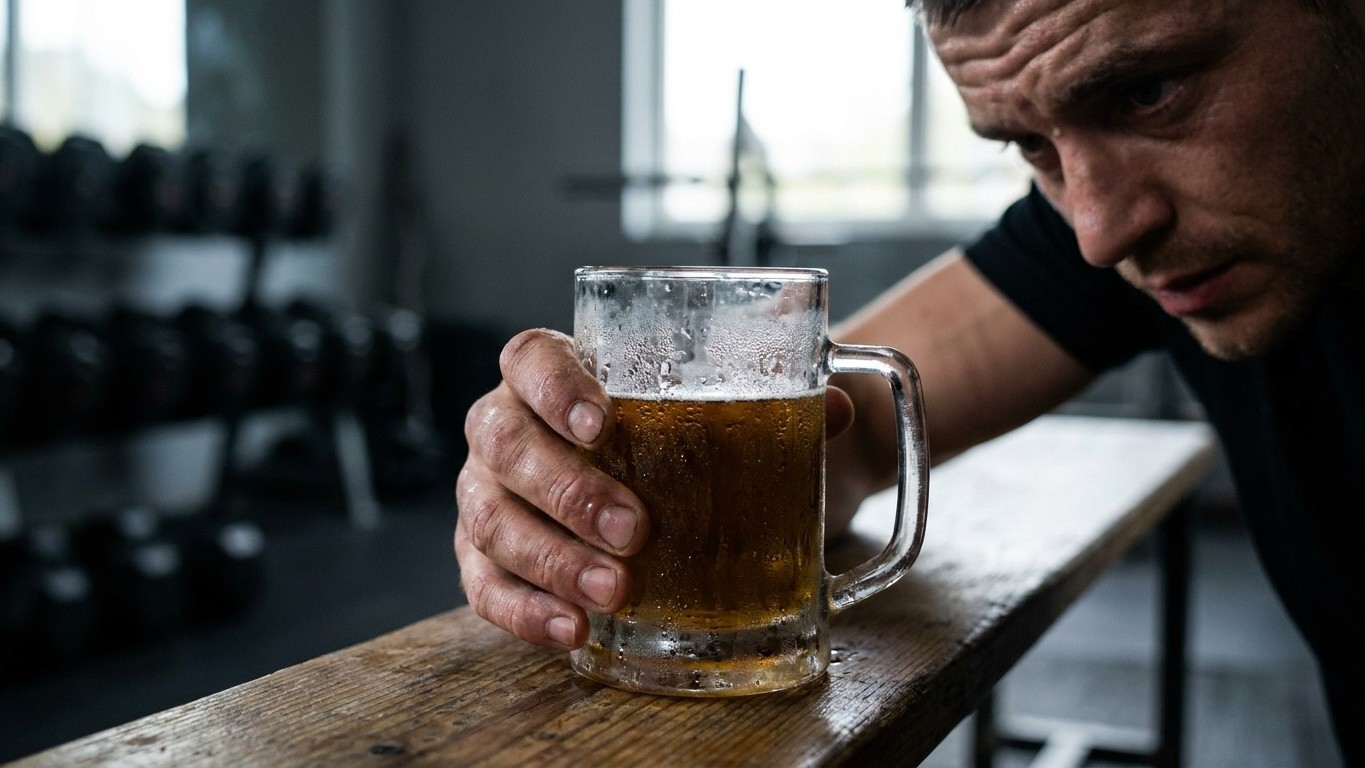
Post-exercise beer has a surprisingly loyal following among recreational athletes. The ritual is almost charming in its logic: you’ve worked hard, you’re dehydrated, you’re hot, and something cold and slightly celebratory feels earned. For a stretch of about eighteen months, this was my exact routine after every training session. A cold lager, sometimes two, consumed within the hour that sports Scientists call the “anabolic window.” Then a coach I was working with ran a basic blood panel, looked at the numbers, and said something I’ve never forgotten: “Your testosterone-to-cortisol ratio looks like someone who trains but never recovers.”
Key takeaways
- A routine blood test revealed why months of training produced zero muscle growth
- Alcohol suppresses muscle protein synthesis by up to 37% even when consumed with protein
- The diuretic effect of beer actually leaves you more dehydrated, not less
What alcohol actually does in the hours after training
The body’s response to resistance or endurance exercise is not simply one of damage and repair. It’s a tightly orchestrated hormonal cascade. Testosterone rises during and immediately after training. Growth hormone spikes during deep sleep later that night. Muscle protein synthesis, the process by which your muscle fibres actually rebuild and grow, remains elevated for anywhere between 24 and 48 hours after a session, depending on its intensity.
Alcohol interrupts this process at several points simultaneously. Research published in journals examining exercise metabolism has consistently shown that ethanol suppresses muscle protein synthesis, even when protein intake is adequate. One study from New Zealand found that consuming alcohol after resistance exercise reduced muscle protein synthesis by approximately 37% compared to consuming protein alone, even when participants drank alongside a protein shake. The protein didn’t compensate for the alcohol. The muscles, in short, were getting the building materials but couldn’t use them properly.
There’s also the cortisol problem. Alcohol raises cortisol, the body’s primary stress hormone, which is catabolic by nature, meaning it breaks muscle tissue down rather than building it up. If your training session has already spiked cortisol (which intense exercise does, temporarily and beneficially), adding alcohol prolongs that elevation rather than allowing it to taper. My blood numbers reflected exactly this: chronically elevated cortisol and suppressed anabolic hormones. My muscles weren’t growing because my body was spending the recovery window in a state of low-grade chemical stress.
The hydration myth that deserves a proper burial
One of the most persistent justifications for the post-workout beer is hydration. Beer is mostly water, the argument goes, and electrolytes from sweat need replacing. This is not entirely wrong, and that’s precisely what makes it so sticky as a belief.
Beer does contain water. It also contains ethanol, which is a diuretic. Alcohol suppresses antidiuretic hormone (ADH), the compound your kidneys use to retain water. The net result is that you urinate more fluid than the beer provided. Studies examining urine markers in athletes who consumed beer after exercise versus water or sports drinks found that those in the beer group remained in a state of net fluid deficit for longer. A standard lager with around 4-5% ABV produces enough of a diuretic effect to counteract its own water content.
Low-alcohol beers (under 2% ABV) appear to sidestep much of this problem. At that concentration, the diuretic effect is minimal, and the carbohydrates and fluid can actually contribute to rehydration. Some sports scientists have noted their potential as recovery drinks, which is where the broader “beer is good for recovery” claim probably originated, before being enthusiastically applied to full-strength lager by people who were, understandably, very thirsty.
Sleep, testosterone, and the compounding effect
The damage doesn’t stop at the two-hour post-training window. Even moderate alcohol consumption, three to four units, disrupts sleep architecture in ways that matter enormously for athletic adaptation. Specifically, it suppresses REM sleep and reduces the duration of slow-wave sleep, which is the stage during which growth hormone secretion peaks.
This is where the compounding effect becomes visible over months rather than days. Miss one night of quality sleep and your growth hormone output drops for that recovery cycle. Do this twice a week, consistently, over eighteen months, and you’ve essentially been training hard while systematically undermining the hormonal environment your body needs to adapt. My coach’s observation wasn’t dramatic. My numbers weren’t catastrophic. They were just chronically suboptimal, the biological equivalent of driving with the handbrake slightly on.
Testosterone suppression follows a similar pattern. Acute alcohol consumption reduces testosterone levels, with the effect more pronounced the larger the dose. Chronic consumption, even at moderate levels, is associated with lower baseline testosterone compared to non-drinkers of similar age and fitness, according to data from several longitudinal studies. For anyone training specifically to build strength or muscle mass, this is a significant headwind.
What I changed, and what actually happened
The adjustment wasn’t abstinence. It was timing. Moving alcohol consumption to at least four hours after training, and limiting it to one or two units on non-consecutive evenings, made a measurable difference within eight weeks. Muscle soreness resolved faster. Progress on compound lifts, which had been stalling for months, resumed. Sleep quality improved, which I hadn’t even attributed to alcohol until it changed.
The more useful shift was replacing the post-session beer with something that actually supports recovery: a protein-rich snack, electrolyte fluid, or a proper meal within the hour. Not because beer is uniquely evil, but because that particular window is physiologically precious, and what you put into it matters more than at almost any other point in the day.
One detail worth knowing: the type of training affects how sensitive the anabolic window is. Endurance athletes face somewhat different hormonal dynamics than those doing resistance training, and the muscle protein synthesis response varies accordingly. For strength and hypertrophy goals specifically, the post-training hour is where alcohol does its most direct interference. For a long Sunday run followed by a social pint two hours later, the picture is genuinely less clear-cut. Context, as ever in nutrition, is everything.
This article is for informational purposes only. Please consult your GP before making significant changes to your diet, training, or lifestyle, particularly if you have underlying health conditions.