
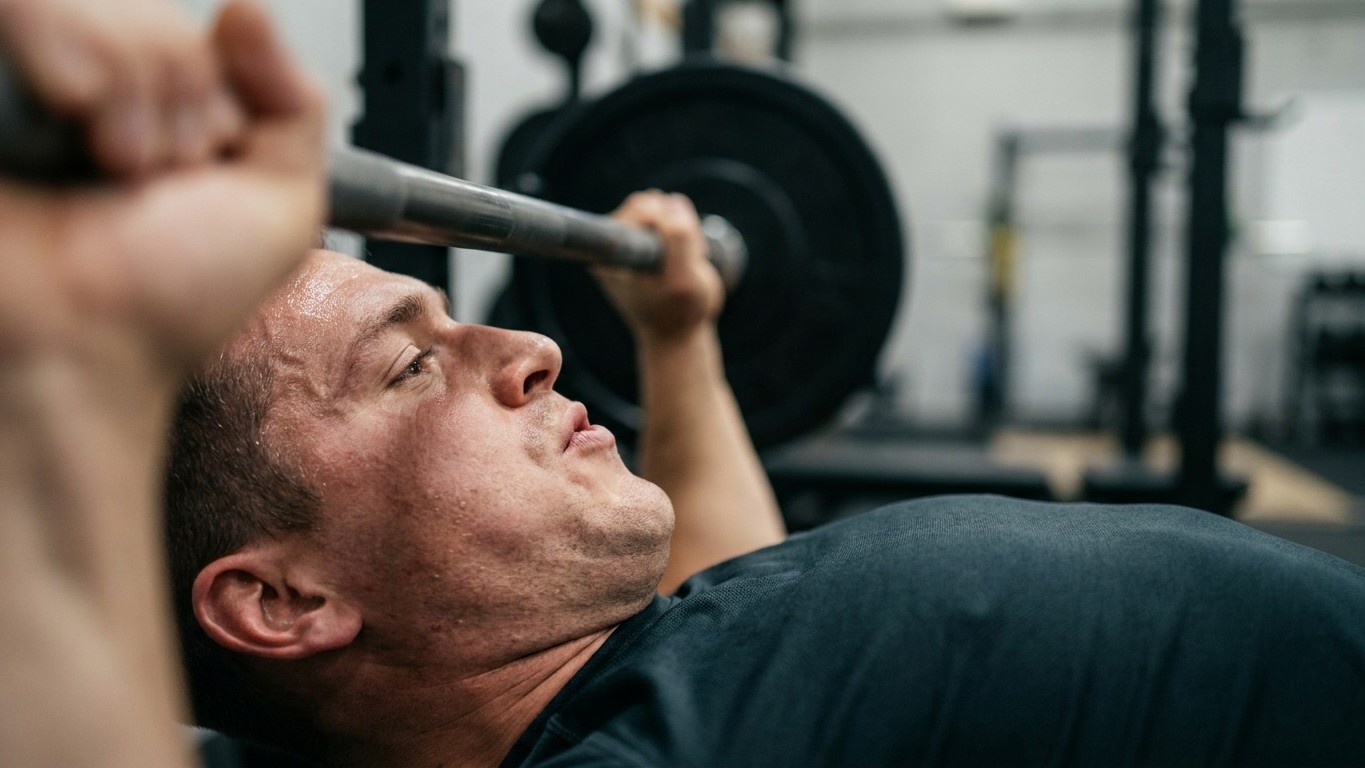
Under a heavy bar, the instinct to seal your lips, clamp your throat and grind through the rep in silence feels like the strong thing to do. It isn’t. That breath-hold, known medically as the Valsalva manoeuvre, sends blood pressure rocketing far higher than a single, deliberate exhale timed to the hardest part of the push. Swap the silent strain for a one-second hiss of air through gritted teeth as the bar leaves your chest, and the pressure spike drops noticeably, according to exercise physiology research spanning three decades.
Key takeaways
- The silent, teeth-clenched strain everyone copies actually triggers dramatic blood pressure spikes—sometimes three times higher than resting
- That safer feeling from breath-holding is a trap: your nervous system feels relaxed while your arteries are under maximum pressure
- One audible, one-second exhale at the hardest part of the lift changes everything—and powerlifting coaches have known this for years
What actually happens when you seal your airway
The Valsalva maneuver is the process of forcefully breathing out against a closed windpipe, trying to breathe out while keeping the glottis, the space between the vocal cords, shut tight. Powerlifters use this deliberately for a reason: when you close your mouth and nose, tighten your abdominal muscles, and exert force, internal pressure spikes, affecting blood return to the heart and causing blood pressure changes. That rigid column of pressure running from your ribcage to your pelvis genuinely does stiffen the spine and help you shift more weight. The trade-off is cardiovascular, and it’s a bigger trade-off than most gym-goers realise.
The mechanism is almost mechanical in its simplicity. When pressure inside the chest suddenly rises, the return of venous blood to the heart is temporarily reduced, followed by dramatic blood pressure fluctuations. Some people notice it immediately: dizziness, seeing stars, or even brief fainting spells. For most healthy lifters this passes in seconds. But for those with pre-existing conditions like high blood pressure, heart disease, or cerebrovascular disease, this may increase the risk of stroke, which is precisely why physiotherapists keep flagging the habit in clinic.
What the research on breathing patterns actually shows
One of the most cited studies on this, involving twenty novice male weight lifters performing an arm curl and a knee extension under three different breathing conditions, found something quite specific. Performing the Valsalva manoeuvre (breath-holding) during either the single arm curl or double knee extension produced the highest blood pressure responses. Crucially, the researchers also tested whether it mattered if you breathed in or out while pushing. It didn’t. Inhaling during the concentric phase of the exercise was associated with blood pressure elevations that were similar to the elevations observed with exhaling during the concentric phase, and the heart rate response was slightly higher with inhalation. The conclusion was blunt: these results suggest that performing the Valsalva manoeuvre exaggerates the blood pressure response to resistance exercise.
A more recent study on the bench press, published in 2025 and involving resistance-trained men, adds a layer of nuance that explains why so many lifters cling to the breath-hold despite the warnings. Inhalation during lifting reduced exercise volume and total sets, whereas exhalation and breath-holding did not significantly affect these parameters. Only the RPE during breath-holding was significantly lower, suggesting reduced perceived effort compared to inhalation. In plain terms, holding your breath makes the set feel easier while your cardiovascular system is quietly working harder in the background. That gap between perceived effort and actual physiological cost is, in my view, the real trap here: the technique that feels most controlled is the one loading your arteries the most.
How much does blood pressure actually rise? Fitness science writers who’ve reviewed the sports medicine literature note that the Valsalva maneuver can raise blood pressure three to four times above resting levels, though there’s an important reassurance buried in the same body of work: experienced weightlifters also have a smaller rise in blood pressure than people who are new to weightlifting, which indicates that the heart and blood vessels adapt to handle these swings in blood pressure over time. Your cardiovascular system, like any muscle, gets more resilient with consistent, sensible exposure.
The one-second fix that actually works
So what should you do instead of sealing your throat for the entire rep? The answer sitting in the research is refreshingly unglamorous: exhale, briefly and audibly, right at the sticking point, the moment the bar is hardest to move. You don’t need a slow, controlled breath out over five seconds. A short, forceful “tss” through slightly parted teeth, held for roughly a second as you drive through the hardest inch of the lift, releases enough intrathoracic pressure to blunt the spike without collapsing your core stability. Powerlifting coaches sometimes call this a partial or “leaky” Valsalva, and it’s become common in strength circles precisely because it keeps most of the bracing benefit while giving the cardiovascular system a pressure valve.
This matters most for three groups of people: anyone with diagnosed hypertension, anyone with a personal or family history of stroke or aneurysm, and anyone newer to strength training whose vessels haven’t yet adapted the way an experienced lifter’s have. If any of that applies to you, resist the urge to copy the powerlifter mid-metre grinding through a personal best in silence. Save the full breath-hold, if you use it at all, for genuine one-rep maximum attempts under proper coaching, and default to the exhale-on-effort pattern for everything else, including your working sets and warm-ups.
Worth remembering too: the wider evidence on breathing and blood pressure isn’t limited to the weights room. Your nervous system automatically lowers your heart rate and widens your blood vessels as part of the rest and digest response, and prolonging your exhalation takes advantage of this reflex. That’s the same underlying mechanism, in gentler form, behind slow breathing exercises recommended for everyday blood pressure management. The gym floor and the meditation cushion turn out to be running on the same physiology, which is a nicer thought than most people expect walking into leg day.
Sources : thestandard.com.hk | pmc.ncbi.nlm.nih.gov