
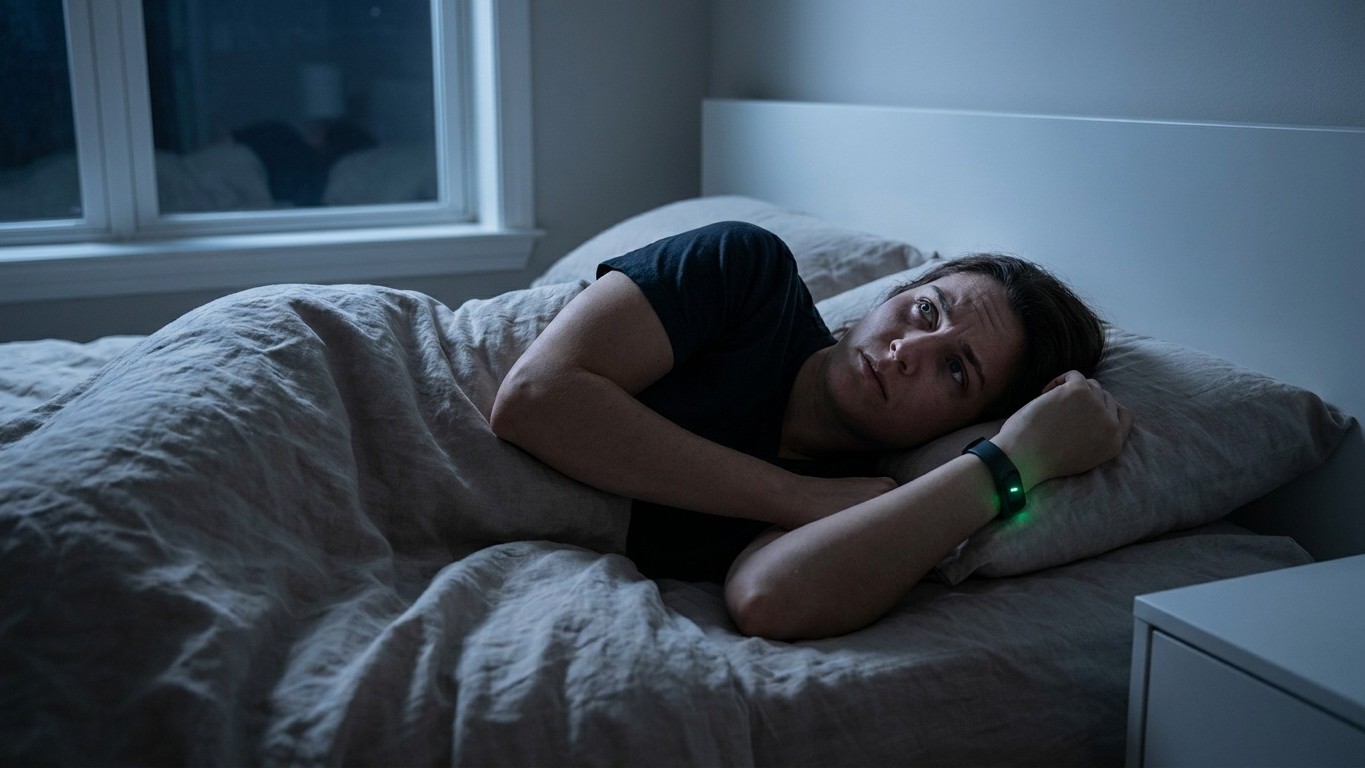
Caffeine has a half-life of roughly five to six hours in most adults. That means a 200mg pre-workout shake consumed at 5:30pm still has 100mg circulating in your bloodstream at 11pm, and around 50mg by 2am. If your sleep tracker ever showed you a night of fragmented, shallow sleep after an evening gym session, that number is probably why.
Key takeaways
- Caffeine consumed at 5pm still has meaningful amounts in your system at 2am, silently destroying slow-wave sleep architecture
- Your sleep tracker reveals what you can’t feel: reduced deep sleep, elevated heart rate, and suppressed recovery metrics despite feeling like you ‘slept fine’
- The evening gym session itself isn’t the problem—it’s the chemical cocktail most people bring to it that tells your body to stay alert when it should wind down
What your sleep tracker is actually measuring
Modern wearables, whether a Garmin, Oura ring, or Whoop strap, don’t directly measure sleep stages. They infer them from heart rate variability, movement, and skin temperature. The data isn’t perfect, but it’s consistent enough to reveal patterns. And when caffeine is involved late in the day, the pattern is hard to miss: reduced slow-wave sleep, higher resting heart rate during the night, and a suppressed heart rate variability score come morning.
Slow-wave sleep, sometimes called deep sleep, is where the body does its most meaningful repair work. Muscle protein synthesis accelerates during this stage, growth hormone pulses are at their highest, and the glymphatic system, the brain’s waste-clearance network, runs at full capacity. For anyone training hard and expecting to recover, losing slow-wave sleep isn’t just annoying. It’s directly undermining the point of the session you used that pre-workout to power through.
Caffeine works by binding to adenosine receptors in the brain. Adenosine is the compound that builds up across the day and creates the sensation of sleepiness. Caffeine doesn’t remove the adenosine; it simply blocks the receptors so you can’t feel it. The moment caffeine clears, all that accumulated sleepiness hits at once, which sounds like it should help you fall asleep faster. But the architecture of the sleep you get is compromised, with measurably less time in the restorative deep stages, even if total sleep duration looks acceptable on the surface.
The evening gym problem nobody talks about honestly
Evening training has a genuine evidence base behind it. A 2019 review published in Scientific Reports found that moderate exercise ending at least an hour before bed does not impair sleep quality in most people, and may even improve sleep onset in some. The issue isn’t the training itself. The issue is the chemical cocktail most people bring to it.
Pre-workout supplements typically combine caffeine with other stimulants: beta-alanine, which causes that familiar tingling, is relatively benign in terms of sleep, but many formulas also include synephrine, tyrosine, or even small amounts of substances that stimulate the sympathetic nervous system. You’re essentially telling your body to stay in a state of alert when it’s evolutionarily wired to be winding down with the light.
There’s a variation in caffeine metabolism worth knowing about. The gene CYP1A2 governs how quickly you process caffeine. Slow metabolisers, a significant proportion of the population, may still feel stimulating effects from a morning coffee by mid-afternoon. For those individuals, a 5pm pre-workout isn’t a compromise. It’s a disaster. The frustrating part is that slow metabolisers often report feeling fine subjectively, because they’ve adapted to the constant low-grade stimulation. Their sleep tracker tells a different story.
Rebuilding your evening training without wrecking your recovery
The practical options here are more interesting than just “don’t use pre-workout after noon.” The simplest swap is a stimulant-free pre-workout, which exists as a genuine category and typically relies on citrulline for blood flow, beta-alanine for buffering, and creatine for power output. None of these compounds interfere with adenosine signalling. Your pump doesn’t require caffeine. Your focus might feel slightly different, but that’s largely habit and expectation.
Another option that sounds counterintuitive: use the tiredness. Adenosine build-up by early evening often coincides with a natural peak in muscle temperature and reaction time, which research consistently shows is the optimal window for strength and power work. Your body at 5pm to 7pm is genuinely primed to perform, even without chemical intervention. The perception that you “need” the pre-workout to function in an evening session is partly real fatigue and partly psychological association.
If caffeine genuinely feels necessary, the pragmatic cutoff most sports nutritionists use is roughly six hours before your intended sleep time. For someone going to bed at 10:30pm, that places the limit at 4:30pm. A 5:30pm session with a caffeinated supplement means you’re already over the line before you’ve changed into your kit.
Cold water immersion after training, used by many athletes to reduce inflammation, can also mildly blunt the cortisol and adrenaline spike that follows intense evening exercise, helping the nervous system shift back toward parasympathetic dominance more quickly. It won’t cancel out a late caffeine load, but it does assist the wind-down process.
One thing worth building into your routine: check your sleep tracker data on the mornings after evening versus morning sessions, and separately compare nights with and without late caffeine. Self-quantification over two to three weeks will show you your personal response more clearly than any generic guideline. Some people metabolise caffeine quickly enough that a 5pm dose is genuinely cleared by midnight. Others are still wired at 3am. The tracker makes the invisible visible, which is exactly what happened on the night this pattern finally became impossible to ignore.
There’s a broader irony in all of this. Caffeine is among the most studied ergogenic aids in existence, with robust evidence for improving endurance, strength output, and focus. The problem isn’t the compound; it’s the timing. Used at the right moment, it’s a legitimate performance tool. Used at the wrong one, it quietly trades tomorrow’s recovery for today’s training session, a bargain that compounds badly over weeks of accumulated sleep debt.