
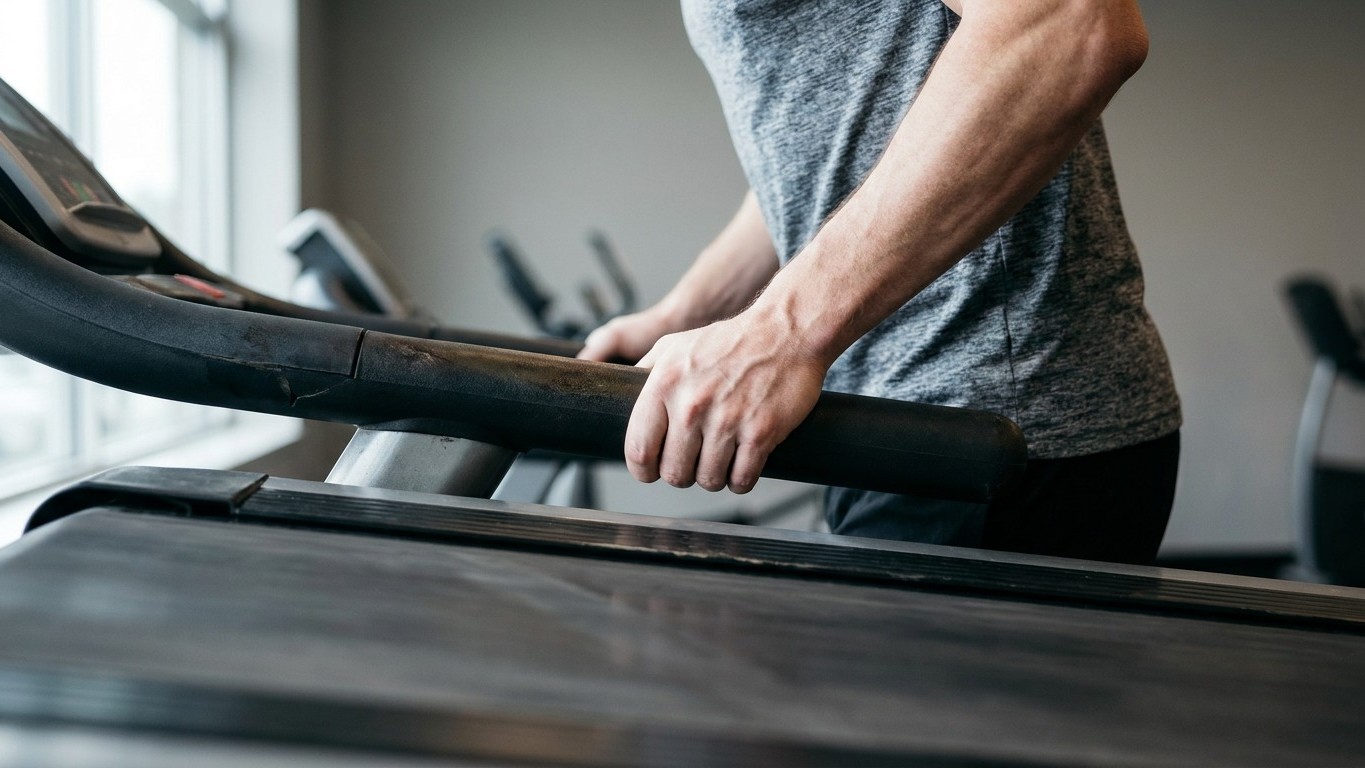
Grip that handrail for more than a few seconds during your treadmill session and you could be Sabotaging-your-real-results/”>Sabotaging up to a third of your workout’s calorie burn without realising it. It sounds dramatic, but the biomechanics behind it are surprisingly simple: the moment your palms clamp down and your body leans back, you’re no longer doing the work. The machine, and your arms, are doing it for you.
Key takeaways
- A single reflex—gripping the handrails—transfers your body weight away from your legs and onto the machine
- At steep inclines, this habit makes a 10% climb burn the same calories as a 5% gentle slope
- Light fingertip contact costs 5-8% of calorie burn, but full-grip leaning can cut it nearly in half
What actually happens when you hold on
The reflex to grab the rails is almost universal, especially at higher speeds or steep inclines, but it comes at a real physiological cost. A 2014 study conducted by Cybex and researchers at the University of Massachusetts—Lowell, published in the International Journal of Exercise Science, looked at how incline, posture and handrail use affected calorie burning during treadmill walking. The findings were stark. If you use the handrails to lean backward while walking, the calorie burn of your workout is reduced by 31.8%. Nearly a third of your effort, gone, simply because your posture shifted and your hands found something to hang onto.
What makes this particularly sneaky is that the sensation doesn’t match the reality. Despite this, it feels like more work to hold the handrails and lean back at a higher incline, even though you’re burning fewer calories. Your brain registers the awkward, tilted stance as effort. Your body, meanwhile, has quietly handed off a chunk of the workload to your arms and the machine’s frame. It’s a bit like paddling a canoe while someone else pulls it along with a rope, you feel busy, but you’re not the one generating the propulsion.
The mechanism is straightforward once you break it down. By leaning on the handrails, you are essentially transferring some of your body weight to the machine, meaning your legs and core muscles have to exert less effort to propel you forward and maintain balance. Your arms, which would normally swing rhythmically and burn calories through repeated muscle contraction, become locked in a static, gripping position instead. Another reason you burn fewer calories while holding onto the treadmill railing is that your arms are in a static position: when you normally walk or run, your arms swing at your sides, causing the muscles in your back and arms to burn calories as they contract and relax with each movement, and holding onto the handrail greatly reduces the amount you are working these muscles. Multiply that lost arm engagement across a 30 or 45-minute session, and it adds up.
Incline is where the habit does the most damage
Handrail gripping becomes almost automatic once the belt tilts upward, which is exactly the setting where it costs you the most. The Cybex research found something genuinely counterintuitive here. Walking at a 10% incline and using the handrails burns about the same calories as walking at a 5% incline without using the handrails. you can double the steepness setting on the display, feel like you’re conquering a mountain, and your body is only doing the work of a gentle slope. The number on the console tells one story; your metabolism is living a completely different one.
I’ve watched this play out at gyms up and down the country, people cranking the incline to double digits, then bracing white-knuckled on the rails as their torso tips backward. It looks impressive. It photographs well for a fitness app. But the physiological truth is closer to standing on an escalator than climbing a hill. Not every grip is equally costly, though, and this matters for anyone genuinely worried about balance. Light fingertip contact for balance only results in a minor calorie reduction, roughly 5–8%, whereas full grip with arm support at steep inclines can cut actual calorie burn nearly in half compared to the console readout. The difference between steadying yourself briefly and settling into a full lean-back is enormous in terms of the number your body actually produces.
Why the console lies to you anyway
Here’s a wrinkle that makes the whole situation more confusing: even if you never touch the rails, the calorie figure flashing on your treadmill’s screen probably isn’t accurate. Research has found that built-in treadmill calorie counters can overestimate actual calorie expenditure by 15-30%, largely because most machines use generic formulas that don’t account for individual body composition. So you’re potentially dealing with two separate sources of inflation, an optimistic algorithm layered on top of a handrail-assisted stride, and the gap between what you see and what you burn can widen considerably.
That’s not a reason to abandon the treadmill altogether. It’s a reason to trust your legs more than the screen. If balance genuinely worries you, particularly for older adults, those recovering from injury, or anyone new to incline training, there’s nothing shameful about a brief steadying touch. Safety comes first, always, and if you feel wobbly enough to fall, grab the rail without hesitation. But if the grip has become a permanent fixture of your session rather than an occasional check-in, it’s worth weaning yourself off it gradually: drop the incline slightly, slow the pace a touch, and let your arms swing naturally until confidence builds back up.
Getting more from the same time on the belt
The fix isn’t complicated, but it does require a bit of deliberate attention, because the handrail habit is so ingrained that most of us reach for it without noticing. Try keeping your posture upright rather than reclined, even when you do need occasional support. Remaining upright and using the handrails while inclined is an alternative that does not reduce the calorie burn of the workout as drastically as leaning back. The leaning, not the touching, is the real culprit. Set your incline to whatever level you can sustain with good posture and free-swinging arms, even if that means dialling back the number from the double digits you’d been showing off. A 6% incline walked properly will do more for your fitness, and your honest calorie count, than a 15% incline spent hanging off the rails like a tired sailor.
Next time you step onto the belt, notice what your hands do in the first thirty seconds. That instinctive reach for the rail is worth catching, because breaking it, even partially, hands your legs and core back the work they were designed to do.
Sources : chefsresource.com | lifefitness.com