
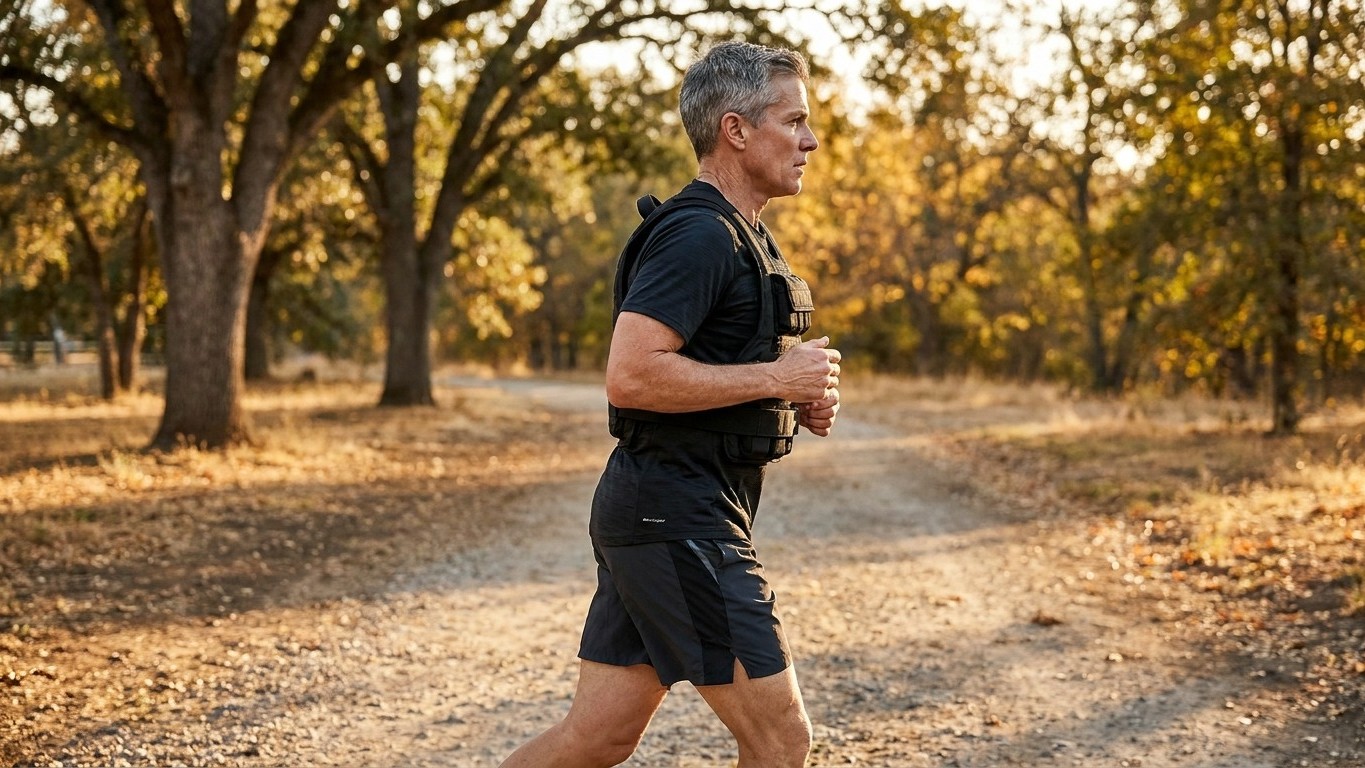
A year of hip protection turned out to deliver less bone-building magic and more of a quiet metabolic bonus. That’s the honest summary after tracking a twelve-month experiment wearing a weighted vest set at roughly 10% of body weight on every single walk, then comparing expectations against what a DEXA scan and the wider research actually show.
The logic seemed sound at the start. Bones respond to mechanical loading, and hips are where osteoporosis does its worst damage in later life. Add weight to the torso during walking, the thinking goes, and you nudge the skeleton into building itself stronger. That idea isn’t fantasy. Walking while wearing a vest weighted with up to 8% of body mass increases loading of the skeletal system, and thus causes increased bone formation and decreased bone resorption in weight stable adults, when compared to sedentary controls. On paper, a full year at 10% should have shown up clearly on a hip scan.
Key takeaways
- A 12-month weighted vest walking experiment didn’t deliver dramatic hip bone density gains—but the reasons why are revealing
- The research shows walking alone, even loaded, is mechanically weaker than combining vests with impact or resistance work
- The real payoff appeared in an unexpected place: metabolic costs and bone preservation during weight loss in older adults
What the scan actually showed
Here’s the nuance that rarely makes it into the marketing copy: walking alone, even loaded, is a weaker stimulus than combining a vest with actual impact or resistance work. One of the most frequently cited trials in this field looked at exactly that distinction. A study by Snow et al. enrolled 18 postmenopausal women, with 9 participants in the intervention group and 9 participants in the control group. Participants in the intervention group used a weighted vest while performing a series of jumping exercises, and participants in the control group did not perform these exercises at all. Crucially, that trial wasn’t testing walking in isolation, it was testing vest-plus-jumping against nothing at all.
The related research that specifically isolates walking with a vest tells a more modest story. The effects of weighted vest walking and strength-training exercises on bone mineral density, balance, strength, and self-efficacy were tested in older women, where eighteen women participated in 32 weeks of supervised strength training and walking, stair climbing, and balance exercises while wearing weighted vests, with measures including BMD of the hip and lumbar spine by DEXA. The result wasn’t nothing, but it was hardly transformative: the exercise group had significant improvements in bone density of the femoral neck and balance and a significant weight loss. That’s femoral neck, not total hip, and the programme included strength training and stair climbing alongside the walking, not vest-walking as a standalone habit.
One respected bone health resource puts the physics bluntly. When adding a weighted vest, the forces through our bones only increase by the amount of added weight, typically 5-10%, so wearing a weighted vest while walking is not likely to provide significantly more benefit to our bones than walking without it. That’s a sobering reality check for anyone who assumed strapping on extra kilos would work bone-building miracles on its own. The same source notes a comparison worth sitting with: running is stimulatory for bones because running provides mechanical forces through our bones that are double the forces from walking. A loaded stroll simply isn’t in the same league as a jog, mechanically speaking.
Where the real benefit showed up
If the hip scan wasn’t the dramatic before-and-after story hoped for, the metabolic side of things was more convincing. Carrying extra load costs energy, and that’s measurable, repeatable, and not dependent on months of biological adaptation. A 2024 metabolic-cost study directly measured the energy cost of walking with weighted vests at multiple loads and grades, confirming proportional energy expenditure with added mass, though the caloric increases are real but modest in absolute terms. Marketing claims about vest walking torching calories tend to overstate this. It’s a nudge, not a transformation, but a nudge sustained daily for a year adds up in a way a single dramatic session never would.
There’s also a specific population where the evidence for vests looks stronger, and it isn’t healthy walkers hoping to bulletproof their hips. It’s older adults deliberately losing weight, who risk losing bone alongside fat. Research examining daily weighted vest use during a dietary weight loss intervention in older adults with obesity found that wearing a vest for a goal of 10 or more hours a day, with weight added incrementally based on amount lost, attenuated the bone loss that typically accompanies caloric restriction. Wake Forest University researchers took this seriously enough to secure substantial funding for a larger trial. Losing weight can be a tricky balance of risks and benefits for older adults, since you want to shed fat to improve overall health but preserve muscle and bone, and with a $2.9 million grant from the National Institute on Aging, researchers tested whether wearing a weighted vest can take the place of traditional resistance training to help maintain bone density. That’s a genuinely different use case from walking the dog with extra kilos strapped on.
Getting the load and the vest right
None of this means a weighted vest is pointless, it means the dose and the design matter more than the marketing suggests. Guidance varies by walking pace, and it’s worth respecting. If you walk at a slow pace, build up to a heavier weight of 15% to 20% of your body weight, whereas if you walk at a brisk pace, 10% to 15% of your body weight is appropriate and even small adjustments will have a greater benefit. Vest design also matters more than most people assume. Vests weighted only at the shoulders can increase downward pressure on the spine, worsen kyphosis, and raise fracture risk, so look for vests that distribute weight across the torso, ideally near the hips and waist.
If you’re currently healthy and simply curious, a vest starting light and progressing gradually towards that 10% mark is a reasonable, low-risk way to add intensity to an existing walking habit. If you already have diagnosed osteoporosis, a spinal condition, or joint concerns, this is exactly the territory where a chat with your GP or a physiotherapist before you start matters, not as box-ticking, but because the wrong load or the wrong vest can genuinely do more harm than good. My own year in a vest didn’t rebuild my hips from scratch, but it did make we wonder less about whether I was doing enough, and that peace of mind, backed by a sensible amount of evidence, was worth the extra weight on my shoulders.
Sources : hes.wfu.edu | pubmed.ncbi.nlm.nih.gov