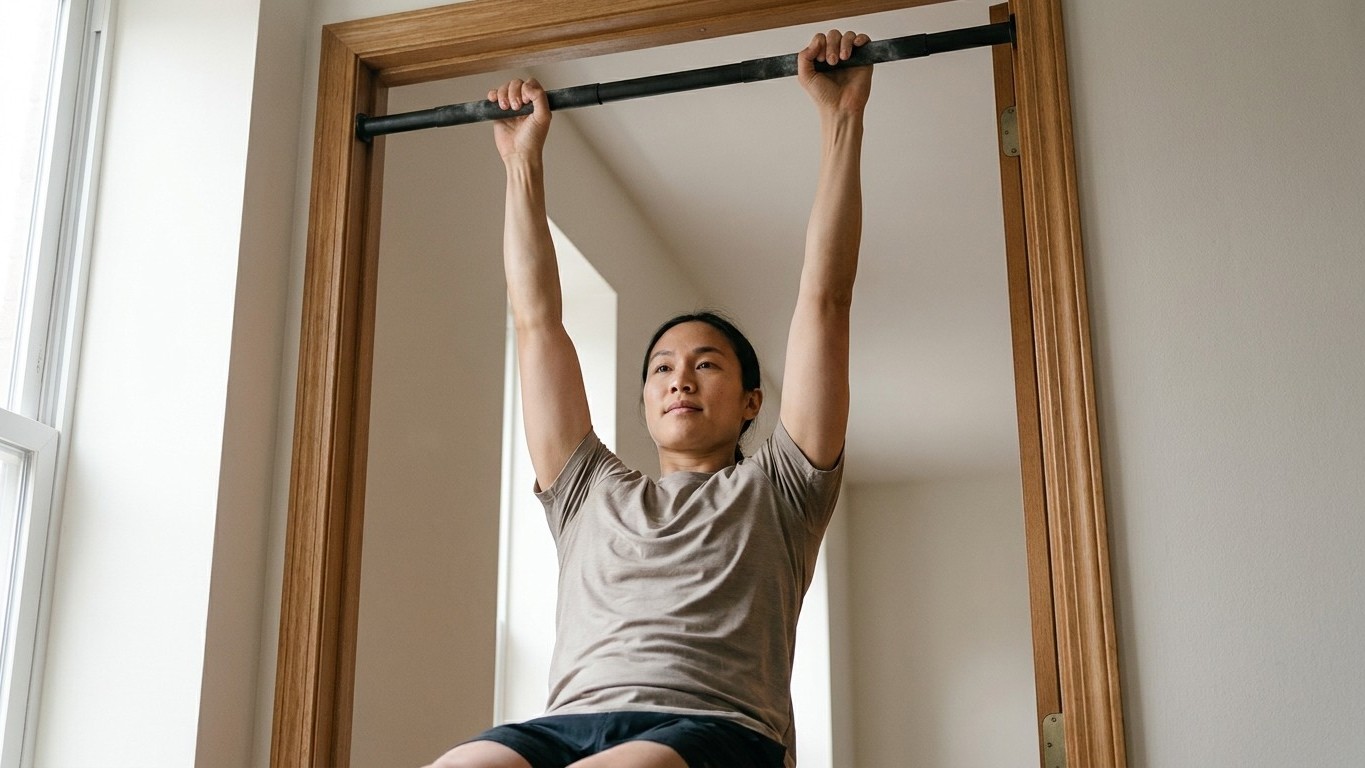
Thirty seconds used to feel like nothing. I’d grab the doorway bar most evenings, let my spine stretch out after a day hunched at a laptop, and drop back down feeling looser through my shoulders and lower back. Then one evening, about four months in, my fingers simply gave out at eighteen seconds. No warning, no cramp, just a slow uncurling of my hand as if someone else was in charge of it. That’s when I started reading about what a failing grip actually signals, and the research turned out to be far more interesting than “you need to do more pull-ups.”
Key takeaways
- One evening, eighteen seconds was all I could manage—what seemed like a weak moment turned out to be measuring something far bigger
- Grip strength predicts mortality better than blood pressure, according to landmark clinical research spanning decades
- The trajectory matters more than any single performance—but the good news is forearms respond quickly to consistent effort
What the hang was doing for my back in the first place
The habit started simply enough. Sitting compresses the spine, and hanging reverses that, if only briefly. A dead hang may decompress and stretch out the spine, and it may be beneficial if you sit often or need to stretch out a sore back. There’s also a shoulder benefit that most people don’t expect from something so passive. A dead hang fully extends your shoulders, which can release muscle tension, enhance flexibility, and increase range of motion, while pulling the shoulders back into proper alignment.
Chiropractors who see this move recommended constantly describe a similar pattern. Done right, hangs can decompress the spine, reduce back pain, improve shoulder mobility, strengthen grip and forearms, reverse bad posture and increase circulation to the muscles in the back. None of that felt dramatic on any given evening. It was the accumulation, thirty seconds here, thirty there, that made my back feel less like a rusted hinge by the end of the week. I genuinely thought the point of the exercise was the stretch. The grip was just the thing that happened to be holding me up.
The night the grip gave out, and why that mattered more than the stretch
Losing my hold that quickly rattled me enough to look into it properly, and what I found reframes the whole exercise. Handgrip strength isn’t just a measure of hand and forearm muscle. It’s one of the most studied, cheapest, and oddly powerful predictors of health outcomes in the whole of clinical research. A landmark analysis in The Lancet, drawn from the huge international PURE study, found that grip strength was a stronger predictor of all-cause and cardiovascular mortality than systolic blood pressure. Read that again: a simple squeeze test outperforming a blood pressure cuff, one of the most routine measurements in any GP surgery.
That finding isn’t a one-off. A Japanese cohort study following nearly 5,000 people for almost three decades established that grip-strength measurement is useful for assessing approximate overall muscle strength of middle-aged and elderly people, and longitudinal studies revealed that it also predicts health-related prognosis. Norway’s Tromsø Study, tracking almost 7,000 people over seventeen years, found something similarly stark: a 1 SD reduction in grip strength was associated with a 17% higher risk of all-cause mortality, even after adjusting for age, sex and body size. A more recent analysis of NHANES data put a number on the decline that’s easy to picture: per 5-kg lower handgrip strength was associated with a 36% higher risk of all-cause mortality in men, and a 49% higher risk in women.
Nobody is suggesting a wobbly doorway hang diagnoses anything. But the biological logic behind these numbers is fairly intuitive once you sit with it. Grip strength isn’t really about hands. It’s a proxy for whole-body muscle mass, nervous system function, and how well your body is ageing overall, which is exactly why researchers keep circling back to it instead of something more hand-specific.
What a weak night actually tells you
My eighteen-second collapse wasn’t a medical event. It was, more likely, a bad night’s sleep, a stressful week, maybe slight dehydration, all things that quietly sap forearm endurance before you’d notice them anywhere else. But it did make me pay attention to grip as a trend rather than a single evening’s performance, which is closer to how researchers actually use it. The Newcastle 85+ Study, following the very old over several years, found that weak grip strength is a key component of sarcopenia and frailty and a powerful predictor of mortality, morbidity and disability. It’s the trajectory that matters, not one shaky evening.
There’s a useful mirror image here too. Research on very old adults found that decline wasn’t destiny: men and women with a negative slope in grip strength had a substantially increased risk of mortality with every kg/year decline, while a 5-year increase in grip strength was protective, irrespective of baseline strength. Strength trained now, appears to buy something back later, whatever your starting point happened to be.
If you want to build the habit properly rather than just testing yourself into anxiety, the technique is worth getting right. Grip the bar with hands roughly shoulder-width apart, thumbs wrapped round for security, arms straight but shoulders gently drawn down rather than shrugged up towards your ears. If you can’t manage a full hang yet, keep your feet on a step or the floor and let your arms take partial weight, building up gradually. Anyone with a rotator cuff issue, a recent shoulder injury, or ongoing back pain should check with a physiotherapist or their GP before adding this to an evening routine, since a passive hang isn’t risk-free for everyone.
The bit I didn’t expect
What surprised me most wasn’t the mortality data, it was how quickly grip endurance came back once I paid attention to it. Within three weeks of tracking hang times rather than ignoring them, I was back past thirty seconds, then forty, without doing anything resembling a proper strength programme, just the same doorway bar, slightly more consistently. The forearms, it turns out, respond fast to being asked something of them regularly. That eighteen-second night wasn’t a warning about my spine at all. It was my grip, quietly and briefly, telling on the rest of me.
This article is for general information and doesn’t replace personalised medical advice. If you’re dealing with persistent back pain, shoulder problems, or a grip that’s weakening over time rather than on one off night, do see your GP.
Sources : ncbi.nlm.nih.gov | nature.com