
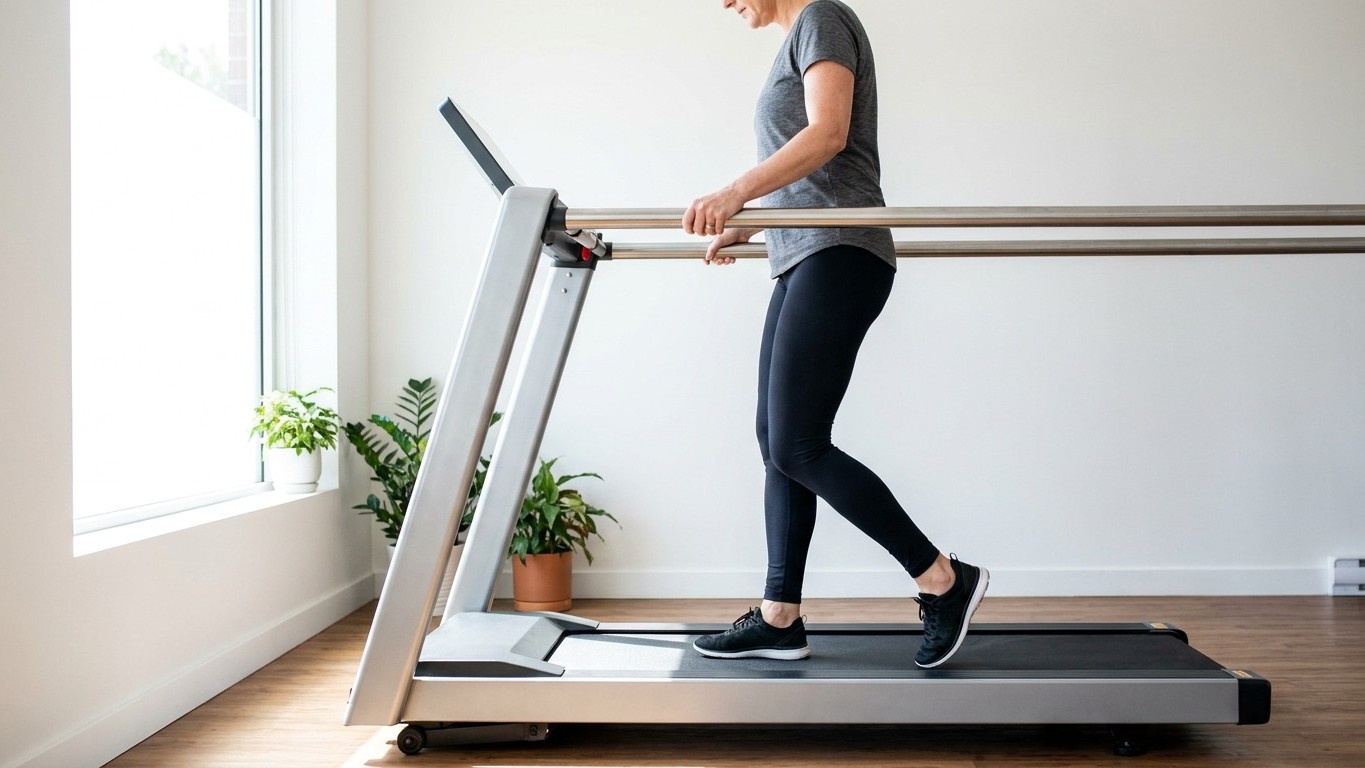
A physiotherapist told me something that changed how I see this whole trend: when you walk backwards, your knee bends without the shearing stress that forward strides put on the joint. Reverse walking activates the quadriceps far more intensely than normal walking, yet it does so through a movement pattern that reduces the load on the inner, medial part of the knee, the exact spot where most age-related arthritis takes hold. walking backward relieves pressure on the inner side of the knee, where many older adults develop arthritis. That’s not something a lunge, a squat, or a brisk forward walk can replicate in quite the same way.
Key takeaways
- One simple movement pattern activates your thigh muscles harder while paradoxically reducing pressure on your most vulnerable knee compartment
- Clinical trials show six weeks of backward walking beat standard exercises at reducing pain and improving strength in people with knee arthritis
- This isn’t a miracle cure, but the biomechanics reveal something forward movement fundamentally cannot do
The mechanics behind the movement
Forward walking and backward walking look like mirror images, but the joints don’t Experience them as opposites. When walking forward, the heel strikes the ground first, rolling onto the toes, which propels the body forward. In contrast, retro walking begins with the toe contacting the ground, rolling back to the heel. That reversed contact pattern changes which muscles absorb the impact and how the knee tracks through each step.
The quadriceps, the muscle group running along the front of your thigh, does most of the heavy lifting during backward walking. Walking forward uses muscles on the front of the thigh, the quadriceps, but these muscles are even more strongly activated when moving in reverse. Greater quad activity causes the knee to stretch more, which can help alleviate knee pain and reduce muscle tightness. What genuinely surprised me is that this stronger quad engagement doesn’t come at the cost of ligament strain. It is also one of the few natural ways of strengthening the quadriceps. It prevents excessive stretching of the anterior cruciate ligament and improves the stability of the knee joint. For anyone nursing an ACL concern or recovering from a knee injury, that distinction matters enormously.
There’s a load-bearing angle to this too. Researchers studying knee osteoarthritis have focused on something called the knee adduction moment, essentially a measure of how much force gets funnelled through the inner compartment of the joint with every step. Backward walking exercise has been shown to improve lower muscle strength and reduce knee adduction moment, making it a recommended intervention for knee OA rehabilitation. Less force through that already-vulnerable compartment, combined with stronger supporting muscles, is a fairly rare combination in exercise terms.
What the trials actually found
I’m always wary of gym trends that outpace the research, so I went looking for the trial data rather than taking anyone’s word for it. A randomised controlled trial comparing six weeks of retro walking against forward walking and a control group found measurable gains. The retro walking group had a greater improvement in quadriceps muscle strength (mean changes, 1.7 kg versus 0.7 kg) and the timed up and go test (mean changes, 0.6 s versus 0.1 s) than the control group. The same trial concluded that the 6-week retro walking program compared with forward walking or control groups resulted in greater reduction in pain and functional disability and improved quadriceps muscle strength and performance in individuals with knee OA.
A more recent systematic review pooling thirteen randomised trials backs this up on a larger scale. Combining backward walking with standard rehabilitation produced substantial improvements over rehabilitation alone, with the review reporting a significant reduction in pain intensity and improvement in disability (Hedges’ g around −1.0 for both measures). That’s a sizeable effect for something as simple as walking in reverse for a few minutes at a time.
None of this means backward walking is a miracle cure, and I’d be doing you a disservice to suggest otherwise. Most trials run for only three to six weeks, participants are usually walking on a treadmill under supervision, and the studies rarely account for people’s medication use or how active they already are day to day. The improvements are real, but they’re best understood as an addition to proper rehabilitation, not a replacement for it.
How to try it without doing yourself a mischief
Safety comes first with this one, obviously enough, given you can’t see where you’re going. Most physios start clients on a treadmill at a very low speed, holding the side rails, before ever considering an open floor. If you don’t have access to a treadmill, a clear stretch of flat, obstacle-free flooring indoors works, ideally with someone nearby the first few times. Begin with short bursts, perhaps thirty seconds to a minute, building up gradually rather than launching into ten minutes on day one.
A few practical points worth keeping in mind:
- Keep steps short and controlled rather than long strides, which reduces the risk of losing balance
- Wear supportive, flat-soled trainers rather than walking in socks or bare feet on slippery flooring
- Stop if you feel sharp pain, dizziness, or genuine instability, as opposed to normal muscle fatigue
- Anyone with significant balance problems, vertigo, or advanced knee OA should check with a physiotherapist first
There’s also a balance and coordination dimension that doesn’t get nearly enough attention. Studies have shown that backward walking has a helpful effect on improving lower limb proprioception, gait synergy and improving limb balance. Proprioception, your body’s internal sense of where your joints are in space, tends to decline with age and after injury, and it’s genuinely difficult to train through conventional gym exercises alone.
If you’re someone managing early knee wear and tear, or simply looking for a low-impact way to build quad strength without hammering the joint, adding a few minutes of backward walking to your existing routine, two or three times a week, appears to be low-risk and reasonably well supported by the evidence. As always, if you have an existing knee condition or you’re recovering from surgery, run it past your GP or physiotherapist before adding it in, since the studies I’ve mentioned were carried out under professional supervision rather than as a solo gym experiment.
Sources : ncbi.nlm.nih.gov | researchgate.net