
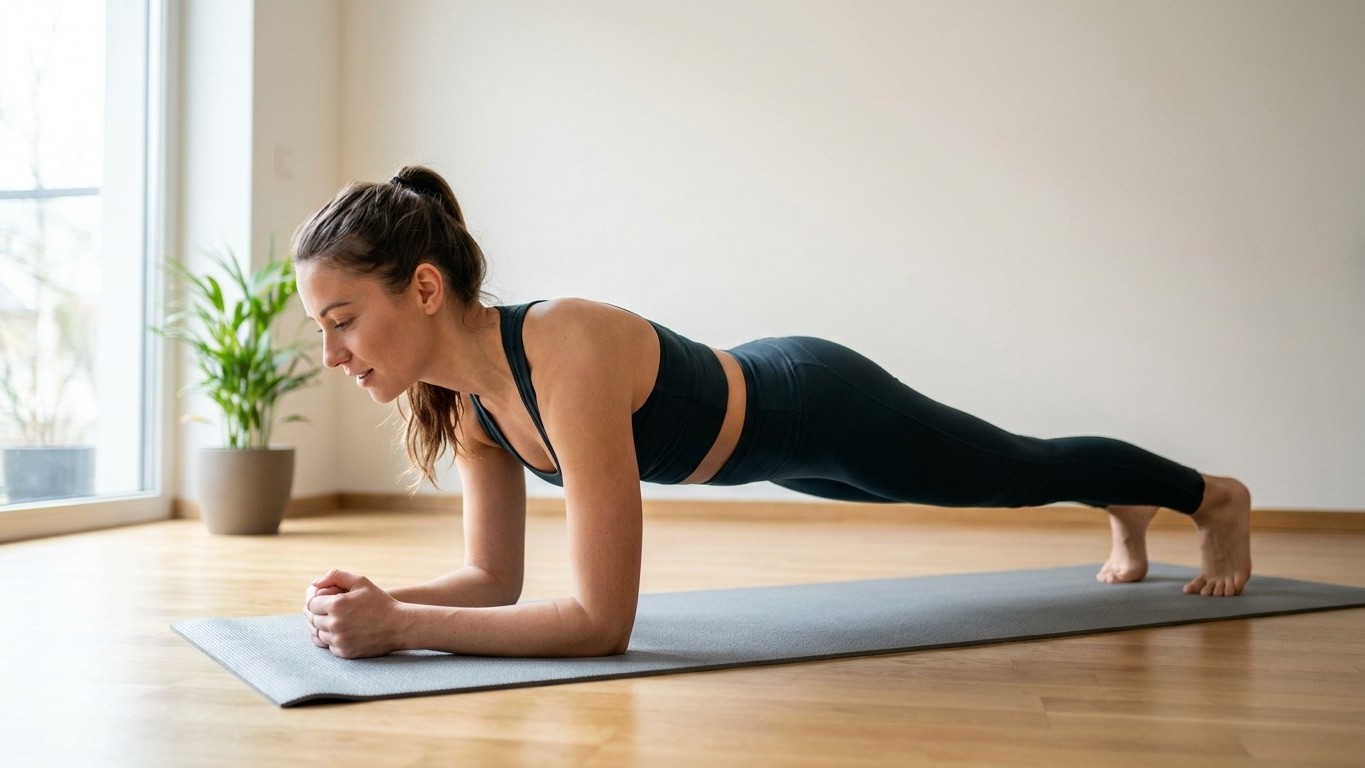
Breath-holding during a plank can send your systolic blood pressure soaring past 200mmHg within seconds, even if your resting numbers are perfectly normal. That’s the uncomfortable truth behind the story of holding a plank longer and longer each morning, only to have a cardiologist’s cuff reveal what was really happening: a textbook case of the Valsalva manoeuvre, the same breath-holding trick used to pop your ears or bear down during labour, quietly turned into a daily habit.
Key takeaways
- A breath-holding plank triggers the Valsalva manoeuvre, causing blood pressure spikes that can exceed readings during intense weightlifting
- Research shows isometric exercises like planks outperform aerobic exercise and HIIT at lowering blood pressure when done properly
- The danger isn’t the plank itself—it’s the breathing pattern that transforms a therapeutic exercise into an accidental cardiovascular stress test
What actually happens when you hold your breath under strain
The Valsalva manoeuvre isn’t some obscure medical curiosity. It’s a particular way of breathing that increases pressure in the chest, causing various effects in the body, including changes in heart rate and blood pressure. When you clamp your airway shut and push against it, whether straining on the toilet or gritting your teeth through minute three of a plank, your body cycles through four distinct phases. In the first phase, blood pressure temporarily rises as some blood enters the aorta. Then, as intrathoracic pressure reduces, blood pressure falls, and a sensor in the carotid artery called the baroreceptor detects the increased blood pressure, causing blood vessels to narrow and the heartbeat to speed up. The real sting comes at the end: typical blood flow to the heart resumes, causing blood pressure to increase and overshoot its baseline. That overshoot is precisely what a cardiologist’s cuff can catch mid-plank or immediately after, and it’s often far higher than anything you’d see during a brisk walk or a jog.
This isn’t limited to amateur exercisers gritting their teeth in a home gym. Research on weightlifters found something similar decades ago: systolic blood pressure is often in excess of 200 mmHg during resistance exercise, depending on the force and length of the Valsalva manoeuvre, with one study finding readings of 198/175 mmHg when subjects exhaled slowly compared to 311/284 mmHg with a closed glottis. Those are startling numbers for anyone to see on a screen, cardiologist or not. Duration matters too, more than most people assume. Blood pressure rises linearly with every second of exertion, making a five-second limit the maximum threshold for most healthy athletes performing a full Valsalva hold. A two-minute plank, held with a locked jaw and no exhale, is a very different physiological event to a five-second brace.
The plank paradox: harmful in the moment, helpful over time
Here’s where it gets genuinely interesting, and slightly counterintuitive. The acute spike during a badly-breathed plank is real and worth respecting, but the long-term story for isometric holds like planks and wall sits is remarkably positive. A 2023 systematic review examined 270 trials carried out around the world between 1990 and 2023, comparing aerobic exercise, isometric holds, resistance training, combined training and HIIT for lowering blood pressure. The finding surprised even seasoned researchers: while all five programmes reduced blood pressure, isometric exercises were the most effective, followed by combined training, resistance training, aerobic exercise, and HIIT. Wall sits, close cousins of the plank, came out on top of the entire list.
Jamie O’Driscoll, senior author of that research from Canterbury Christ Church University, explained the mechanism behind this. The static contraction squeezes the vessels supplying blood to the working muscles, reducing blood flow during the hold, and when the muscle relaxes afterwards it causes a large flow of blood through the vessels, likely the trigger driving improvements in blood flow regulation. His practical guidance was refreshingly specific: performing four sets of two-minute wall sits, with two minutes’ rest in between, three times per week, is an effective way to reduce your blood pressure. Notice the rest periods built into that protocol, and the sensible two-minute cap, rather than an ever-lengthening personal best chased every morning.
More recent work on the plank specifically backs this up. A 2025 randomised cross-over trial published in Clinical Hypertension looked at young adults with prehypertension and found that isometric plank exercise significantly reduced 24-hour systolic and diastolic blood pressure and improved nighttime blood pressure variability, providing preliminary evidence that it may serve as a potential nonpharmacologic strategy for early BP management. The researchers noted this benefit likely stems from the sheer amount of muscle recruited during a proper plank, given that the larger muscle mass engagement during plank exercise may have contributed to the favourable BP response observed in this study.
Breathing your way through it, without the drama
None of this means the plank is dangerous. It means the breathing pattern around it matters enormously, more than the duration itself. Fitness professionals have long flagged this exact issue in resistance training generally: to prevent clients from performing a Valsalva manoeuvre, instructors caution against holding the breath and teach appropriate breathing technique, encouraging clients to talk or count during the exertion to minimise breath holding. The same logic applies flat on your forearms on a yoga mat as it does under a barbell.
Practically, that means counting out loud, humming, or simply reminding yourself to breathe in a steady rhythm through your nose while your core stays braced, rather than sealing your throat shut and turning puce for two minutes straight. If you have existing high blood pressure, a history of stroke, or any cardiovascular condition, this becomes more than a comfort issue. If you have high blood pressure or are at risk of developing high blood pressure, it’s important to monitor your blood pressure regularly to identify any potential problems before they become more serious. A quick chat with your GP before chasing personal bests in any isometric hold is sensible, not excessive caution.
The irony worth sitting with is this: the very exercise that spiked one person’s blood pressure so alarmingly in a cardiologist’s office is, done with proper breathing and sensible rest intervals, one of the best-evidenced tools we currently have for bringing blood pressure down over weeks and months. The problem was never the plank. It was the held breath turning a beneficial isometric squeeze into an accidental stress test.
Sources : pubmed.ncbi.nlm.nih.gov | pmc.ncbi.nlm.nih.gov