
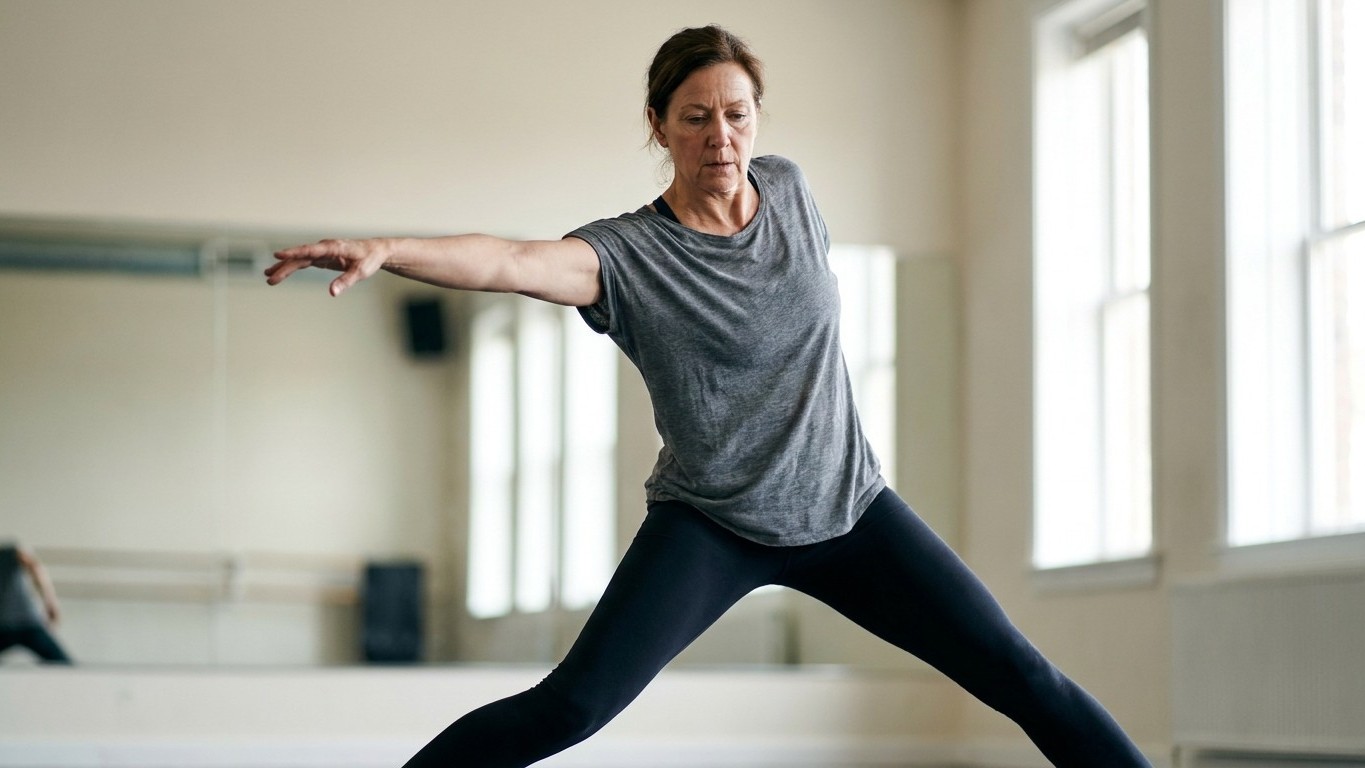
Fifty-two healthy adults over 63 spent six months exercising for the same amount of time and at matched intensity, yet only one group finished with measurably better brain chemistry. The difference wasn’t the treadmill or the stationary bike. It was dancing.
This six-month-long program was compared to conventional fitness training matched for intensity. Researchers at the German Center for Neurodegenerative Diseases in Magdeburg wanted to know whether burning the same number of calories through different movement patterns would produce different effects on the ageing brain. Dancing compared to conventional fitness activity led to larger volume increases in more brain areas, including the cingulate cortex, insula, corpus callosum and sensorimotor cortex. Perhaps most tellingly, only dancing was associated with an increase in plasma BDNF levels. Same calorie burn, same time on your feet, but one workout left a chemical fingerprint the other didn’t.
Key takeaways
- Two groups burned identical calories over six months, yet only one showed measurable improvements in brain chemistry
- The difference had nothing to do with intensity or duration—it came down to novelty and cognitive demand
- Your brain responds differently to activities that force constant learning versus repetitive mechanical movements
What made the dancing group’s brains respond differently
The researchers didn’t hand participants a simple step routine and let them coast. The participants changed steps, arm-patterns, formations, speed and rhythms every second week to stay in a constant learning process. According to lead author Dr Kathrin Rehfeld, “the most challenging aspect for them was to recall the routines under the pressure of time and without any cues from the instructor.” That constant demand to learn something new, rather than repeat the same mechanical stride, appears to be the key ingredient.
This tracks with a broader idea in exercise neuroscience: a combination of physical activity and sensory enrichment has the largest and the only sustaining effect on adult neuroplasticity, and dancing has been suggested as a human homologue to this combined intervention as it poses demands on both physical and cognitive functions. A treadmill session asks your legs to repeat one motion for an hour. A dance class asks your brain to predict, adjust, remember and physically execute a constantly shifting sequence, while your cardiovascular system works just as hard underneath it all. I find this genuinely reassuring as someone who has always found the gym treadmill mind-numbing: the boredom you feel isn’t just in your head, it may actually be costing you a brain benefit that a livelier session would deliver for free.
It’s worth noting that both groups in the Magdeburg study did improve. Overall, both groups showed an increase in the hippocampus, but the dance group also showed a significant difference in balance compared to their counterparts. Balance matters enormously in later life, since age-related mental decline is linked to balance disturbances and cognitive impairment. So the treadmill isn’t wasted time. It’s just outperformed.
Coordination, not just cardio, seems to be the active ingredient
Other researchers reviewing this field have reached similar conclusions about complex, coordinated movement. Coordination, another hallmark of mind-body exercise, also promotes neuroplasticity, and high coordination, complexity and novelty may be key to cognitive benefits. It appears able to stimulate various cognitive domains simultaneously, and increases the volume of brain regions such as the hippocampus, cingulate cortex and insula. Separate imaging work comparing training types found that cardiorespiratory training such as aerobic exercise was associated with increased sensorimotor network activation, while coordination exercise was associated with increased visual-spatial network activation and had a positive effect on cognitive processing speed. They’re not doing identical jobs on your brain, even when they’re doing an identical job on Your Heart Rate monitor.
None of this makes steady cardio pointless, and I’d never suggest binning your treadmill routine. Aerobic work still has strong evidence behind it: aerobic exercises like walking, jogging, swimming, and biking enhance blood flow, stimulate BDNF release, and support memory and executive function. But if you’re choosing between two hours you could spend either repeating the same stride or learning a new sequence of steps, the evidence increasingly favours variety and challenge over pure repetition.
What this means for your Tuesday evening workout
You don’t need to become a competitive ballroom dancer to borrow this effect. The mechanism seems to be novelty combined with sustained physical effort, not dance specifically. A boxing class where combinations change weekly, a coordination-heavy circuit session, or genuinely learning a new sport all plausibly tap the same pathway that a monotonous jog doesn’t. What matters is that your brain has to keep learning, not just your legs keep moving.
For anyone currently doing forty-five minutes on a treadmill purely out of habit, swapping even one weekly session for a structured dance class, an adult ballet beginner course, or a salsa night at the local leisure centre costs you nothing in calorie terms and, based on this research, may hand your hippocampus something a flat stretch of belt never could. If group classes aren’t your thing, look for any activity that forces you to memorise a changing sequence: choreographed HIIT formats, martial arts katas, even complex skipping-rope routines share that same learning demand. As always, if you’re managing a health condition or returning to exercise after injury, it’s worth having a quick word with your GP before ramping up anything new, but for most healthy adults this is simply a case of making your existing hour work a little harder for the organ that actually decides how well you’ll remember doing it.
Sources : journals.physiology.org | ncbi.nlm.nih.gov