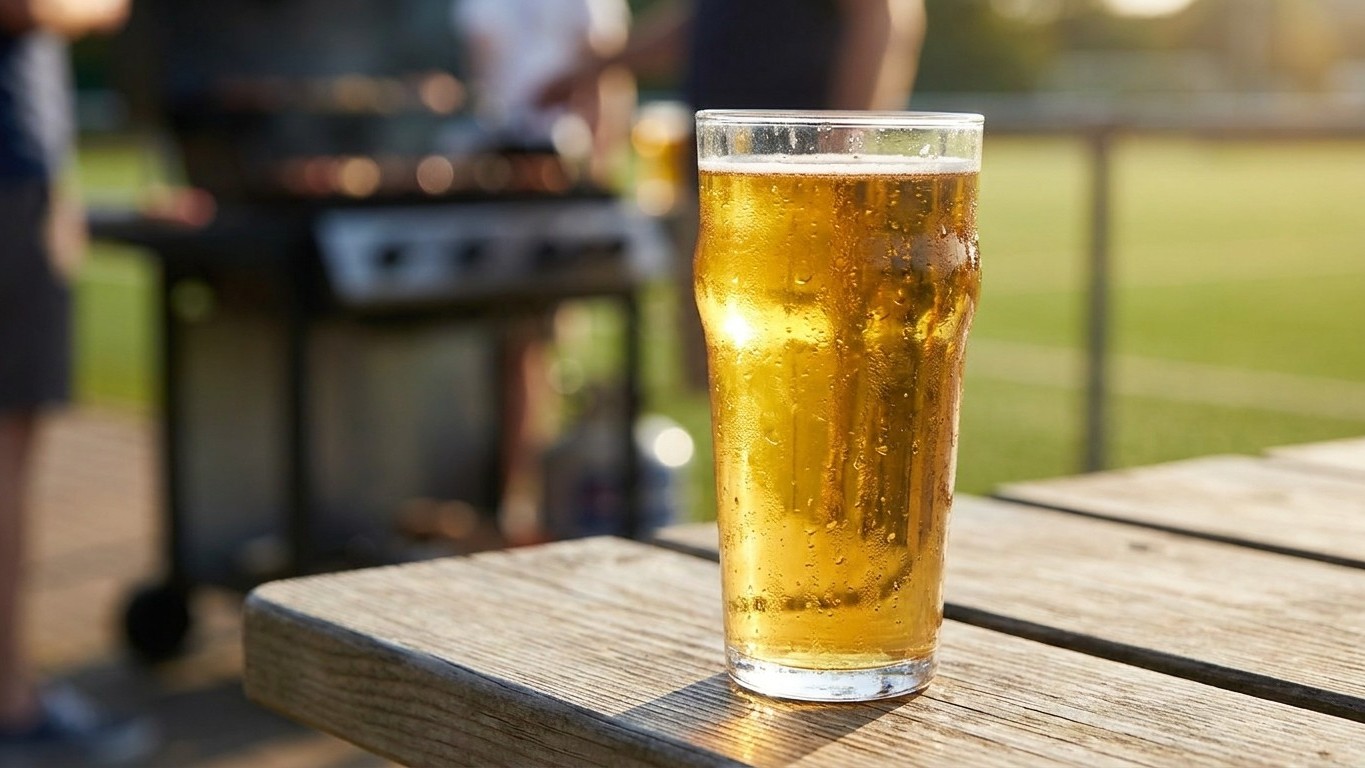
That ice-cold pint waiting for you at the post-training barbecue feels like exactly What Your Body Is craving. It’s cold, it’s wet, it goes down easily after an hour of running or five-a-side in 28°C heat. The trouble is that beer does almost the opposite of what you think it does, and the science on this is now fairly settled: alcohol interferes with your body’s ability to hold onto fluid at precisely the moment you need to be replacing what you’ve sweated out.
Key takeaways
- Why does alcohol feel refreshing when it’s actively dehydrating you more?
- One study found full-strength beer left athletes with just 21% fluid retention versus 42% for sports drinks
- There’s a surprisingly simple sequence that lets you enjoy that beer without sabotaging recovery
What alcohol actually does to a dehydrated body
Alcohol suppresses the release of vasopressin, the hormone that tells your kidneys to conserve water. Alcohol has classically been shown to exert its diuretic action by the inhibitory effect of ethanol on vasopressin release from the posterior pituitary gland. In practice, that means you produce more urine than the volume of liquid you’ve actually drunk, which is the opposite of rehydration. Drinkaware puts it plainly: alcohol is a diuretic, which means it encourages the kidneys to get rid of fluid, and that’s why you tend to urinate much more when you drink alcohol.
Here’s where it gets more interesting, and slightly more forgiving than you might expect. A well-known study published in the Journal of Applied Physiology found that the diuretic effect of alcohol is substantially blunted when alcohol is consumed by individuals who are in a state of hypohydration induced by exercising in the heat. So the classic “beer makes you pee more” effect doesn’t apply quite as brutally once you’re already dehydrated from training. Researchers in that trial found that even with alcohol added, alcohol has a negligible diuretic effect when consumed in dilute solution after a moderate level of hypohydration induced by exercise in the heat. That’s a genuine nuance worth knowing. It doesn’t mean beer is a good rehydration choice, just that the doom scenario of a pint actively draining you dry the moment you’re already parched is somewhat overstated.
The evidence from the lab: beer against water and sports drinks
Where the real problem shows up is in direct comparisons. A Dutch crossover study from Wageningen University had active men cycle until they’d lost 1% of their body mass in sweat, then rehydrate with non-alcoholic beer, low-alcohol beer, full-strength beer, an isotonic sports drink, or plain water. The full-strength beer performed worst on every measure. After 1 h, urine production was significantly higher for 5% beer compared to the isotonic sports drink, and at the end of the 5-h observation period, net fluid balance was negative for all conditions, with the poorest fluid retention percentage for 5% beer (21% fluid retention) and the best percentage for the isotonic sports drink (42%). That’s a striking gap: your body kept less than a quarter of the beer you drank, against nearly half of the sports drink.
A separate study out of the University of Costa Rica pushed the point further by testing not just fluid balance but actual physical function. Men were dehydrated by around 2% of body mass through exercise, then rehydrated with full-strength beer, low-alcohol beer, or water. The conclusion was blunt: rehydration with beer resulted in higher diuresis, slower reaction time, and impaired postural control than rehydration with low-alcohol beer or water. This matters beyond the barbecue banter. If you’re driving home, walking near a barbecue grill, or heading back onto a pitch for a second half, a slower reaction time and worse balance are not trivial side effects. The researchers behind that study made a point that’s worth repeating: beer is promoted by popular media as a good choice for rehydration, but there is limited support for the claim.
There’s also the mineral content to consider. Beer simply isn’t built for the job. The majority of beers have a sodium concentration in the range of 3–5 mmol/l, and as a result of this low electrolyte content, beer will not enable rehydration to be achieved as effectively as a specially designed oral rehydration solution. Sodium is exactly what your kidneys need in order to hold onto water rather than flush it straight back out, and beer simply doesn’t bring enough of it to the table.
What this means for your Saturday session in the heat
None of this means one beer after a hot training session is dangerous for a healthy adult who has already rehydrated properly. A moderate amount of beer, drunk alongside water and some food, doesn’t appear to derail recovery in the way older gym folklore suggested. One Spanish crossover trial testing up to 660ml of beer after dehydrating exercise in the heat concluded that restoration of markers of hydration after a dehydrating bout of exercise in the heat is not negatively influenced by the acute intake of a moderate amount of beer as part of the rehydration strategy. The catch is the order of operations. That study also found something most of us get wrong: voluntary fluid intake in the 2 h following exercise and based on thirst sensation is not enough to completely recover the initial hydration status, whether or not beer is involved. In plain terms, thirst lies to you after exercise, and most people stop drinking long before they’ve actually replaced what they lost.
The practical sequence that the research supports is straightforward. Water or a proper oral rehydration drink first, ideally with something salty to eat alongside it. Only once you’ve replaced the bulk of your fluid losses should the pint make an appearance, and even then, treating it as a treat rather than a hydration strategy:
- Rehydrate with water or an electrolyte drink within the first hour after training in the heat
- Eat something salty (crisps, olives, cured meat) to help your body retain the fluid you drink
- Weigh yourself before and after hard sessions in hot weather, since every kilogram lost is roughly a litre of sweat to replace
- Save the beer for once your urine has returned to a pale straw colour, not dark yellow
One detail that rarely gets mentioned: heat itself changes how alcohol affects you. Research on thermoregulation has shown alcohol can interfere with the body’s ability to dump heat efficiently during warm exposure, which is part of why a beer garden session on a genuinely hot day leaves people feeling worse, not better, faster than the same drinks would on a mild evening. If your GP has advised you to watch your fluid intake for any reason, kidney health, heart failure, or medication interactions among them, that advice takes priority over anything in this article, so do check with them before making changes to how you rehydrate after exercise.
Sources : link.springer.com | tandfonline.com