
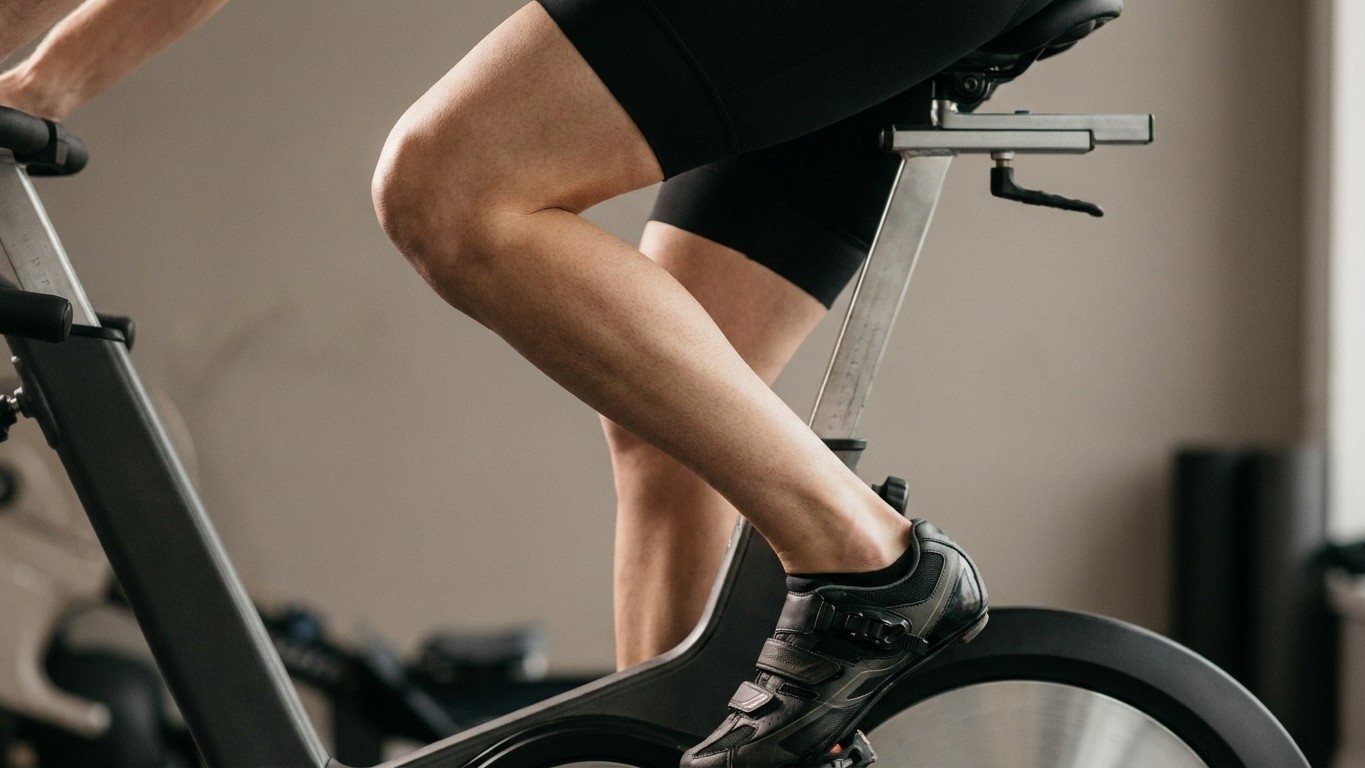
That numbness and bruising you feel after a 45-minute spin class almost never comes from the padding itself. It comes from a saddle sitting just a few centimetres too high, forcing your hips to rock side to side with every pedal stroke and grinding your sit bones against the narrower, less supportive part of the seat.
Most people blame the equipment. The studio bike feels unforgiving, so the instinct is to add a gel cover or switch bikes next time. But bike fitters see this pattern constantly: a high saddle forces the pelvis to rock across the top of the saddle because the legs can’t dynamically extend far enough, and it tends to shove you forwards onto a narrower and less supportive section of the seat. That’s the real source of the ache, not the density of the foam underneath you.
Key takeaways
- A saddle just a few centimetres too high forces your body into a compensatory movement pattern that lasts hundreds of pedal strokes per class
- This rocking motion shifts pressure away from your sit bones onto softer tissue that wasn’t designed to bear load, causing bruising and numbness
- The heel method can reveal saddle height errors in minutes—and most gel covers and seat upgrades won’t help until this geometry is corrected
What actually happens when the saddle sits too high
Picture the bottom of your pedal stroke. If the saddle is set correctly, your knee holds a gentle bend as your heel reaches the pedal. Set the saddle too high, though, and your body has to improvise to reach that pedal at all. The opposite problem occurs when your saddle is too high: your legs overextend and your hips start to rock side to side to reach the bottom of each stroke, wasting energy and straining the lower back, Hamstrings and even the Achilles tendons. That rocking motion is subtle, often invisible to the rider, but it’s constant. Forty-five minutes of it, multiplied across hundreds of pedal revolutions per minute in a typical spin class, adds up to serious localised irritation.
The knock-on effect on the saddle itself matters just as much as the hip movement. A saddle set too high often leads to subtle pelvic rocking as you pedal, which shifts pressure from side to side and increases friction at the contact points, a recipe for bruising. Rather than resting your weight evenly on the two sit bones (the bony points designed to bear load), you end up sliding forward and sideways onto soft tissue that was never built for that kind of pressure. That’s why a saddle swap rarely fixes the problem long-term. You can buy the plushest seat on the market and still end up sore, because saddle height and tilt won’t usually cause sit bone pain on their own, but they can make it worse.
It isn’t just your bottom that pays the price. A saddle too high causes lateral hip rocking and posterior knee pain, while one that’s too low overloads the patella. Instructors rarely have time to check every rider’s setup in a packed class, which means small errors go uncorrected week after week, quietly reinforcing a bad position rather than a fresh one every session.
Finding the height that actually suits you
The good news is that fixing this takes minutes, not money. One reliable starting point is the heel method: place your bike on a stationary trainer or against a wall, sit on the saddle with your heel (not the ball of your foot) on the pedal, rotate the pedal to its lowest point, and check that your leg is fully extended with the knee straight but not hyperextended; if your heel loses contact or you have to rock your hips to reach the pedal, your saddle is too high. Once you clip in normally, with the ball of your foot on the pedal, that setup should leave you with a small, natural bend in the knee rather than a locked-out leg.
Professional fitters tend to work towards a specific range rather than a single magic number. Saddle heights that are too low or too high alter the knee angle and, thereby, the mechanical work and pedalling efficiency, and a correctly set seat height helps prevent injury while improving rider economy and power. In practice, that means aiming for a knee bend of roughly 25 to 30 degrees at the bottom of the stroke, checked either by eye, with a phone filming you side-on, or by a studio instructor who can glance at your form before the warm-up finishes.
Adjustments should be small and patient rather than dramatic. Getting the correct saddle height requires making small adjustments of around 2mm at a time based on feedback and awareness, not a single big drop that swings you from one extreme to the other. Give each tweak a full session before deciding whether it’s helped, since your body needs a ride or two to register the difference between “different” and “wrong”.
When the saddle height isn’t the only culprit
Height is the biggest single factor, but it rarely acts alone. Fore-and-aft position matters too: sitting too far forward on the nose of the saddle concentrates pressure exactly where you don’t want it, while sitting too far back leaves you perched on the narrowest part of the shell. Sit bone width plays a role as well, since most men have around 120mm wide sit bones and women 130 to 135mm, and a saddle that doesn’t match that spacing will never feel comfortable no matter how the height is set.
There’s also a genuine adaptation period worth knowing about before you assume something is wrong. Sit bone pain is normal when starting the season or using a new saddle, as the body needs time to adapt, typically around five to six rides, and it helps to take at least two days off between initial rides to allow irritated tissues to recover. If the discomfort is fresh, easing back on frequency for a fortnight while you dial in the height might solve the issue without buying anything new at all.
One detail surprises most spin regulars: the padded shorts and gel seat covers sold at the front desk address symptoms, not the underlying geometry. If the saddle sits a centimetre or two too high, that padding simply cushions a fall you shouldn’t be having in the first place. Check the height before you check the price tag of a new seat, and if the ache persists once the numbers look right, that’s the point to mention it to a GP rather than keep guessing.
Sources : bisaddle.com | selleanatomica.com