
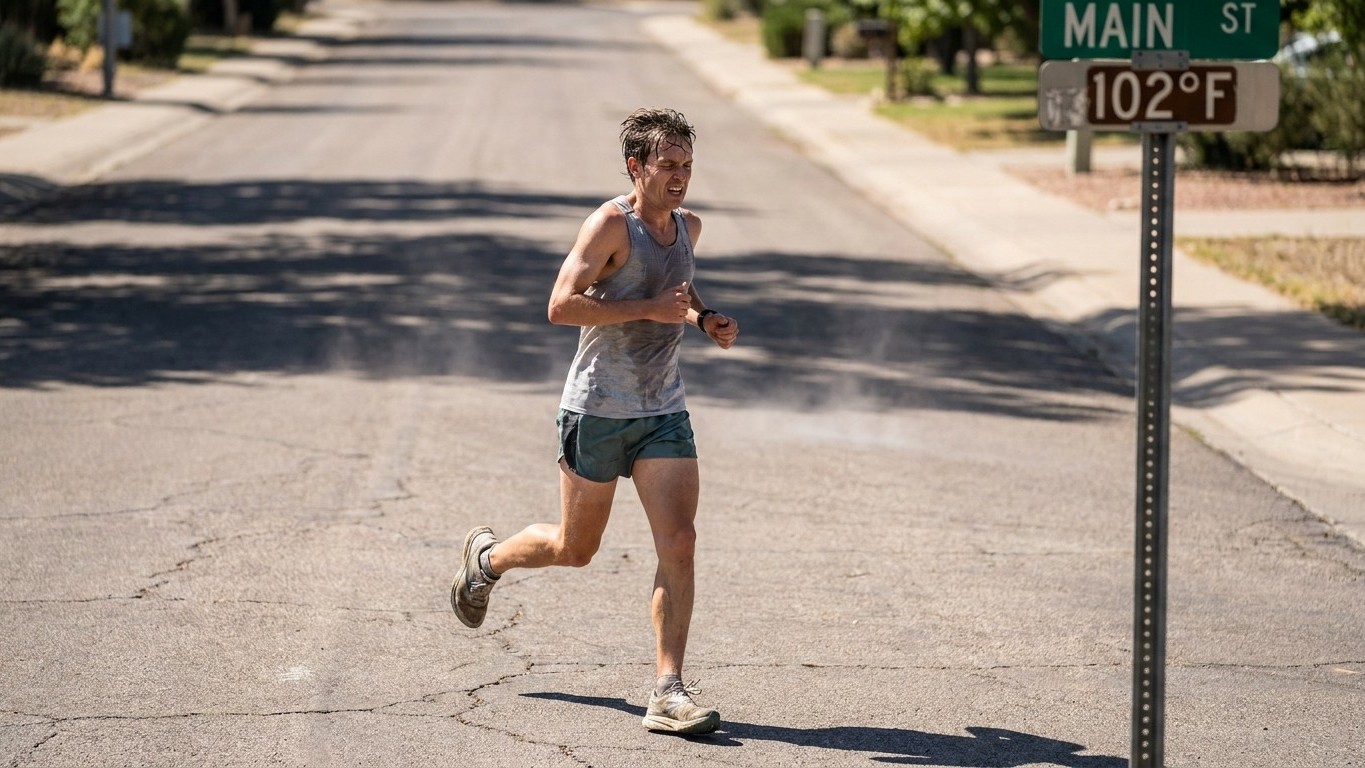
Your Heart Rate is 20 beats higher than usual for the same easy pace. Your legs feel like lead by kilometre three. You put it down to poor sleep, a heavy meal, stress at work, anything but the obvious answer: your body simply hasn’t learned to cope with 30°C yet, and it’s telling you so in the clearest way it knows how.
This isn’t a mood or a bad training day. It’s a measurable physiological response, and understanding it changes how you should think about summer running altogether.
Key takeaways
- Your heart works twice as hard in heat, splitting blood between muscles and skin cooling—learn why this creates that lead-legged feeling
- Plasma volume expands and sweat efficiency transforms on different timelines; one takes a week, the other demands 10-14 days
- The gap between feeling terrible and genuine heat illness is narrower than most runners think, and acclimatization is your first line of defense
Why your cardiovascular system is fighting itself
Heat wreaks havoc on running performance through multiple physiological mechanisms, and when you run in hot conditions, your cardiovascular system faces a double demand: delivering oxygen to working muscles while simultaneously pumping blood to your skin for cooling. That split demand is precisely Why Your Heart Rate Climbs at paces that feel effortless in cooler weather. Your body is essentially trying to do two jobs with one blood supply, and something has to give, usually your pace, sometimes your judgement.
The good news, if you can call it that, is how quickly this can improve. Cardiovascular adaptations, including decreases in heart rate and increases in plasma volume, occur within 3–6 days of heat acclimation and are known to have a strong influence on exercise performance. Blood plasma volume expansion is the first domino to fall, and it’s a big one. Studies show that with seven to 10 days of heat acclimation, resting blood plasma volume can expand anywhere from 4.5 to 13%. More plasma means more blood available to circulate simultaneously to muscles and skin, which is exactly the conflict that made your first hot run feel so laboured.
The 10 to 14 day rule isn’t arbitrary
The timeframe referenced in the title comes directly from exercise physiology research, not from anecdote. Cardiovascular adaptations are generally complete during the first week of acclimation, whereas alterations in sweating responses require 10–14 days of repeated heat exposure. That’s an important distinction because sweating is your primary cooling mechanism, and it lags behind the heart rate improvements you might notice earlier.
Sweat itself changes character over this period. Your sweat response transforms too, you start sweating earlier, produce more sweat, and lose fewer electrolytes per litre. Decreases in sweat electrolyte concentration typically occur within 5–10 days of heat acclimation, while increases in sweat rate typically occur within 5–14 days. Coaches who’ve spent years working with runners in warm climates describe a similar pattern in practical terms: if you can accumulate 90 to 100 Minutes of Exercise daily in a hot environment, you’ll see the vast majority of adaptations in 10 to 14 days.
None of this is comfortable while it’s happening. Days one to four feel terrible by design, but push through sensibly and it gets better fast. The mistake most people make isn’t going too hard on day one, it’s quitting on day three when the discomfort hasn’t yet given way to adaptation.
When “bad day” is actually a warning sign
There’s a meaningful difference between the sluggish, unpleasant sensation of unacclimatized heat running and the early markers of genuine heat illness, and every runner should know where that line sits. Heavy sweating, headache, dizziness, nausea, fast heart rate and muscle cramps are symptoms of heat exhaustion. These aren’t reasons to panic, but they are reasons to stop, cool down and rehydrate rather than push through for the sake of a training plan.
Heat stroke sits a category above this, and it’s far less forgiving. Without treatment, heat exhaustion can turn into heat stroke, and a key difference is that heat stroke causes signs of brain dysfunction, including persistent confusion and changes in behaviour like aggression or agitation. What makes this genuinely worth knowing is that it doesn’t always announce itself gradually. Heat stroke can develop without warning, and while it might seem like something that only happens during extreme events like a marathon in a heatwave, it can happen in the most ordinary of situations. A pacey Tuesday evening tempo run in unfamiliar heat qualifies as ordinary in every sense, which is exactly why so many cases catch people off guard.
Lack of acclimatization isn’t just a comfort issue either, it’s listed among the recognised risk factors for heat-related collapse. Heat syncope, a fainting or dizzy episode that usually occurs when standing for too long or suddenly standing up, is more likely with factors including dehydration and lack of acclimatization. Recreational runners often underestimate this risk category. Survey data from ultra-endurance events bears that out starkly: 78% of runners in one large study declared a history of heat-related symptoms while training or competing, yet only 24.3% of those living in temperate climates had trained in the heat before racing. That gap between exposure and preparation is where most heat-related mishaps live.
Building the adaptation without wrecking your training week
The practical approach doesn’t require a heat chamber or a training camp abroad. Gradually increasing exposure over a fortnight, shorter sessions first, building duration and intensity as your body responds, mirrors exactly what clinical guidance recommends. Acclimatizing means slowly working up to more intense physical activity in the heat over a period of at least a couple of weeks, starting with short sessions and gradually increasing the duration and intensity. Running the same familiar loop at the same familiar pace in 30°C, expecting your usual splits, is the single most common way people undo weeks of good training in one overambitious session.
One detail surprises most runners: these gains don’t last indefinitely once the weather cools or training moves indoors. Heat adaptations fade after roughly two to four weeks without heat exposure, with the early-acquired plasma volume slipping first, though getting a heat session in every few days, even a couple of hot workouts or sauna sessions weekly, can preserve much of the adaptation. If you’ve already put in the ten to fourteen days this summer, a weekly top-up session is a far smaller ask than starting the whole process again from day one. Your body remembers effort, but not indefinitely, and not without occasional reminders.
Sources : frontiersin.org | ncbi.nlm.nih.gov