
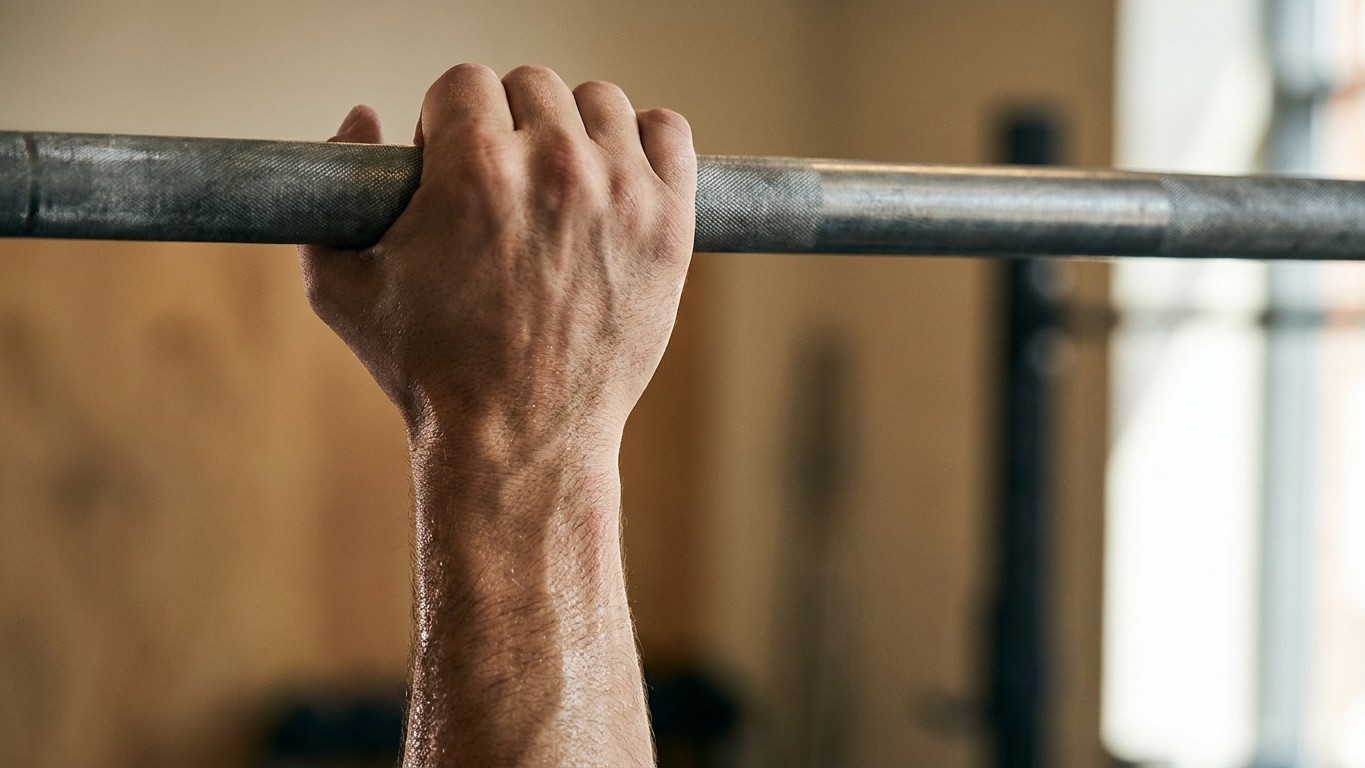
Wrist pain during pull-ups is one of those complaints that sits somewhere between “probably fine, push through it” and “you’re about to do real damage.” The distinction matters enormously. A simple adjustment to how your hands meet the bar can redistribute the mechanical load across your forearm, elbow and shoulder in ways that feel minor until, halfway through a set, you sense exactly where the stress is concentrating and why it might not end well.
Key takeaways
- Standard overhand grip compresses wrist structures in a way that builds cumulative stress—but most people don’t feel it until the top of the movement
- Neutral grip realigns your radius and ulna, letting tendons share load evenly and reducing peak joint forces by measurable amounts
- The transition to rings or rotating handles is simple, but the first week requires patience: your forearm flexors will suddenly work harder than before
What actually happens at your wrist when you hang from a bar
The standard overhand grip (pronated, palms facing away) places your wrist in a position of ulnar deviation combined with slight extension. That combination is not inherently dangerous, but it does compress the structures on the outer edge of the wrist and increases the mechanical demand on the extensor tendons. For many people, this is completely fine. For others, particularly those with longer forearms, a history of repetitive strain, or poor scapular control, it becomes a source of cumulative irritation.
Switching to a neutral grip (palms facing each other, as on a parallel bar or rotating handles) brings the wrist into a more anatomically neutral position. The radius and ulna sit more comfortably aligned, the extensor and flexor tendons share load more evenly, and the elbow tends to track in a path that suits the shoulder more naturally. This is not just gym folklore: biomechanical assessments of upper limb loading consistently show that neutral grip orientations reduce peak wrist joint forces compared to fully pronated positions. Whether that matters for you depends heavily on your specific anatomy and training history.
The underhand grip (supinated, palms facing you) is the third option, and it creates its own trade-offs. Bicep activation increases, which many people experience as a performance boost, but the supinated wrist under high load puts stress on the medial elbow structures, specifically the tendons and ligaments around the medial epicondyle. Anyone who has ever developed a twinge on the inner elbow from heavy chin-ups will recognise this immediately.
The moment of feedback that changes how you think about grip
There is a specific point in the pull-up movement, roughly when the chin approaches bar height and the elbows begin to drive back rather than simply down, where the wrist transitions from acting primarily as a stable anchor to absorbing a rotational torque. If your grip is compromised or your wrist is already irritated, this is the moment you feel it. The load does not suddenly increase at that point, but the direction it travels through the joint changes, and that shift exposes whatever tension was already building.
This is why wrist pain during pull-ups rarely announces itself at the bottom of the movement. Hanging with straight arms is largely passive. The problem surfaces on the way up, in that upper third of the range, when shoulder internal rotation, elbow flexion and wrist loading all converge simultaneously. Training clients who switched to neutral grip handles often report that the discomfort simply vanishes at this stage, not because they are weaker or working less hard, but because the joint is no longer being asked to manage a torque it is poorly positioned to resist.
The grip switch is also worth considering for anyone experiencing elbow pain that radiates from the lateral side (outer elbow, often called tennis elbow) and seems to be aggravated by pulling movements. Overhand pulling places the common extensor tendon origin under considerable eccentric load on the way down, and repeatedly performing negatives or weighted pull-ups in this position without adequate recovery can irritate the attachment point progressively.
Making the switch practically and safely
If you train on a standard fixed bar with no neutral grip option, gymnastic rings are the most practical solution. They rotate freely with your movement, which means your wrist and forearm find their natural orientation throughout the pull rather than being locked into whatever angle the bar dictates. Many people find their pull-up volume increases on rings simply because the movement stops hurting, not because rings are inherently easier.
Rotating pull-up handles, which clamp to a standard bar, achieve a similar result. The key feature to look for is genuine free rotation under load rather than handles that are technically described as rotating but bind when gripped tightly.
The transition period matters. Switching grip changes the muscle recruitment pattern enough that your initial sessions should be treated as a new movement, not a direct substitute. Reduce your sets by roughly a third for the first week and pay attention to how your forearm flexors respond, as neutral grip places greater demand on them in positions where overhand grip might rely more on wrist extensors as stabilisers.
It is also worth being honest about whether the wrist pain you are managing is actually wrist pain. Discomfort along the inner forearm during pulling movements can sometimes trace back to thoracic outlet issues or ulnar nerve irritation rather than the wrist joint itself. If the pain persists through multiple grip variations, does not respond to rest, or produces tingling or numbness into the fingers, that is a conversation for a physiotherapist or your GP, not something to work around with equipment adjustments.
One detail that rarely comes up: thumb position affects wrist loading more than most people expect. A thumbless (false) grip on an overhand pull-up reduces the forearm’s ability to generate the slight internal rotation that would otherwise protect the wrist through the top of the movement. For most recreational athletes, wrapping the thumb around the bar is simply the safer default, whatever grip orientation they choose.