
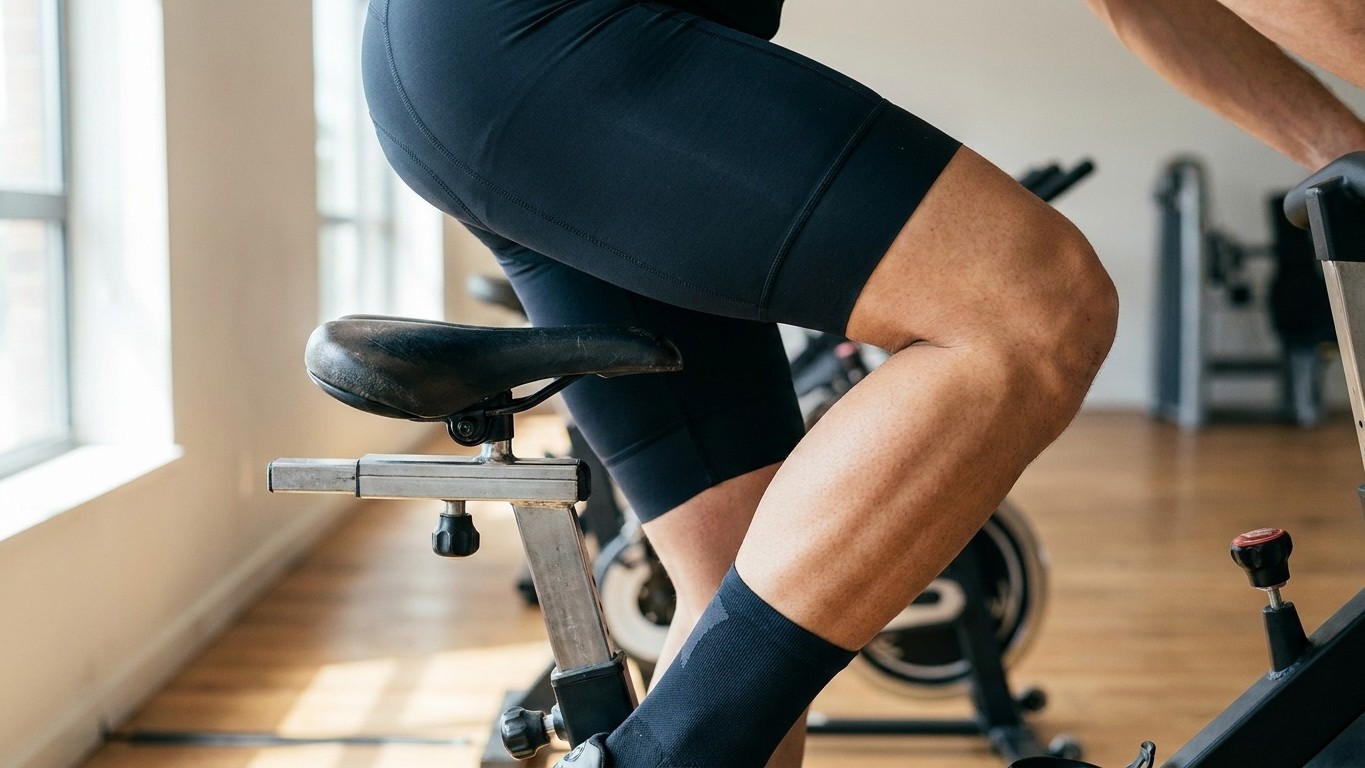
A grinding sensation in the knee during cycling is not something to ignore, and for good reason: it often points directly to bike fit rather than any underlying joint disease. When a physiotherapist listens to a knee and hears crepitus, that crackling or grinding sound produced by surfaces moving under abnormal load, the first question they should ask is not “how long has this been happening?” but “show me how your bike is set up.” Saddle height is almost always part of the answer.
Key takeaways
- A grinding sound in your knee during cycling points directly to saddle height, not joint disease
- Lowering the saddle for comfort keeps your knee too bent, compressing the kneecap against the femur repeatedly
- The correct position feels surprisingly high at first, but it’s the only angle that protects your joints while building power
Why lowering the saddle feels comfortable but isn’t
The instinct to lower a spin bike saddle makes complete sense. A lower seat means both feet can rest flat on the floor, which feels stable and reassuring, especially for newer cyclists. The problem is that this sensation of security comes at a cost to your knees. When the saddle is too low, the knee remains in a more deeply flexed position throughout the pedal stroke. At the bottom of each rotation, the leg never fully extends, which means the patellofemoral joint, the interface between the kneecap and the femur beneath it, stays compressed for longer and at a sharper angle.
Research in cycling biomechanics has consistently shown that saddle height is one of the primary variables affecting knee joint loading. A 2014 study published in the Journal of Science and Medicine in Sport found that lower saddle positions significantly increased peak knee flexion angles and were associated with greater compressive forces at the patellofemoral joint. That compression, repeated hundreds of times per session, is precisely what produces the grinding sound a physiotherapist can hear or feel when moving the kneecap manually.
There’s also a subtler mechanism at work. With insufficient leg extension, the quadriceps and hamstrings never complete their full contraction-and-release cycle. The muscles fatigue unevenly, which alters the tracking of the patella. Instead of gliding cleanly up and down the femoral groove, it starts to pull slightly laterally. Over weeks and months, that lateral pull irritates the cartilage underneath, leading to the condition commonly known as patellofemoral pain syndrome, or informally, “cyclist’s knee.”
What the correct saddle height actually looks like
The most widely used method for setting saddle height is the heel-to-pedal technique. Sitting on the bike with the heel placed on the pedal at its lowest point (the 6 o’clock position), the leg should be completely straight. When you move the foot into its normal cycling position, with the ball of the foot over the pedal axle, there will be a slight bend at the knee, roughly 25 to 35 degrees of flexion. That small bend is not a compromise. It is the optimal position for efficient power transfer and joint protection simultaneously.
Another common method uses a percentage of inseam length. The standard formula, attributed to decades of professional bike fitting practice, suggests setting the saddle height at approximately 109% of inseam length measured from the centre of the bottom bracket (the axle around which the pedals rotate) to the top of the saddle. Both methods are useful starting points, though individual anatomy, particularly femur length and hip flexibility, will always require some personal adjustment.
One detail that surprises many people: the correct saddle height often feels slightly too high at first. The hips may rock very slightly side to side at the bottom of the pedal stroke if the seat is genuinely too tall, but a correctly fitted saddle that is simply unfamiliar will feel like your feet are “losing” the pedals. Give it two or three sessions before dropping the seat in response to that initial discomfort.
The physio appointment that changes how you train
Physiotherapists who specialise in sports rehabilitation are trained to assess movement under load, and the knee is one of the most revealing joints in the body. Crepitus alone is not always a sign of damage. Many healthy knees make noise. But crepitus combined with anterior knee pain after cycling sessions, particularly pain felt behind or around the kneecap, is a clinical pattern that strongly points toward patellofemoral overload.
A good physio will typically assess hip strength alongside the bike setup conversation. Weak gluteus medius muscles, the stabilisers on the outer hip, are frequently found in cyclists with knee tracking problems. When these muscles are underactive, the femur rotates inward during the pedal stroke, which changes the angle of the kneecap’s path. Correcting saddle height addresses the mechanical load; targeted hip strengthening addresses the muscular cause. Both interventions together are considerably more effective than either alone, a point supported by clinical practice guidelines from the British Journal of Sports Medicine.
Cleat position, for those using clip-in pedals, is another variable physios assess. A cleat positioned too far forward shifts load toward the forefoot and increases stress on the knee. Most cycling footwear experts and bike fitters recommend positioning the cleat so the ball of the foot sits directly over the pedal axle, and allowing some rotational “float” in the cleat mechanism to accommodate the natural rotation of the foot during each stroke.
Recovery and returning to the bike
Once saddle height is corrected, recovery from patellofemoral irritation typically takes between four and eight weeks, depending on how long the issue has been present and how much inflammation has built up. During this period, reducing session intensity and duration is usually more helpful than stopping entirely. Low-resistance spinning maintains joint fluid circulation and muscle condition without adding compressive load.
The part that most people overlook: even after the pain resolves, the habit of checking saddle height periodically matters. Spin bikes in gyms are reset by different users constantly, and a saddle that was correct last Tuesday may be two centimetres lower this Friday. Carrying a small piece of tape or a hair tie to mark your preferred height on the seat post takes about ten seconds and saves your knees considerably more trouble than that.
Always consult your GP or a registered physiotherapist for personalised medical advice regarding knee pain or injury.