
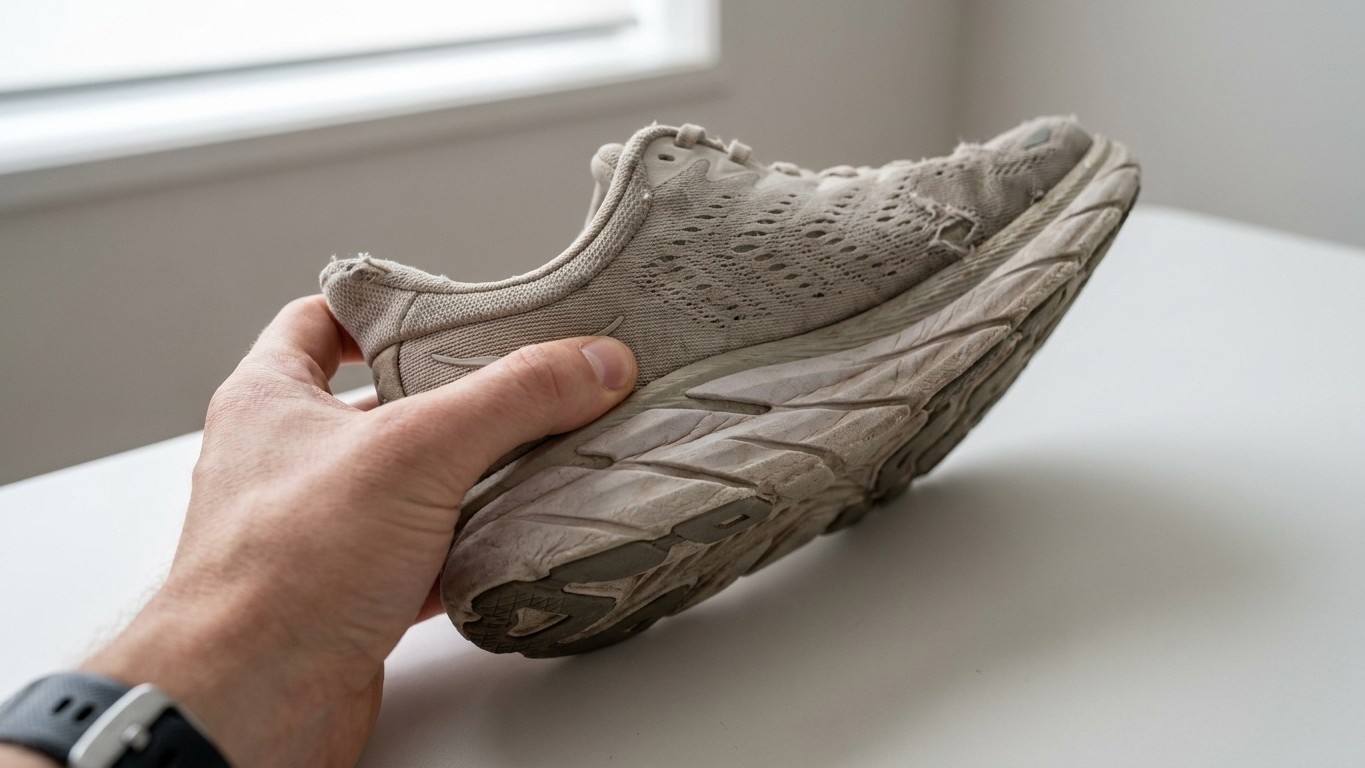
Running shoe midsoles degrade whether you use them or not. That’s the part most runners never hear, because the damage is invisible, happening quietly inside the foam while your shoes sit in the back of the wardrobe between seasons. When a physiotherapist examined a pair of trainers that had been worn for one summer and then stored for nine months, the verdict was unambiguous: the cushioning had compressed unevenly, the heel counter had softened, and the shoes were biomechanically finished. The runner had been about to start their spring training programme in them.
Key takeaways
- Foam midsoles break down chemically even without running, accelerated by heat and humidity
- Structural damage is invisible to the eye but detectable through uneven compression and softening
- Resuming training in degraded shoes during already-vulnerable early season is a common injury formula
What actually happens inside a running shoe over time
The midsole is the workhorse of any running shoe. Made from EVA foam (ethylene-vinyl acetate) or, in more modern designs, polyurethane-based compounds and proprietary foams, its job is to absorb impact and return energy with each stride. The problem is that foam is a cellular structure, and those cells break down progressively under load. A single kilometre of running subjects the midsole to hundreds of thousands of compression cycles. Each one degrades the foam slightly. But here’s what catches most recreational runners off guard: the cells also oxidise and stiffen with age, even without use.
Storage conditions accelerate this. Heat, humidity, and UV exposure all hasten the chemical breakdown of EVA. A garage in summer, a car boot, a sunny porch, all hostile environments for foam. Research published in sports science literature has confirmed that midsole hardness increases measurably after extended storage, meaning the shoe absorbs less impact before that force travels up into your joints. The cushioning doesn’t disappear visually. The shoe looks fine. The damage is entirely Structural, detectable only by pressing firmly on the midsole and noticing the resistance has changed, or by having someone experienced in gait analysis look at the compression pattern.
The signs your physio sees that you don’t
Physiotherapists who work with runners develop a quick and practised eye for shoe wear that most people lack. The first thing they examine is the midsole stack height, checking whether one side has compressed more than the other. Uneven compression is a red flag because it subtly tilts the foot during the gait cycle, loading the knee, hip, and lower back asymmetrically. A few millimetres of difference sounds trivial. Over a 5k run, that asymmetry repeats roughly 3,000 times per foot.
The heel counter, the firm cup that wraps around your heel, also softens with age. Press your thumb firmly into the back of a shoe that has seen one season of use plus several months of storage, and compare it with a newer pair. The older one often gives way more readily, which allows the foot to roll inward or outward without the shoe correcting it. This kind of instability rarely causes immediate pain, it accumulates quietly, typically manifesting as Achilles tendon irritation, plantar fascia strain, or anterior knee pain after two or three weeks of resumed training, by which point most runners blame their mileage rather than their footwear.
There’s also the outsole to consider. Rubber wears in predictable patterns that reveal gait tendencies, and a physio can read those patterns like a map. But the outsole often looks perfectly serviceable long after the midsole has given up. This is precisely the trap: the grip is fine, the upper is intact, the shoe appears usable. The invisible interior is the problem.
When to retire a running shoe (and when storage resets the clock)
The commonly cited guideline of 500 to 800 kilometres before retirement applies to shoes in regular use, but the calculation changes when storage is involved. A shoe worn for 250km in summer and stored for nine months has not simply “used up half its life.” The oxidation process during storage has continued, and the foam’s mechanical properties have shifted in ways that distance alone doesn’t capture.
A reasonable rule of thumb, drawn from sports medicine guidance rather than manufacturer marketing, is to treat any shoe that has been stored for more than six months in non-ideal conditions as suspect, regardless of apparent mileage. Before lacing up at the start of a new season, apply the thumb test to the midsole in multiple locations, check that the heel counter has not softened, and look for any visible creasing or compression lines in the foam. If the midsole has developed a network of fine wrinkles rather than a single clean compression point, the foam structure has broken down significantly.
Cooler, dry storage out of direct light genuinely extends midsole life. Some runners rotate between two pairs, which allows each to decompress fully between sessions, a practice that has been shown to extend foam longevity by allowing the cellular structure to partially recover between uses. The recovery is never complete, but it slows the degradation meaningfully over a season.
Getting the spring season right from the first run
The timing matters as much as the equipment. Returning to running after a winter break already asks a great deal of the body, tendons and connective tissue that have been relatively inactive need weeks to adapt to load. Doing that in shoes whose cushioning has silently deteriorated doubles the mechanical stress on structures that are not yet ready for it. The combination is one of the more common routes to early-season injury that physiotherapists see in general practice.
A brief assessment at a specialist running shop, where staff use pressure plates or video gait analysis, takes about twenty minutes and can catch exactly the kind of wear a non-specialist eye misses. Many shops offer this free of charge with a purchase. If the shoes pass inspection, great. If they don’t, the cost of a new pair is considerably less than four to six weeks of physiotherapy.
One detail worth holding onto: foam compounds vary enormously between price points, and some of the newer nitrogen-infused and PEBA-based foams used in carbon-plated racing shoes actually show faster initial degradation than traditional EVA under high-frequency use, though they recover better between sessions. The same pair of shoes is not equally reliable across every type of training. That’s a conversation worth having with both your physio and whoever fits your next pair.
Always consult your GP or a registered physiotherapist for personalised advice about injury prevention and footwear.