
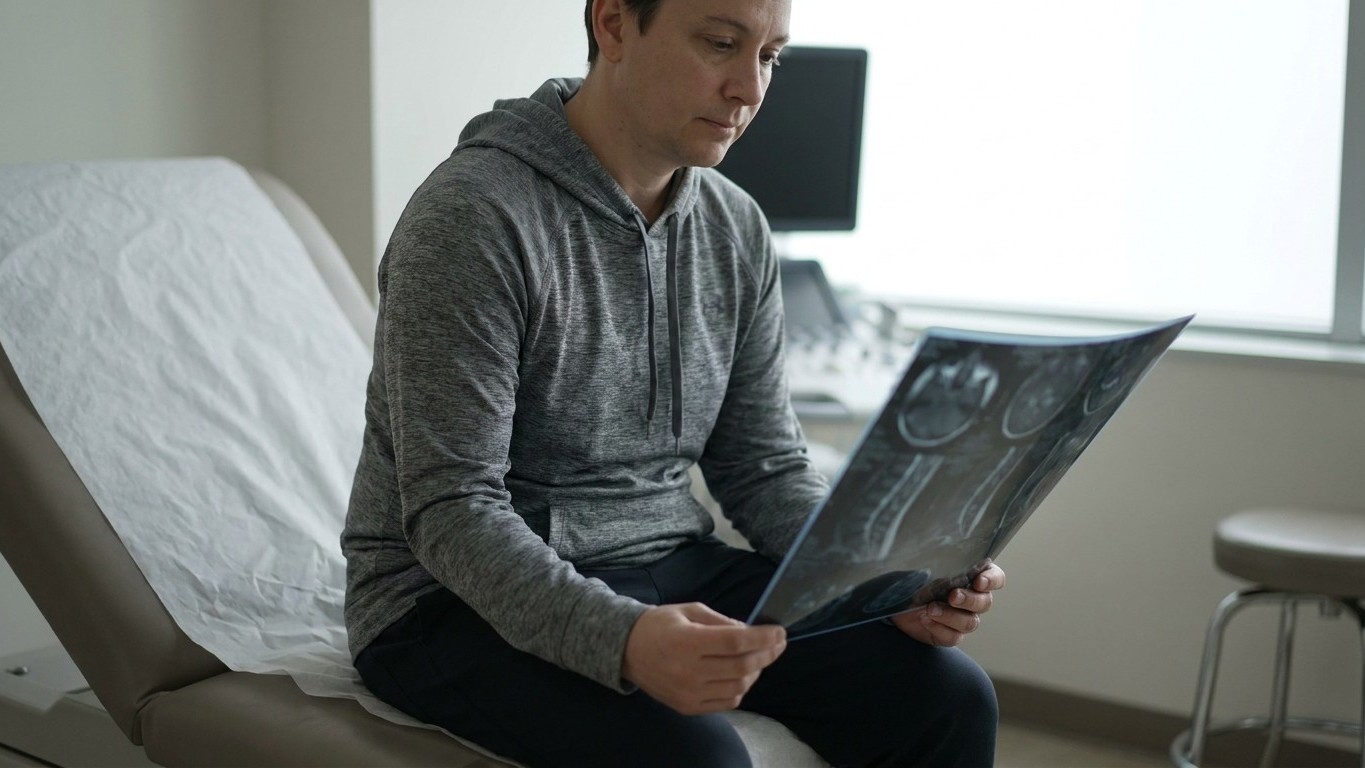
Getting a scan at 42 that shows wear and tear from two decades of the same training routine is not a freak occurrence, it is, for a growing number of middle-aged exercisers, a turning point. The loyalty to a fixed programme that once felt like discipline looks rather different when a radiologist’s report lands in your hands. What scans can reveal, and what the science says about years of repetitive movement, is a story worth understanding before your own joints tell it for you.
Key takeaways
- Microscopic damage accumulates silently for years before a scan reveals the true cost of repetitive training
- Your body becomes efficient at the same routine—then that efficiency becomes the reason joints deteriorate
- Bone density, muscle imbalances, and load distribution patterns all conspire against single-method loyalty
The silent cost of repetition
An overuse injury occurs when repetitive stress is placed on a part of the body without giving it enough time to heal. Unlike sudden, acute injuries, overuse injuries develop gradually, often making them harder to detect until the damage has progressed significantly. That gradual nature is precisely what makes long-term training loyalty so deceptive. You feel fine, year after year, because the deterioration happens in increments too small to register as pain. Until, suddenly, it does.
Repetitive motion injuries are caused by overuse of a particular muscle or group of muscles. As a result of this overuse, microscopic tears develop in the tissue. When the body cannot repair these tears as fast as they are being made, inflammation occurs, causing pain and other symptoms. The body is remarkably tolerant of repetitive stress in the short term. Over years, that tolerance has a ceiling.
Overuse injuries can happen to anyone, but they are more likely to occur among workers who do repetitive motions and single-sport athletes. The risk of these injuries also increases with age. They are more likely to occur if you don’t recognise the impact ageing can have on your muscles, joints and tissues and modify your activities accordingly. This is the compound problem: the same routine that your body tolerated at 22 exerts different forces on tissues that have accumulated two decades of mechanical loading. The training did not change. Your biology did.
What an MRI can make visible at 42 is often sobering. MRI provides detailed images of the joint, allowing for the visualisation of cartilage thickness, surface irregularities, and other structural changes. MRI is particularly effective in detecting early signs of cartilage degeneration and associated conditions such as bone marrow lesions and synovitis. These changes don’t announce themselves dramatically. Overuse injuries develop gradually, with the pain often starting off mild and progressively worsening over weeks or months. By the time a scan is warranted, the conversation with a clinician can feel like reading history rather than headlines.
What your body does when you stop surprising it
When you first start exercising, your body responds dramatically because the stimulus is new. Over time, however, your muscles, cardiovascular system, and metabolism become efficient at handling your routine. This adaptation is actually a good thing, it means you’re getting fitter, but it also means you need to evolve your approach. The body’s efficiency, works against you in the long run. The adaptations that once felt like progress become the very reason progress stalls.
When you repeat the same workout routines, your muscles and cardiovascular system become more efficient. This efficiency means burning fewer calories and building less muscle from the same activities. But the performance plateau is only half the problem. The structural consequences are the other half. Running the same route at the same pace with the same foot strike pattern for 20 years does not mean 20 years of protection, it can mean 20 years of the same joint surfaces absorbing the same forces, with no redistribution of load.
Overuse injuries may occur from doing just one specific exercise in which only certain muscles or bones are used. People who play one sport year-round are also at higher risk of overuse injuries. Think of the dedicated runner who has never done a single strength session targeting the glutes, or the weightlifter whose rotator cuff has been performing the same arc of movement since their mid-twenties. The muscles that are worked become dominant; those that are ignored become weak. The resulting imbalances alter joint mechanics in ways that accumulate damage across years.
There is also a bone density dimension that rarely gets discussed in the context of loyal training habits. After the age of 40, bone mass decreases by about 0.5% per year, regardless of sex or ethnicity. Exercise can slow this, but only if it includes the right variety. While low-volume impact-oriented aerobic activities like running have been shown to be effective at increasing bone density, excessive endurance training has been linked to low bone density. A person who has done exclusively cardio for two decades, without any resistance or load variation, may find their scan reveals skeletal vulnerabilities they never anticipated.
The physiology of variety, and why it matters more after 40
Mixing different types of physical activity can help prevent repetitive strain. Incorporating cross-training days works different muscle groups and gives overused areas a break. This is not a new recommendation, but the research behind it has grown more granular. A 2024 study published in Research Quarterly for Exercise and Sport compared the effects of varied versus constant resistance exercises on muscular adaptations in young women over ten weeks. Researchers compared the effects of varied and constant resistance exercises on muscular adaptations. The varied group performed different movement patterns across each session of the week, targeting the same muscle groups through multiple angles, the kind of approach that protects against the localised tissue overloading that a fixed routine cannot avoid.
Instead of focusing on one type of exercise, building variety into your training programme is recommended. Doing a variety of low-impact activities prevents overuse injuries by allowing your body to use different muscle groups. The fortysomething body needs this principle applied with particular seriousness. Hormonal changes, slower recovery, and increased life stress require a more thoughtful approach in the forties and fifties. This isn’t about limitation, it’s about optimisation. Common plateaus in this decade are often tied to hormonal shifts, increased stress, and declining muscle mass, as sarcopenia begins around 30 but accelerates after 40.
The intensity and increment of the type of load are two fundamental elements of exercise to avoid adaptation phenomena and produce an improvement on bone mass rather than just decreasing the loss. That is a precise way of saying that novelty, not just effort, is what drives biological adaptation. The same load, repeated indefinitely, stops being a stimulus and becomes a stressor.
Rebuilding intelligently after the scan
A scan at 42 that shows early cartilage changes or tendinopathy is not necessarily a verdict. MRI can identify inflammatory changes before bone damage becomes permanent. Catching structural changes at this stage, rather than a decade later, is genuinely useful information, provided it leads to action rather than denial. The response to a scan finding should always begin with a conversation with your GP or a sports medicine physician, who can interpret your specific results in the context of your individual history.
From a training perspective, the science points clearly in one direction. Preventing overuse injuries includes proper technique, balanced training, sufficient recovery, and listening to your body. Your body needs variety to continue adapting. Changing your routine every four to six weeks, not completely, but adjusting variables like intensity, volume, or exercise selection — is one of the key tools available. Periodisation, the structured variation of training stress, is the method elite athletes have used for decades precisely because it prevents the body from settling into patterns that lead to both Performance plateaus and tissue damage.
“Whenever a person is active, they are micro-injuring their body,” notes one sports medicine clinician. “They are micro-fracturing their bones, and micro-tearing their muscles and tendons. When the body is given time to rest, it heals these micro-injuries and adapts to become stronger. But if the body is not allowed enough time to heal, the micro-injuries can continue to progress and eventually become an overuse injury.” The solution is not less training, it is smarter sequencing. Strategic deload weeks, where you reduce training intensity by 40–60%, can help break plateaus. This allows your body to fully recover and rebuild, often leading to improved performance when you return to regular training.
One detail worth holding onto: the scan result is a snapshot of what two decades of the same stimulus created. But the body retains a remarkable capacity to respond to new demands. Cells possess a “memory” such that adaptations can be more quickly regained when a previously encountered challenge is reintroduced. Exercise provides an excellent experimental model to explore the concept of cellular memory to physiologically relevant stressors in humans. The muscle memory that stored your old routine can be redirected. The tissue that has been underloaded, the stabilisers, the opposing muscle groups, the planes of movement your programme never touched — can still be recruited and strengthened. At 42, that conversation with your body is not closed. It has simply changed in vocabulary.
This article is for informational purposes only and does not constitute medical advice. Always consult your GP or a qualified healthcare professional regarding any health concerns or before making changes to your exercise routine.
Sources : tandfonline.com | pubmed.ncbi.nlm.nih.gov