
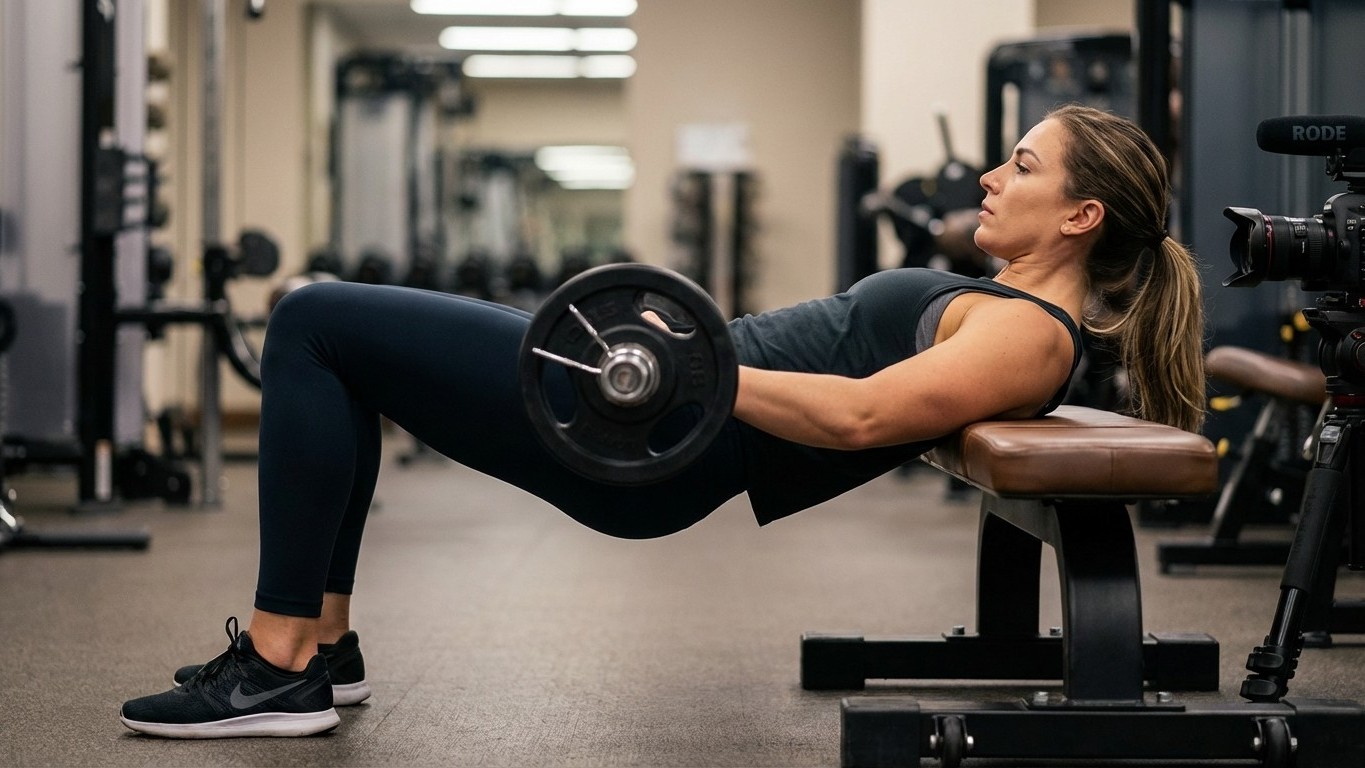
Hip thrusts are one of the most popular exercises in any gym, and for good reason: when performed correctly, they are the most effective movement for building glute strength and size. But there is a single, almost invisible error that millions of people make every repetition, every session, often for years, that quietly switches off a significant portion of the very muscles they are trying to train. The frustrating part? It takes roughly two seconds to correct, and the difference in how your glutes feel the next morning is startling.
Key takeaways
- A two-second form adjustment most people have never heard of could be costing you months or years of glute development
- Your head position directly controls your spine alignment, which determines whether your glutes or lower back does the work
- Lifters report genuine muscle soreness within 24 hours after fixing this one detail, using weight they’d grown comfortable with
The two-second mistake hiding in plain sight
The error is this: letting your chin drift upward as you drive your hips to the top of the movement. It sounds almost too simple to matter. But the position of your head and neck directly influences the curve of your lumbar spine, and that spinal position determines whether your glutes are doing the work or whether your lower back and hip flexors are quietly taking over.
When you extend your neck and look up at the ceiling at the top of a hip thrust, your lumbar spine hyperextends. Your pelvis tips into anterior tilt. At that moment, your glutes are mechanically shortened and compressed before they can fully contract. The muscle fibres that should be firing hardest, the ones responsible for that final squeeze at peak extension, are robbed of their tension. You feel like you’re working hard, your heart rate is up, you’re definitely doing something, but the upper fibres of gluteus maximus are essentially along for the ride.
The fix takes exactly two seconds to learn: tuck your chin gently toward your chest before you lift, and keep your gaze directed forward or very slightly downward throughout the movement. That single adjustment encourages a neutral spine position, keeps the pelvis in posterior tilt at lockout, and allows the glutes to reach full tension right where the exercise is supposed to peak. Many people who make this correction for the first time report feeling genuine gluteal soreness within 24 hours from a weight they have been using comfortably for months.
Why the pelvis position matters more than the weight on the bar
The gluteus maximus functions as a hip extensor, but it is most active when the pelvis is in a neutral or slightly posteriorly tilted position at the top of the movement. Research published in journals examining electromyographic (EMG) activity consistently shows that glute activation drops substantially when lumbar hyperextension is present during hip extension exercises. Your nervous system is not lazy; it simply recruits the path of least resistance, and if your lower back muscles can complete the movement while your glutes are geometrically disadvantaged, that is exactly what will happen.
There is also a proprioceptive element that gets overlooked. Most of us have spent years sitting at desks, driving, or slouching, patterns that leave the hip flexors chronically shortened and the glutes relatively underactive. The brain, through repeated exposure, starts treating glute firing as an “optional extra” rather than the primary driver of hip extension. This is sometimes called gluteal amnesia in clinical and coaching circles, and while the term is informal, the phenomenon is well-documented among physiotherapists. The chin-tuck cue works partly because it forces a postural reset that re-engages the neural connection to the glutes before the movement even begins.
The other form habits quietly undermining your results
Once you have sorted the chin position, it is worth auditing the rest of your set-up, because the head-neck error rarely travels alone. Foot placement is a common companion issue. Placing your feet too far forward causes the hamstrings to dominate the drive phase; too close to your hips and the quads take a larger share than intended. A rough guideline (and it will vary by individual anatomy) is to position your feet so that at the top of the movement, your shins are approximately vertical. That geometry places the glutes at their optimal length-tension relationship for peak contraction.
Bench height is another variable that quietly sabotages sessions. If the bench is too high relative to your torso length, you spend the entire exercise fighting to achieve full hip extension at all, which means you never reach the range where glute activation is highest. Most standard gym benches sit at a height that works reasonably well for average height individuals, but if you are shorter or taller, experimenting with a lower surface can make a noticeable difference to how the exercise feels.
Bar placement matters too, though this is one people tend to get right once they invest in a decent barbell pad. The bar should sit across the hip crease, not on the lower abdomen and not on the upper thighs. When it drifts even a few centimetres in either direction, the loading angle changes and, again, the work redistributes away from where you want it.
Making the correction stick
Changing an ingrained movement pattern is genuinely harder than learning a new exercise from scratch. Muscle memory, or more accurately motor engrams, are stubborn. The most practical approach is to drop the weight by around 20 to 30 percent for your next two or three sessions while focusing exclusively on the new cue. Film yourself from the side if you can; the camera will show you exactly what your body is doing far more honestly than your own proprioception will, especially in the early stages of relearning.
A single resistance band placed just above the knees can help here too. It encourages slight external rotation at the hip, which is the position in which the gluteus maximus generates the most force, and it gives you real-time feedback if your knees are caving inward under load.
The broader question this raises is how many other exercises we perform with confident familiarity while quietly training around the very muscles we intend to build. The hip thrust is a particularly clear example because the results should be obvious, but the feedback loop between flawed form and apparent effort is so convincing that years can pass without anyone realising what they are missing. Sometimes the smallest technical adjustments carry the largest returns, and a two-second cue is as small as they come.
If you have any concerns about pain during exercise or underlying hip and lower back conditions, please consult your GP or a qualified physiotherapist before modifying your training.