Twelve years of back-to-back meetings, spreadsheets, and lunch eaten in front of a screen. When one woman Finally-discovered-i-was-loading-the-wrong-muscles/”>Finally mentioned to her physiotherapist that her hips felt “a bit stiff,” the assessment that followed took less than a minute, and what it Revealed changed how she moved, slept, and exercised for good. Her story is far more common than most desk workers realise.
Key takeaways
- Your hip flexors adapt to sitting by shrinking, pulling your spine and pelvis into a position that affects everything from your knees to your shoulders
- The Thomas Test—a simple 60-second assessment—reveals years of accumulated tightness that most people don’t even realize they have
- Daily targeted stretching and movement variety throughout the day can reverse damage that took a decade to develop
What nine hours of sitting actually does to your hips
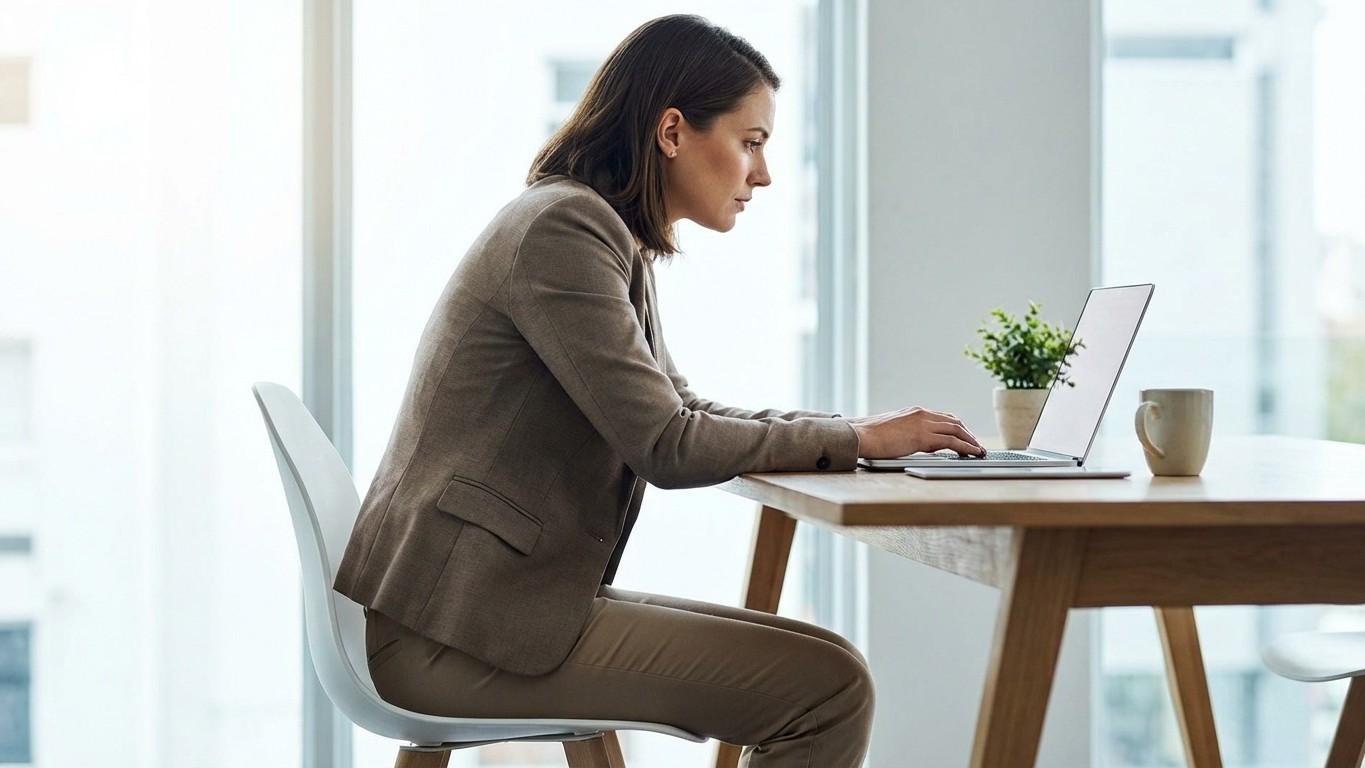
The hip flexors are a group of muscles that run from your lower spine and pelvis down to your thigh bone. Their job is to pull your knee toward your chest, which is, inconveniently, exactly the position you hold them in every time you sit down. Hold that position for most of your waking hours, across most of your working years, and those muscles begin to adapt. They shorten. They tighten. And because the body is a system of competing tensions, a shortened hip flexor starts to pull on your lumbar spine, tilting your pelvis forward in what clinicians call an anterior pelvic tilt.
This is the postural change that Physiotherapists spot almost instantly. The pelvis tips forward, the lower back curves more than it should, and the glutes (which are supposed to counterbalance all of this) become progressively underused. There’s a phrase some physios use informally: “gluteal amnesia.” Your backside, essentially, forgets how to fire properly. And once that chain of dysfunction is established, the knock-on effects travel in both directions, up into the lower back and shoulders, and down into the knees and feet.
None of this happens overnight, which is part of why it goes unnoticed for so long. The stiffness is gradual enough to feel like ageing rather than damage. The discomfort is vague enough to dismiss. By the time something hurts clearly enough to prompt a GP visit, years of compensation patterns are already baked in.
The one-minute assessment that reveals a decade of damage
The test the physiotherapist used is called the Thomas Test, and it has been a standard clinical tool for assessing hip flexor tightness for decades. It requires no equipment. You lie on your back at the edge of a table, pull one knee to your chest, and let the other leg hang. If the hanging leg rises off the table rather than lying flat, your hip flexor on that side is shortened. The degree of lift indicates the degree of tightness.
It sounds almost insultingly simple. But the information it yields is genuinely useful, because it gives a physio a baseline, a starting point from which to understand why your lower back aches, why your running gait looks odd, or why certain yoga poses feel impossible despite months of practice. The test itself doesn’t hurt. What it shows, in many long-term desk workers, is a tightness that has been quietly accumulating since their twenties.
A physical assessment like this also tends to reveal the compensations people have developed without realising. Many chronic desk workers unconsciously hike one hip higher than the other when standing, or shift their weight onto one leg to relieve pressure. These small habits, repeated thousands of times a day, create asymmetries that eventually become painful in their own right.
The practical path back to functional hips
The good news, and there genuinely is good news here, is that shortened hip flexors respond well to consistent, targeted stretching and strengthening. The challenging part is that “consistent” is doing a lot of heavy lifting in that sentence. Sporadic stretching at the end of a yoga class once a week is unlikely to reverse twelve years of adaptive shortening. What works is daily attention, woven into existing routines rather than bolted on as an extra chore.
The couch stretch (lying face down with one shin pressed against a sofa, the other foot flat on the floor) is widely used in physiotherapy and sports conditioning for precisely this reason. It places the hip flexor under a sustained, deep stretch that many standing lunge variations simply don’t achieve. Holding it for two minutes per side, daily, is a reasonable starting target. Pair that with glute activation work, clamshells, glute bridges, single-leg deadlifts, and you begin to address both sides of the problem: the tightness and the weakness.
Equally worth considering is the role of movement variety throughout the day. Sitting itself isn’t necessarily the enemy; it’s the unbroken, unvaried sitting that does the damage. Standing desks have their place, but standing rigidly for eight hours is its own form of monotony. What the body responds to best is change: sitting, standing, moving, crouching, stretching, rotating through positions rather than committing fully to any single one. Some occupational health specialists now recommend a position change every 30 to 40 minutes as a practical minimum.
If you have a chair at home or in the office that allows you to sit cross-legged, or in a slightly reclined position with your legs elevated, those alternatives can reduce the sustained hip flexor load during the parts of the day when you can’t get up. Variety, again, is the mechanism.
One thing worth saying plainly: if you recognise yourself in any of this, the years of desk sitting, the vague hip stiffness, the lower back that never quite feels right — a session with a physiotherapist is a worthwhile investment, not an overreaction. You don’t need to be in acute pain to benefit from a functional assessment. And a good physio isn’t just looking for injury; they’re looking at how you move, and how you could move better. The question that often goes unasked is not “what hurts?” but “what has your body quietly been working around for the past decade?” The answer, in many cases, starts at the hips.
Always consult your GP or a qualified physiotherapist before beginning a new exercise programme, particularly if you are experiencing pain or discomfort.