
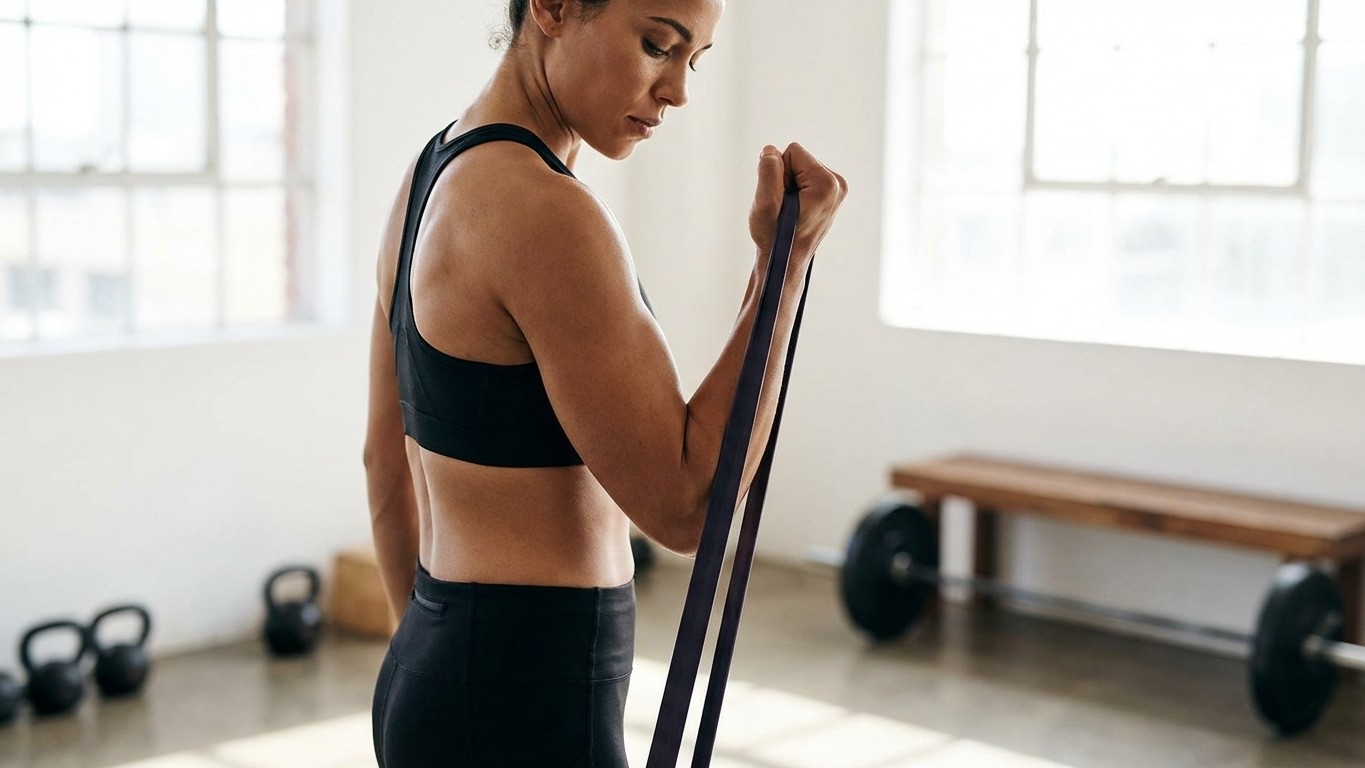
Eight weeks ago, I packed my dumbbells into a corner of the spare room and committed to training exclusively with resistance bands. No dramatic reason behind it, a shoulder niggle made heavy lifting uncomfortable, and I was curious whether the fitness world’s enthusiasm for bands was genuinely warranted or just another social media trend dressed up as Science. What followed surprised me more than I expected.
Key takeaways
- Variable resistance from bands creates a completely different challenge than traditional weights—the learning curve is steeper than expected
- Research supports bands for strength gains, but there’s a critical detail about progressive overload that most fitness influencers skip
- Stability muscles activate differently with bands, but building significant lower body mass has a noticeably lower ceiling
The learning curve nobody talks about
The first session was, frankly, humbling. I’d assumed that swapping a dumbbell for a band would simply mean lighter resistance with the same mechanics. It doesn’t work that way at all. Resistance bands create what Exercise physiologists call variable resistance — the tension increases as you stretch the band further, meaning the hardest point of the movement is at the end range, not the midpoint. With a dumbbell, gravity does the work of creating consistent load throughout the lift. With a band, you’re fighting something that actively fights back harder as you commit.
This distinction matters more than it sounds. During a bicep curl with a dumbbell, the peak difficulty is roughly at 90 degrees of elbow flexion. With a band anchored underfoot, the peak hits near full contraction at the top. My biceps, which I’d considered reasonably well-trained, were shaking after three sets. My ego took a quiet but necessary knock.
The adjustment period lasted about two weeks. I had to relearn pacing, relearn what “failure” felt like, and, perhaps most usefully, relearn how to control the eccentric (lowering) phase without simply letting the band snap me back into position. That accidental discipline may have been the first genuine surprise.
What the research actually says
I went looking for evidence, partly to validate my experiment and partly because I was genuinely curious whether I was wasting my time. The research is more supportive than I’d anticipated. A meta-analysis published in the Journal of Human Kinetics found that resistance band training produced comparable improvements in muscular strength and endurance to free weight training across multiple muscle groups, particularly in older adults and rehabilitation settings. A separate study in the Journal of Sports Science and Medicine reported similar findings for upper body strength gains when band tension was progressively increased over time.
That phrase, progressively increased, is the key caveat the fitness influencers often skip past. Bands only work if you keep making them harder, just as you would add weight to a barbell. This means buying bands of varying resistance levels, or doubling up, or shortening the anchor point to increase baseline tension. It’s not complicated, but it requires the same intentionality as traditional progressive overload.
One area where the evidence points clearly in bands’ favour is joint stress. The accommodating resistance they provide means that loads are typically lower at joint-vulnerable positions (the bottom of a squat, the start of a press) and higher where the musculature is in a stronger mechanical position. For anyone managing mild arthritis, tendon sensitivity, or, in my case, a grumpy shoulder, this is not a minor point.
The unexpected wins, and the genuine limitations
By week four, something shifted. My shoulder discomfort had settled considerably, which I’d anticipated. What I hadn’t anticipated was noticing improvements in stability muscles I’d essentially been ignoring for years. Resistance bands, because they don’t travel in a fixed plane the way a barbell or machine does, require constant micro-adjustments from stabilising muscles throughout each movement. My rotator cuff, my hip abductors, my obliques, all started registering a different kind of fatigue. Not soreness from overload, but the pleasant ache of muscles that had previously been passengers Finally being asked to drive.
Travelling became almost comically easy. I took a set of bands to a work trip in Edinburgh and trained in a hotel room the size of a generous wardrobe. The entire kit weighed less than a paperback novel. There’s something liberating about that portability, and I say this as someone who previously considered a gym bag packed with chalk and straps to be a personality trait.
The limitations, though, are real and worth being honest about. Building significant lower body mass with bands alone is genuinely difficult. The glutes and quadriceps respond to heavy, progressive loading, and while bands can absolutely strengthen these muscles, the ceiling is lower than with barbell squats or leg press. If your primary goal is adding substantial leg muscle, bands work better as a complement than a replacement. Heavy compound movements have decades of evidence behind them for a reason.
Grip training, too, is compromised. Deadlifts and rows with bands don’t tax the hands and forearms in the same way that pulling a loaded barbell does. After eight weeks, my grip felt noticeably less challenged, a small thing for most people, but worth knowing if forearm strength matters to you.
Where this leaves me
The dumbbells are back out of the corner now. But they’re not doing all the work anymore. I’ve settled into a hybrid approach, using bands for warm-ups, accessory movements, travel days, and any session where joint comfort is the priority. The weights come back for heavy compound work where loading specificity genuinely matters.
What changed most, though, wasn’t the equipment. It was the reminder that adapting your training to your body’s current needs isn’t a compromise, it’s just sensible practice. The Fitness industry has an odd habit of treating every tool as either gospel or gimmick. Bands are neither. They’re a remarkably versatile piece of equipment with specific strengths and specific gaps, and understanding both is what makes any training approach actually work for you.
If you’re managing any pain or discomfort during exercise, please do speak with your GP or a qualified physiotherapist before making changes to your training regime.