The plank had become my religion. For twelve months, I dropped to my forearms every morning, held for sixty seconds, then ninety, eventually two minutes, and felt quietly smug about my commitment. My core felt stronger. My back pain had eased. Then one rainy Tuesday, a physiotherapist friend watched me move and said, almost as an afterthought: “Have you ever tried a dead bug?” Three weeks later, I understood what I’d been missing.
The plank is genuinely one of the most popular core exercises in the world, and for good reason. It activates the transverse abdominis, the deep stabilising muscle that wraps around your spine like a corset, and it teaches the body to resist motion rather than create it, a concept sports scientists call “anti-extension training.” Research published in the Journal of Orthopaedic & Sports Physical Therapy has consistently supported isometric core exercises for reducing lower back pain and improving postural endurance. So no, a year of planks wasn’t wasted. But it was incomplete.
Key takeaways
- One overlooked exercise exposed a year-long gap in core training that planks alone couldn’t fix
- Your body doesn’t move through life in a static brace—and your core needs to learn that
- The science shows why dynamic stabilisation beats pure strength endurance for real-world protection
What a static hold can’t teach you
Here’s something nobody tells you when you first discover planks: the human body doesn’t Actually move through life in a static brace. You walk, rotate, reach, twist. Your core’s job isn’t just to hold still, it’s to coordinate limb movement while protecting the spine simultaneously. A plank trains one half of that equation beautifully. The other half requires something entirely different.
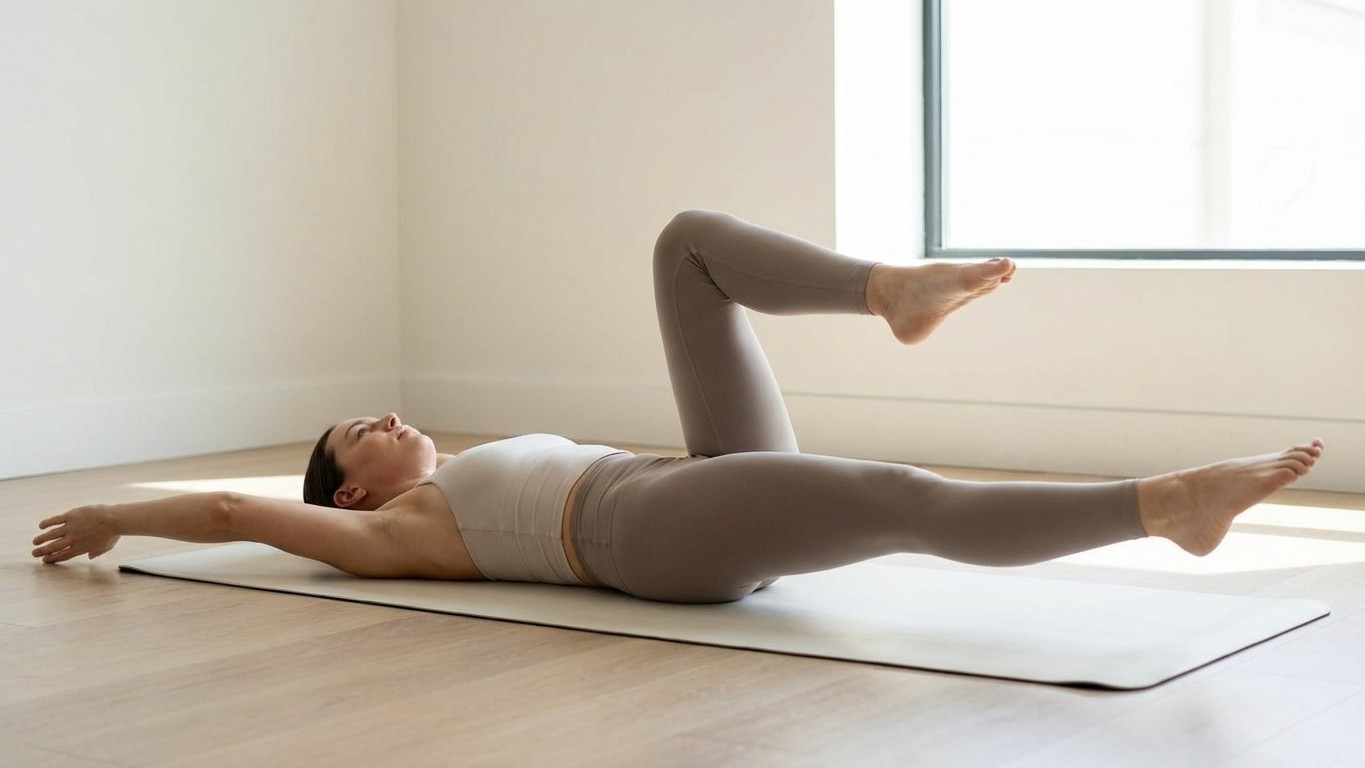
The dead bug exercise looks almost embarrassingly simple. You lie on your back, arms pointing straight toward the ceiling, knees bent at ninety degrees and raised so your shins are parallel to the floor. Then, slowly, you lower one arm toward the floor behind your head while simultaneously extending the opposite leg, keeping your lower back pressed flat against the ground. You return, switch sides, repeat. That’s it. Elderly patients use it in rehabilitation. Elite athletes use it in pre-season conditioning. The gap between how it looks and what it does is extraordinary.
The genius of the movement is in what it demands from your nervous system. To extend your right leg and left arm simultaneously while keeping your spine perfectly neutral, your brain has to coordinate what Physiotherapists call “contralateral limb loading.” Your deep core muscles fire not to prevent you from falling, but to stop your lower back from arching as gravity pulls your limbs away from your centre. That’s a completely different neural challenge from planking. And after twelve months of training only one skill, discovering the other felt like switching on a light in a room I didn’t know was dark.
The science behind the switch
Research comparing isometric holds (like the plank) to dynamic stabilisation exercises (like the dead bug) suggests that both are valuable, but they develop different qualities. Isometric training builds muscular endurance and the ability to sustain tension, while dynamic stabilisation exercises improve what researchers describe as “feed-forward activation”, the way your core pre-activates in anticipation of movement, rather than reacting to it after the fact.
Think of it this way: a plank trains your core to be a dam, holding Everything in place. The dead bug trains it to be a traffic controller, coordinating movement and keeping things orderly while everything else is in motion. For anyone who has ever thrown their back out reaching for something on a high shelf, that second skill is the more life-relevant one.
Some physiotherapy research also points to the dead bug’s particular usefulness for people with chronic lower back pain, precisely because it demands lumbar stabilisation without any spinal loading. Unlike sit-ups or crunches, which create compressive force on the vertebral discs, the dead bug is performed supine and keeps the spine in a neutral, unloaded position throughout. (Always speak to your GP or a qualified physiotherapist before starting any new exercise if you have an existing back condition.)
How to actually add this to your routine
Integrating the dead bug doesn’t mean abandoning the plank. They genuinely complement each other, and after a year of planking, I kept the habit. What changed was the sequence. Starting with dead bugs before moving to a plank hold made an immediate difference in how the plank itself felt, more controlled, less effortful, as if the right muscles were Finally showing up for work.
A few practical notes from experience. Speed is your enemy with the dead bug. The slower you lower that arm and leg, the more your core has to work. Rushing turns it into a hip flexor exercise and misses the point entirely. Aim for a three-to-four second lowering phase. Your lower back must stay in contact with the floor throughout, if it lifts, you’ve gone too far, and you should shorten your range of motion rather than push through it. Start with three sets of six to eight repetitions per side and work up over several weeks.
Breathing matters too, possibly more than in any other core exercise. Exhale as you extend the limbs, which naturally engages the transverse abdominis and makes it easier to maintain that flat-back position. Most beginners hold their breath, which defeats much of the purpose.
The plank gave me a foundation I’m genuinely grateful for. But the dead bug showed me that strength isn’t always about holding on harder. Sometimes it’s about learning to let the limbs move freely while the centre stays absolutely quiet, and that particular skill, it turns out, has a way of showing up everywhere else in life too.